SNOWDROPS: HEALTH BENEFITS PROVEN BY MEDICAL SCIENCE


SNOWDROPS, GALANTHUS NIVALIS
Snowdrops are native to Europe, and their original range extended from the Pyrenees to Ukraine eastward and from Germany and Poland through to southern Italy, Albania and northern Greece. They became naturalized in northern Europe including the British Isles.
  Writing in the latter part of the 16th century Gerard says that they were a garden flower, and said “Nothing is set down hereof by the ancient writers, nor anything observed by the moderne” as regards their medicinal properties. However we now know that Gerard was wrong. The Bulbous Violet as the snowdrop was called then was mentioned in an old glossary dating from 1465, under the name “Leucis i viola alba” or the white violet, stating that it was an emmenogogue, used to regulate menstruation. It can also be found under narcissi in other old manuscripts and these say that it was a “digestive, resolutive and consolidante” so Gerard hadn’t done his homework too well.
   Snowdrops also go by the name “Fair Maid of February” which is when it pushes its head up through the winter snows, bringing with it the promise of spring and life and rebirth after the cold of winter. It was one of my grandmother’s favourite flowers as was the blue violet. Legend has it that when Adam and Eve were thrown out of the Garden of Eden it was winter on Earth and snowing. Eve cried for the warmth of Paradise and God took pity on her and transformed some snowflakes into snowdrops to console her. Hence they are now the flower of Hope.
   The Druids traveled before they settled in the British Isles and it is possible that they knew of the healing properties of the snowdrop, as in Celtic mythology it is the flower of the Triple goddess, Brigit, goddess of poetry and inspiration, of healing and of the blacksmiths arts. She was the goddess of the New Moon and of flame hearth and the smithy. The Celtic nation of Brigantia was once in parts of Spain, Brittany and the British Isles, and as the snowdrop was native to Spain, the Celts would have known of it. Whatever the case, their healing was lost in the period of the introduction of Christianity and we may only now be beginning to rediscover what they knew of the healing powers of plants. A German legend says that snow got its whiteness from the snowdrop as it wanted a colour and god said it should ask plants and animals for some of theirs. Only the snowdrop was willing to share its colour with the snow and so it is white.
  It is believed that snowdrops were taken to the British Isles by monks from Italy, as they were grown in old monastery gardens.
   William Wordsworth wrote lines “On seeing a Tuft of Snowdrops” in 1819: -
  …these frail snowdrops together cling,
 And nod their helmets, smitten by the wing
 Of many a furious whirl-blast sweeping by”
And this “whirl-blast” seems to accurately describe the way Alzheimer’s patients must feel. It is perhaps apt that modern medical research has shown that galanthamine or galantamine, extracted from snowdrops may be able to help Alzheimer’s sufferers.
   A Russian pharmacologist visiting Bulgaria observed a peasant woman treating children with poliomyelitis with a concoction made from snowdrop bulbs, and was amazed when they recovered without any signs of paralysis. Later, in 1951, another Russian pharmacologist, Mashkovsky, discovered galanthamine in the snowdrop Galanthus woronwii and this has been used in Eastern Europe for the alleviation of neuromuscular ailments including neuralgia and neuritis. It enhances the neurotransmissions in the brain, so was used for poliomyelitis.
   Now in the West, snowdrop lectin (Galanthus nivalis agglutinin) from Galanthus nivalis is being studied for its potential activity against HIV. It is also a powerful insecticide. Galanthamine is used in the treatment of traumatic injuries to the nervous system too.
  It seems as though the humble snowdrop has a lot of health benefits for us that we probably hadn’t realized.

BLUEBELLS FAIRY FLOWERS: SUPERSTITIONS, USES AND BENEFITS OF BLUEBELLS.


BLUEBELLS, HYACINTHOIDES NONSCRIPTA
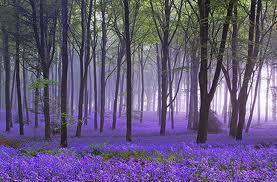
Bluebells are native to the British Isles and Ireland, although there seems to be a little confusion surrounding them. The “bluebell of Scotland” is the harebell, Campinula rotundifolia which is a completely different flower. This is usually a single flower on a stalk, but bluebells have many bell shaped flowers on a single stalk, and the native British bluebell has a heady fragrance. The invading species of Spanish bluebell is Hyacinthoides hispanica, which is easy to distinguish from the British variety as it doesn’t have a fragrance, has paler blue flowers, is taller, is more upright and has wider leaves. The British variety is now a protected species, under the 1998 Wildlife and Countryside Act so unfortunately it is illegal to collect them. However they were abundant in the woods where I grew up and there were no restrictions on picking them, although no one I knew ever uprooted them. This may have been because of an ancient superstition, which says that anyone who picks or damages a bluebell will die because they are fairy flowers. It was thought that the fairies rang the bluebells to call a fairy meeting and any human who heard the bells ringing would die, or fall under the enchantment of the fairies. In some parts of the country it was believed that you shouldn’t walk into a ring of bluebells because you would fall under a spell or die. They are sometimes called Dead Man’s Bells. When I was young I had no idea that they were a flower of doom, but knew them as fairy flowers, which was not something to fear.
    Another superstition is that if someone wears a garland of bluebells they are compelled to tell the truth. Also if you are a young woman and can turn a single bluebell flower inside out without tearing or damaging it, you will win the one you love.
   The Daily Telegraph newspaper in Britain keeps a close watch on bluebells and got very excited in 2009 and again in may 2010 when white bluebells were found. I have often seen them growing along with pink ones and knew they were rare, although I hadn’t realized (because there were always a fair number of them) that a white bluebell occurs once in every 10,000. We had pink ones in the woods too and these are even rarer, I have since learned. In 2008 it reported that the bluebells had flowered a month early on the 3rd of March, possibly because of global warming.
  Bluebells along with wild wood anemones, foxgloves, primroses, sorrel and dog violets indicate places where ancient forests (pre1600) once stood. If you have these in your garden, then it is likely that your house in built on ancient forest land.
   These flowers attract bees and butterflies, and the 19th century poet laureate, Alfred, Lord Tennyson, waxed poetically lyrical about them. Here are some of his lines:
     “In the month when earth and sky are one,
      To squeeze the bluebell ‘gainst the adder’s bite”
And “The heaven’s upbreaking through the earth” was how he described the bluebell in flower, which it does normally around April and May. Juice from the bluebell stems was an old remedy for poisonous bites; the adder mentioned by Tennyson is the viper, the only poisonous snake native to the British Isles.
   Britain actually has 30% of the world’s population of bluebells, which grow in North America, North Africa, Western Europe, the Iberian Peninsula and Central France. They can also be found along the Mediterranean as far as Italy.
   The plant was first called Hyacinthus by the botanist Linnaeus, because of their resemblance to the wild hyacinth which meant that he associated it with the Greek myth of the youth Hyacinth who was beloved of Apollo the Sun god and Zephyrus the god of the West Wind. Hyacinth loved Apollo best and the jealous West Wind sent a quoit in the wrong direction while Hyacinth was playing quoits with Apollo, and he was killed by its blow. In his grief, Apollo caused a hyacinth flower to grow from the blood of Hyacinth and the letters Ai Ai (alas, alas) were written on it. The bluebell was called Hyacinth nonscripta because it was not written upon.
   In the language of flowers the bluebell means constancy, humility and gratitude and is a symbol of humility and gratitude.
  Traditionally the bluebell root was used as a styptic (which stops bleeding by contracting the bleed vessels and tissue) and diuretic, and also as a substitute for starch when huge white ruffs were fashionable (Elizabethan and Jacobean times). The bulb contains inulin and mucilage and trials are underway to teat the efficacy of the bluebell for the treatments of infections stemming from HIV and cancer treatments, but the trials are still in the early stages.

HOW TO MAKE SPICY APPLE SOUP: IDEAL FOR WINTER: EASY AND TASTY RECIPE


WINTER APPLE SOUP
A tasty soup to help ward off colds and flu as it has vitamins and minerals that boost the immune system.
  Broken rice is rice that has been damaged during hulling and so is cheaper than perfect basmati rice. It is commonly used in Pakistan as an addition to soups (as here) or for desserts. Ordinary rice can be used too.
   You can also add crushed roasted chestnuts or shelled walnuts to this soup for added flavour and nutrition when you add the rice.
 
Ingredients
1 onion, chopped finely
3 cloves garlic, finely chopped
½ inch ginger root, finely chopped
1 apple, peeled, cored and finely chopped
3 tbsps besan (chickpea flour)
3 tbsps tomato puree (peel and chop a tomato and fry to a paste)
1 tsp freshly ground black pepper
½ tsp ground coriander seeds
2 tbsps white vinegar
2 tbsps fresh lemon juice
salt to taste
2 tbsps butter
1 tbsp oil
2 glasses chicken stock
1 cup broken rice cleaned washed and soaked
6 glasses water
3-4 green chillies, chopped for garnish

Method
Heat the butter and oil over a low heat so that they don’t burn. Add the onion and fry until soft. Add garlic and ginger and cook for 1 min.
Add the besan and fry but stir so that it doesn’t burn.
Now add the tomato paste and the apple. Cook over a low heat for 5 mins taking care that they do not burn- stir well.
Add the chicken stock slowly and stir to mix completely. Then add the garam masala, coriander, black pepper and rice. Allow the soup to boil, and then add the vinegar, water and cook for 45 mins or until the mixture thickens.
Add the lemon juice and salt, garnish and serve.
If you want to you can keep this in the fridge until ready and just add a little more water and reheat.
This has Taste and is a Treat.

WHAT IS PIPPALI? PIPER LONGUM OR LONG PEPPER: MEDICINAL BENEFITS AND USES OF PIPPALI: LONG PEPPER PEARS RECIPE


LONG PEPPER, PIPER LONGUM, PIPPALI
There are two kinds of long pepper, one is Piper longum, which comes from the Indian subcontinent and the other is Piper retrofractum which grows in South East Asia, notably in Indonesia and Thailand and is sometimes referred to as Balinese pepper. Long pepper was known to the Romans and ancient Greeks and has been used in Ayurvedic medicine since time immemorial.
Theophrastus described it as “elongated and black and has seeds like those of the poppy…”He goes on to say that it was used as an antidote, along with other pepper as an antidote “for poisoning by hemlock.” In the first century AD Dioscorides describes it as “a tree that grows in India. It produces fruit, which is at first oblong-like pods; this is the long pepper, the contents of which closely resemble millet.” He says that it was used to treat poisonous bites. Parsimonious Pliny also refers to long pepper, “Long pepper is very easily adulterated with Alexandrian mustard; its price is 15 denarii per pound, while that of white pepper is 7 and of black, 4.” It actually reached Europe before black pepper did, and it was used in mediaeval cooking.
   It is dried and only a little is needed to flavour a dish. When it is fresh and wet it has a sweet taste but the drying process makes it much more pungent. It grows on a vine and is believed to be native to the Himalayan regions of the Indian subcontinent. Now it is cultivated in Assam, Tamil Nadu and Andhra Pradesh, where it is called pippali.
  It has traditionally been used to cure STDs, menstrual pain, TB, leprosy, chronic stomach pain, sleeping disorders, a diuretic, for relaxation of the muscles, to relieve tension and alleviate anxiety, to strengthen the immune system, treat respiratory problems, reduce fevers, as an abortifacient, an emmenogogue, for piles, recurrent fevers, to aid digestion, to boost reproductive functions and so as an aphrodisiac.
   A paste made from the peppers may be applied externally to painful swellings, and when mixed with ghee and honey as a remedy for coughs and TB. Long peppers and Indian gooseberries are used together to treat anaemia. This is a remedy for respiratory problems etc: 3 long peppers boiled in 4 parts milk to 1 part water, for a few minutes, and then drunk. You should take this for 10 days adding one long pepper a day, then for a further 10 days decrease the number of peppers per day by one. This is supposed to also be good for the treatment of recurrent fevers, piles and digestive problems. An infusion is also given after childbirth to expel the placenta.
   Modern medical research has shown that the long pepper had antifertility activity in rats, and that it has antiamoebic properties. It is also an analgesic (has the ability to relieve pain), has anti-tumour properties, and regulates the immune system. Research on the properties of the long pepper is ongoing. However it has proven to be an effective anti-inflammatory and is a diuretic.
   Long pepper is one of the spice ingredients of Ras el Hanout (a Moroccan spice mixture) and berbere which is an Ethiopian spice mixture which contains dried red chillies, long pepper, ginger, cinnamon, cloves and cardamom seeds. The following recipe is a Mediaeval one, and the proportions might not be quite right, so you will have to experiment.

LONG PEPPER PEARS
Ingredients
 a little water
¼ pint white wine
2 tbsps sugar
4-6 long peppers

Method
Stand the pears upright in a saucepan and add the liquids, vanilla pod and long peppers. Bring to a boil then cover and simmer for 20-30 mins or until the pears are tender.
This has Taste and is a Treat.