SPEEDWELL ( VERONICA OFFICINALIS) - INFORMATION: USES AND BENEFITS OF SPEEDWELL HERB : COMMON SPEEDWELL TISANE RECIPE


SPEEDWELL, VERONICA OFFICINALIS and GERMANDER SPEEDWELL, VERONICA CHAMAEDRYS
There are many varieties of Speedwell or Veronica but they have different medicinal properties, with officinalis being the one used in herbal remedies (hence the ‘official’ title). The Common Speedwell (V. officinalis) is native to Europe, including the British Isles, and to temperate parts of Asia, but it now grows abundantly in North America and other parts of the world. It is believed that it got its name Veronica because the flowers have streaky marks on them resembling the ones which were left on the cloth Veronica, the woman who wiped the face of Jesus while he was carrying the cross to his crucifixion at Calvary or Golgotha.
  It was used by the Physicians of Myddfai (Wales) along with other native plants in a number of remedies. This is an old remedy for abdominal complaints and the following herbs were used to make a medicine: - “sweet gale, bay leaves, pimpernel, male speedwell, river star tip, borage, moss, liverwort, the young leaves of the earth nut, and the mallow.” Another remedy was for carbuncles although it was a third alternative: - “…take the roots of the purple dead nettle, the roots of mugwort, and the speedwell, boiling all together in goat’s whey, adding butter to the scum thereof, and drinking it day and night.”
  Speedwell means to thrive, and it has been used as a general cure-all and modern medical trials have found that the V. officinalis contains more potent properties than the Germander speedwell. John Gerard, writing in the 16th century, thought rather highly of the Germander Speedwell, and believed that “given in good broth of a hen” it was useful for cancer treatment. He also thought that it got its name “from the form of the leaves like unto small oak leaves” and so he claims it was given the name “chamaedrys which signifieth a dwarf oak.” This is rather stretching one’s imagination as the leaves do not appear to resemble those of any kind of oak. However the old writers extolled the virtue of this Speedwell and wrote that it was a good wound healer, blood purifier, as well as being useful in the treatment of small pox and measles. A decoction of the whole plant was used to stimulate the kidneys and the leaves were thought to be good for coughs. The juice from the fresh plant was boiled with honey to make a syrup for asthma and catarrh.  It is best to harvest the whole plant in summer (May-July) and dry it for future use.
   An infusion of the Common Speedwell (V. officinalis) has been given through the centuries for gout, to promote sweating in fevers, as a diuretic, expectorant, tonic, for heart and liver complaints, haemorrhages skin problems and wounds. Today the infusion or tisane is used externally for skin complaints and for coughs and catarrh.
  In clinical trials it has been discovered that the Common Speedwell enhances the regeneration of the gastric mucous and is useful in the treatment of old ulcers.  The plant contains β-sisterol, and is rich in vitamins including E (phytol) and K as well as vitamin C. The polyphenols in this plant have potent antioxidant activities and it also contains the omega-3 fatty acids. Trials have shown that it can reduce the cholesterol levels in the blood of lab animals and it contains the glycoside, aucuboside which is thought to have anti-inflammatory properties. The astringency of the plant is due to the tannins it contains. It is an ingredient of some skin whitening creams along with Lemon Balm and yarrow, although whether or not these work is open to question.

COMMON SPEEDWELL TISANE
Ingredients
2 tsps fresh flowering herb
½ cup boiling water

Method
Chop the herb and pour the boiling water over it. Allow to steep for 15 mins then strain and drink.
This has Taste and is a Treat(ment).  

PTEROSPERMUM ACERFOLIA - THE DINNER PLATE TREE: USES AND BENEFITS OF PTEROSPERMUM ACERFOLIA TREE


THE DINNER PLATE TREE, MAPLE LEAFED BAYUR TREE, KARNIKARA TREE, PTEROSPERMUM ACERFOLIA, KANAK CHAMPA TREE
This tree has a number of names in many languishes, and it resembles a fig tree. The immature fruit look a little like figs, although as they mature they become more elongated, until they finally split open to release the myriad winged seeds they contain. The name Ptero means winged in Greek, and spermum means seeds, so it’s easy to see how this tree got its name. The seeds pods take a year to become mature, so can be seen on the tree along with the flowers, which give off their fragrance at night. Like some honeysuckles and night-flowering jasmine, the flowers come into their own in the evening and leave a wonderful aroma on the air. There are about 40 species of Pterospermum which live in the Eastern Himalayan area, West Malaysia and South East Asia. They belong to the Malvaceae family or the Sterculiaceae one. It gets its English name from the fact that its leaves are the size of dinner plates and food is sometimes served on them.
  Pterospermum acerifolia (also known as Pentapetes acerifolia Linn.) is native to India, Bhutan, Nepal, Myanmar and Thailand and is cultivated in Pakistan and North America, grown on roadsides and as a garden ornamental. There is a huge old tree of this variety in the Pearl Continental Hotel grounds in Rawalpindi. The wood from this tree is used to make packing crates and cases, for planks and ply wood and decorative items.
   It is used in folk medicine for a number or purposes; the under part of the leaves are used to staunch bleeding from skin wounds, and the flowers act as mothballs, repelling insects from cloth where they have been laid. A tonic is made from the flowers, which is also used for inflammation, ulcers, tumours, blood problems and leprosy. The bark and leaves have reportedly been used to treat small pox. The bark is used as an anthelmintic to get rid of intestinal parasites.  It has been found that the stem bark has antimicrobial properties, while the leaves contain boscialin glucosides which seem to be liver protective. It is thought that they might be useful for sufferers of Type 2 diabetes. The leaves have antioxidant and anti-inflammatory properties possibly because of the phenolic compounds they contain, and researchers are continuing their research into the medicinal value of this tree.

GOLDENROD - TOUCHED BY MIDAS? HEALTH BENEFITS AND USES OF GOLDENROD: GOLDENROD TISANE RECIPE


GOLDENROD, SOLIDARE VIRGAUREA
Goldenrod has been given a bad press because people confuse it with the yellow ragwort which flowers at the same time and causes hay fever in some people. Goldenrod is a healing herb and has been used for centuries to heal wounds, as its Latin name, Solidare (to make whole) suggests. Virgaurea basically means “pure gold” which refers to the colour of the flowers and to the fact that it is a very useful medicinal plant. Its colour is one that might have been given it by the Midas of Greek legends, who had the unhappy gift of having everything he touched turn to gold. It is native to Europe, and is the only one of the Solidare family to be native to Britain. It grew in the garden when I was a child, but got removed after someone was repeatedly stung by the bees that swarmed to the flowers. The plants grow to around 3 feet high, but the Canadian variety can grow higher.
  Goldenrod cross-breeds easily, to the extent that there are now at least 130 species in North America alone. It has spread from Europe to Asia, North and South America and the Azores.
  In Europe it can be found in the ingredients of cough medicines and arthritis medication, but not much research has been done into its properties. Because it has been used since time immemorial for a number of ailments it is generally considered safe for human consumption.
  Goldenrod contains the bioflavonoids kaempferol and quercetin among others and phenolic glycosides which have anti-inflammatory actions. It is generally thought to have a diuretic action, and be anti-inflammatory. The tisane prepared from the plant can be used both internally for dispelling kidney and gall bladder stones, as well as for rheumatism, a general tonic, and urinary tract and yeast infections. The tisane may be drunk three times a day, a cupful each time, or applied to eczema and other skin irritations. It is believed that it might also have anti-spasmodic actions, and it is known to stimulate the functions of the liver and kidneys. It can also be used as a gargle for sore throats, and mouth infections.
  Goldenrod is also known as Woundwort in the UK because the tisane can also be applied to old wounds as well as fresh ones to heal them. The tisane can be made from the flowering tops or from the whole plant which is above ground. It should be harvested just before it is in full flower and hung in an airy room until dry, then it can be crumbled or reduced to a powder and stored for later use. (Wear gloves to handle it as some people get allergic dermatitis from it.) Some people swear that it keeps colds and flu at bay if the tisane is drunk at least once a day during the winter. You can take ½ tsp of the powdered Goldenrod in a glass of water, as a general tonic, as well as for any of the ailments mentioned above. For ulcerous colitis and other stomach problems, you can chop a whole plant and boil it in 2 cups of water for 15 minutes, then allow to steep for another 15 mins before straining and drinking. This is good for hay fever and other seasonal allergies as it soothes the mucous membranes in the lungs.
  Goldenrod has been used in folk medicines around the world to treat the following ailments: - TB, diabetes, gout, enlargement of the liver, haemorrhages of all kinds, menstrual problems, piles and asthma.
  After the Boston Tea Party in 1773 there was a shortage of tea, so Americans made a substitute with equal parts of Goldenrod, betony, red clover and New Jersey Tea (Ceanothus Americana). Later Goldenrod was exported to China where it commanded a high price as a tea substitute.
    In some European countries Goldenrod is thought to point to riches, whether in the form of treasure which you can find if you hold the flowering tops in your hand as you will have visions of where treasure is hidden, or point to hidden springs (close to where it grows wild) which were equally valuable in ancient times.
 

GOLDENROD TISANE
Ingredients
2-3 tsps dried whole herb, chopped
1 cup boiling water

Method
Put the herb in a cup and pour boiling water over it. Leave it to steep for 15 minutes then strain and drink.
This has Taste and is a Treat.

EYE - CATCHING SILK OAK TREE (GREVILLEA ROBUSTA) - INFORMATION AND USES


BAHEKAR, BEKKA, SHAHBLOOT, SILKY OAK, SOUTHERN SILKY OAK, GREVILLEA ROBUSTA
Grevillea robusta is a member of the Proteaceae family and as its name suggests is a hardy member of that genus, which is why it is used as rootstock for the less hardy types of grevillea. It has many names in many languages; the ones given above are its Urdu names. In English it is also known as River oak, Silk oak, Silver oak and Southern Silky oak. It gets the oak name because the wood from it looks like oak wood. It also has Latin synonyms: - Grevillea umbratica and Grevillea pectinata. It was names by Allan Cunningham after Charles F. Greville (1749-1809) who was one of the founders of the Royal Horticultural Society, London; because of its hardiness it got the Latin name robusta (robust).
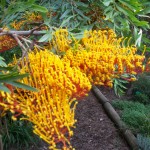
  In Uganda and East Africa generally, as well as in Brazil, India and Hawaii, it is used for shade in coffee plantations, and for the same purposes in tea plantations in India and Sri Lanka as it protects not only the coffee and tea plants but also the workers. It can grow to heights of between 25 and 40 metres and is very beautiful when in flower. The flowers look like huge furry orange-gold caterpillars crawling across the branches. They are full of nectar and the Aborigines in Australia to which it is native, drink it straight from the flowers, or make a drink from them. The flowers are said to be very rich in vitamin C, and attract honeybees. Because it sheds its leaves and flowers, a thick layer of leaf mulch can build up in the soil around the tree, and as this may go to a depth of 30-40 centimetres, it protects the soil and maintains its temperature. The leaves and twigs ar said to be rich in aluminium.
  I came across this species of tree in Rawalpindi and it was clearly an old tree that had been planted many years ago. Bees are attracted to the flowers, but the flowers, fruit and seeds of the tree can cause skin irritation because of the cyanogenic compounds found in them; the leaves can also irritate the skin. Despite this, in Kenya the natives of the Kakamega Forest use the tree for medicinal purposes, which is a little unusual given that it is a non-native species. They use it to cure sore throats, earache, chest problems, flu and toothache, and there are also superstitions regarding it. However in Hawaii where it was also introduced it has come to be seen as invasive.
  The wood from Grevillea robusta is used in parts of the world for fuel as it makes good charcoal and firewood, as well as being used to make furniture. It is thought that the gum which exudes from the tree when it is cut could be used for industrial purposes. Yellow and green dyes can be made from the leaves, and the flowers are used for their fragrance.
   Some research has already been done on this tree and its properties but there is a lot more to be done before scientists can determine what it can be used for in terms of medicine. So far they have isolated his-resorcinols from it, striatol being the most potent, which may be a potential help for the cardiovascular system. The tree also contains grevillol a phenolic which resembles uroshiols the skin irritant in poison ivy. It also contains 5 alkylresorcinol glycosides, names Grevillosides G and H which are also being investigated. Who knows in what ways this tree can help us? Until we find out, I’ll continue to admire its beauty.