ANNATTO ( LIPSTICK TREE): HISTORY, USES AND HEALTH BENEFITS OF ANNATTO TREE

ANNATTO, ACHIOTE, THE LIPSTICK TREE BIXA ORELLANA
The Lipstick tree which bears the fruit from which we get annatto is native to the Caribbean and Latin America. The tree grows to heights of around 9 metres, with rose- pink and sometimes white flowers. Now it is cultivated for its seeds from which we get the food colouring. . It was found in Latin America by the Spanish explorers in the 16th century and named Orellana after one of them, Francisco de Orellanna. Bixa comes from the Carib name for the tree, bya or biche. There are only two known trees in the Bixa genus and both of them are native to South America. The pod containing the seeds looks a little like a red beech mast, and the seeds inside are small triangles 3-5 mm in size.
   Like gum Tragacanth (gond katira) annatto has its own E number, E610b as it is used as a food colouring. It is used in margarine and cheeses such as Red Leicester and Cheshire, and to colour smoked herring (kippers) and cod. .
  It is now cultivated in India, and Kenya as well as in the countries of its origin. In some of the Pacific islands, it is an introduced species which has become an invasive one, and it is classed as invasive in Hawaii too. It is cultivated in the Philippines where the seeds are ground and used as a condiment. It is from the seeds that a red food colouring comes, and this is easy to obtain by steeping the seeds in water. The resulting red liquid can be used to colour rice, and is known, as is turmeric (haldi), as “poor man’s saffron.”
  It is used in the cosmetics industry as well as the food industry and has traditionally been used as lipstick, rouge and to make the sandour mark on Hindu women’s foreheads in India.
  The pulp from the fruit which covers the seeds has been used as an insect repellant and when rubbed on the skin it is said to get rid of pimples and other eruptions. The leaves pulp and seeds have been used in traditional medicine for centuries to cure a number of ailments. A decoction of the leaves can be made with 8-10 leaves to a litre of water. Boil together for 10 minutes then leaves to cool and drink half a cup three times a day for liver problems. If applied to the skin the decoction can soothe burns and promote wound healing. The decoction is a diuretic and can also calm minor stomach upsets, as well as aiding digestion. In Brazil the decoction is used for heartburn, and prostate problems as well as a vaginal antiseptic.
In tribal medicine it has been used as an aphrodisiac and as a mild laxative, not as strong as senna or jamalgota or the castor bean’s action.
  Annatto can reduce inflammation and protects the liver it is believed after clinical trials. It can also kill bacteria in the lab, and research is underway to ascertain if it can be beneficial to our health. It seems also to raise blood sugar levels but lower blood pressure.
  The seeds are said to be expectorants so they can clear phlegm and mucous and the roots of the tree have been used as a digestive aid and cough suppressant.
  Annatto contains vitamins C and E as well as some B-complex vitamins, amino acids, minerals such as calcium, iron and phosphorous and bet-carotene. Annatto seeds also contain tocotrienols which are potent antioxidants with cholesterol lowering abilities, and which also have a neuro-protective action. These also have anti-inflammatory actions, so many of the traditional uses have their basis on a solid foundation according to medical scientists.
  The rainforests of the Amazon Basin and the South American continent have yielded amazing medicinal species, such as the quinine or fever tree, although sadly we may have lost some of these plants due to the wanton destruction of the rainforests that has gone on in the past.

ELEPHANT'S HEAD PLANT - HEALTH BENEFITS AND HOW TO USE

ELEPHANT’S HEAD, RED SPINACH, AMARANTHUS GANGETICUS OR A. TRICOLOR
This species of amaranth is not cultivated for its grain as are others in the Amaranthus species, but for its leaves which are a traditional food in Bangladesh. Other amaranths are currently being investigated for their grain for example A. caudatus, A. cruentis and A.  hypochondriacus as this is very nutritious, so could help stave off malnutrition in still-developing countries, and also may be a useful biofuel.
   There are seeds, of course from the elephant’s head amaranth, (also known as pigweed, Joseph’s coat and a number of other names) and these may be eaten, but the main reason for its cultivation is its leaves which are eaten like spinach. It is said to be a substitute for asparagus. The leaves are rich in vitamin A and contain B-complex vitamins as well as vitamin C. It contains the minerals phosphorous, calcium, iron, manganese and potassium. These make it useful for bones, blood and to help cure anaemia.
  The seeds from this plant contain saponins so before it is eaten it should be soaked for 12 hours and then the water should be discarded before they are boiled. They are very gelatinous, and need to be cooked slowly.
  The plant is used in traditional medicine in a number of countries, and in China the leaves are used to treat dysentery. The leaves are simmered for a few minutes, then honey is added and this is cooked for a few minutes longer, before it is eaten.
  A tisane can be made with a teaspoon of the leaves, chopped then boiled with a cupful of cold water. You should allow the leaves to steep for 10 minutes before straining and drinking.
  It is thought that the galactosyl diacylglycosides present in the plant can inhibit the growth of some cancer cells, although more research is currently needed.
  Traditionally the plant is used with Cucurbita moschato, winter squash, to stop haemorrhaging after abortions, while a decoction of very old leaves is taken to improve night vision and to strengthen the liver.
  It is thought that it may boost the immune system, but more research is needed, and it may also help to reduce the risk of heart disease.
   In Jamaica it is used as a salad green, and is believed to have diuretic properties and be useful in cases of oedema. In Ayurvedic medicine it is also used for menstruation problems, and for general weakness, and this makes sense as it contains protein as well as the vitamins and minerals needed in our diets.
  In many countries it is grown for purely ornamental purposes, so you may have it in your garden.

WHAT IS GHOBI? CAULIFLOWER: INFORMATION AND HEALTH BENEFITS OF CAULIFLOWER: ITALIAN CAULIFLOWER RECIPE

CAULIFLOWER, GHOBI, BRASSICA OLERACEA
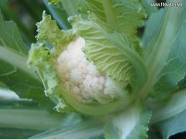
The cauliflower was famously described by Mark Twain as “nothing but a cabbage with a college education.” He was right, as it is thought that the cauliflower as we know it came from a wild cabbage, just like cabbages. They are members of the same family of Cruciferous vegetables, and are also related to broccoli, kale, collard greens and mustard. They may have originated in Asia Minor in modern day Turkey, where they have been an important crop since at least 600 BC, and this is also true of the Italian cauliflowers. They gained popularity in France in the mid 16th century, and were then cultivated in Northern Europe including the British Isles.
  The cauliflower has undergone great transformations since it began life as a wild cabbage. Today there are different coloured cauliflowers, purple, orange and green being the most common, as in the picture here. Scientists are keen to point out that this is a case of selective breeding, and not genetic engineering, as the orange one comes from a mutant cauliflower that was found in Canada. The green one is known as Romanesco and has been around since the 1990s.
  The carrot was also bred by the Dutch in the 17th century to be the ubiquitous orange one that we have now. The cauliflower has had similar treatment. The ‘rainbow’ caulis look better on a plate than the white ones, although they still taste much the same. The orange variety (Brassica olearacea var botyris) has 25 times the beta-carotene content of the white one, while anthocyanins also found in red wine and red cabbage, give the purple one its colour. Anthocyanin may help prevent heart disease by slowing blood clotting, and beta-carotene has potent antioxidant properties.
  The name cauliflower comes from the Latin caulis meaning cabbage and floris, meaning flower and the French name chouxfleur has the same meaning.
  Boiling a cauliflower is not the best way to cook one to get the maximum health benefits from it. You should sautée the florets, or par boil them and sautée them or steam them. They actually need very little cooking, and you can coat the florets in a flour and water batter, shallow or deep fry and serve with an olive oil and lemon sauce, which just needs to be blended.
  A white cauliflower contains vitamins A, C, and K plus many of the B-complex ones, as well as 18 amino acids, Omega-3 fatty acid, and the minerals calcium, copper, iron, manganese, magnesium, phosphorous, selenium and zinc.
Romanesco
  Studies are underway to determine if a diet which includes cauliflower can help to prevent cancers, heart disease, Crohn’s disease, irritable bowel syndrome (IBS) and a variety of other ailments. The cauliflower has anti-inflammatory properties and can aid digestion. Glucoraphin, a glucosinolate contained in this vegetable can help protect the stomach lining and so helps the digestive system.
  Why not try one of the rainbow cauliflowers instead of the usual white variety? It seems that they could have more health benefits than the white one, but don’t boil them or you will not reap the full benefits from the cauliflower.

ITALIAN CAULIFLOWER
Ingredients
1 cauliflower, green leaves removed and cut into florets
2 cloves garlic, finely chopped
2 tbsp fresh parsley leaves, shredded
2 tomatoes, peeled and seeds removed
¼ pint dry white wine
olive oil
freshly ground black pepper
freshly grated Parmesan cheese
Cauli romanesco

Method
Pour 2 or 3 tbsps olive oil into a pan; add the garlic and parley and fry for two minutes, stirring so that the garlic doesn’t burn.
Blanch the cauliflower florets in boiling salted water for 2 mins. Remove from the heat and drain, and dry on absorbent paper.
Add the cauliflower to the oil and stir till a golden-brown colour (2-4 mins).
Stir in the tomatoes, wine and seasoning and cook, stirring, for 2 mins.
Serve hot and top with the grated cheese.
Cauli purple
This can be used as a side dish with veal, chicken or fish, or as a main meal with pasta of your choice.
This has Taste and is a Treat.


MARSH BARBEL ( HYGROPHILIA AURICULATA) - MEDICINAL BENEFITS AND USES

MARSH BARBEL, HYGROPHILIA AURICULATA
The Marsh Barbel is native to the Indian subcontinent, including Nepal and Sri Lanka, the Andaman Islands and the Nicobar Islands, as well as to Malaysia, South East Asia and parts of Africa, including South Africa, Senegal, Sudan, Cameroon, Guinea-Bissau, Nigeria and Mali. It has a few synonyms including Hygrophilia schulli and Asteracantha longiflolia and is known in English by many other names including the Temple Plant. It is a member of the Acanthaceae family and as the name suggests, likes to live in wet places. It can grow to 2 metres high or more, and has blue-purple flowers, with upper and lower “lips”. These flowers look a little like violas, or wild pansies.
  The whole plant is used in traditional medicine systems for a number of ailments. These include impotence and quality of sperm. The powdered seeds are given in milk to improve the male libido, so it is supposedly an aphrodisiac. It is used for liver problems, including jaundice, to treat urinary tract infections and for gout and oedema. It is said to have diuretic qualities.
  It contains vitamin C and flavonoids, phenolic compounds, saponins, steroid, terpenoids and cardiac glycosides.
  In Ayurvedic medicine the plant is used for rheumatism, inflammation, jaundice and other liver problems and as a pain-killer.
  Few clinical trials have been carried out on this plant, but the few that have were concentrated on proving the traditional uses of the Marsh Barbel. One study that was reported in the Journal of Ethnopharmacology in April 2006, conducted by M. Vijayakumar et al., concluded that it has “significant anti-diabetic activity along with potent antioxidant potential in diabetic condition.” However, the study was performed on rats and an extract of the plant used.
  In an earlier study reported in the same journal in 1995 reported by Singh A. and Handa S.S, concluded that it does act to protect the liver, but once again, the study was done on lab animals.
  While there is no doubt that the plant has medicinal value, given its traditional use over centuries, no scientific studies have been conducted on people.