LOVAGE - OLD-FASHIONED HERB MAKING A COMEBACK: HEALTH BENEFITS, USES AND HISTORY OF LOVAGE: FRESH LOVAGE AND VEGETABLE SOUP RECIPE


LOVAGE, LEVISTICUM OFFICINALE
Lovage is native to the Mediterranean region, but has been cultivated in Britain for centuries in herbalists’ gardens and those of monasteries and is naturalized. It is a member of the Apiaceae family or Umbelliferae family of plants and as such is related to parsley, angelica, carrots, parsnips and fennel. It has been used in alcoholic cordials for centuries, although it was probably first sold commercially by Phillips’ of Bristol in their range of shrubs which date back to 1793. In the Lovage cordial it is mixed with tansy and yarrow, and this was used in winter (and still is) mixed with brandy. It seems that the original cordials were used on long sea voyages, so lime juice was a constituent to ward off scurvy (vitamin C deficiency), while lovage was to prevent rheumatism, and shrub, a mixture of plant juices which was alcoholic was the ingredient which staved off colds and flu. The first cordials containing lovage are recorded in the 14th century, and these contained tansy and yarrow or milfoil. Lovage is also used in some liqueurs and could be found with borage in one of the Pimms mixes.
  Lovage gets its name because it was reputed to be an aphrodisiac, but also this is a corruption of Liguria, (the Italian Riviera) which was where the plant was first cultivated, it is believed. It was certainly growing there in the first century AD and probably before. Levisticum is apparently a corruption of Ligustikos, the Greek for Liguria.
  The plant grows to 5 or 6 feet tall with large flower heads, rather like cow parsley, sweet cicely and elder flowers but they are a greeny-yellow colour. The seeds these heads bear after the flower has died contain oil and have been used in traditional medicine for centuries, along with all other parts of the plant.
  In ancient times, lovage leaves were used by travellers who put them in their shoes as deodorant and for their antiseptic qualities. Today it is generally believed that the root is the most potent part of the plant, but Culpeper, writing in the 17th century believed the seeds to be the best part of the plant and that they were more potent than the root. He wrote that an infusion of the seeds,” being dropped into the eyes taketh away their redness or dimness.” He also recommended it as a drink for fevers, and a gargle for sore throats and that it should be drunk two or three times a day as a remedy for pleurisy. He suggested that the leaves should be bruised and flattened and cooked in “hog’s lard” and used hot on boils and skin eruptions.
  Traditionally the plant has been used to stimulate the appetite, stop flatulence, aid digestion and an infusion of the roots has been used for gravel and kidney stones and urinary tract inflammation for problems such as cystitis. The leaves have been used for their diuretic properties and as deodorant.
  The leaves have been taken as an emmenagogue for centuries to ease period pains and bring on delayed menstruation as well as to alleviate the symptoms of PMT / PMS. The tisane can be made from 1 tbsp of fresh leaves shredded or 1 tsp dried, to one cup of boiling water which you pour over them and leaves to steep for about 15 minutes before straining and drinking .If you harvest the leaves, you can freeze them whole and shred them as you use them, rather than drying them as this may be easier. The tisane is good for a number of problems including stomach cramps during menstruation. (You should drink 2 cups a day.)
  You can use the leaves in salads- the young, tender ones are best, which come before the flower blooms. Some people confuse this plant with hemlock (Conium maculatum), which is poisonous, but the flowers are different and I think it’s more easily confused with angelica or sweet cicely. However be careful if you gather this from the wild.
  The plant has hollow stems, which can be dried and used as brushes to baste meat and fish with. They can also be used fresh as stirrers, instead of swizzle sticks or straws for Bloody Mary’s and the seeds of lovage may be substituted for celery seeds in the drink. (Lovage seeds are a little sweeter than those of celery though.)
  You can add shredded leaves to risottos and other rice dishes, and eggs-they go well in omelettes and scrambled eggs, and mashed potatoes too, as well as being testy additions to soups and stew. Use the stalks in salads as you would those of the globe artichoke, blanched and peeled or just blanched and eat it like celery. The leaves can be added to salads to give them a different flavour too.
  The roots, leaves and seeds of the plant have antispasmodic properties and have been used to speed up slow labour in child birth, and as a stimulant; .they are also mildly expectorant so are good for respiratory problems.
   You can add the leaves to your bath water or even better try this recipe:-Pour 2 pints of boiling water, over 1 cup of shredded lovage leaves, ½ a cup of the chopped root, ½ a cup of fresh mint leaves and 1 tbsp eucalyptus leaves that have been torn to the vein but are still in tact. Leave this to cool, strain and pour the liquid into the bath water when tepid for a relaxing bathe.
  Early American colonists used to chew the roots of lovage to help them stay alert, much as we chew gum, and in Mediaeval times, people wore bunches of the herb around their necks to avoid the general stench.
  In 1990 the German Commission E approved the lovage roots and dried rhizome for urinary tract inflammation (cystitis etc.) saying that “the linguistilide –containing essential oil is antispasmodic.” They concluded that it was suitable for “irrigation therapy for inflammation of the lower urinary tract and for the prevention of gravel.” The recommended daily dose is 4-8 grams of the root.
  In 2009 the European Food Safety Advisory Authority said that there was insufficient evidence for them to approve the use of the root for improved diuretic function, despite the German stance.
   Recent scientific research has shown that the essential oil from the leaves of lovage inhibit cancer cell growth in “Head and Neck Squamous Carcinoma Cells” (S. Sertel et al, University of Mainz, Germany, published in 2011 in the Anticancer Research Journal of Cancer Research and Treatment). Other research has also shown the oil to have antimycobacterial properties.
  It may be worth taking a look at the possibilities of using this herb in your kitchen and growing it in the garden; it has a number of uses.


FRESH LOVAGE AND VEGETABLE SOUP
Ingredients
20 gr butter
1 onion, finely diced
a few young lovage stalks, chopped
1 head Kos lettuce
½ cucumber diced small or a small cucumber
1 sprig thyme, stripped of its leaves
salt to taste and freshly ground black pepper
100 gr peas (shelled weight)
small handful of young lovage leaves, shredded finely
natural yoghurt to serve

Method
Warm the butter and add the onion, thyme, a pinch of salt and fry until soft and translucent.
Add the lovage stalks and fry for a further 2-3 minutes.
Add the stock and simmer for 10 minutes. (Add a glass of white wine if you like and adjust the amount of stock you use.)
Now add the rest of the vegetables, shred the lettuce, but reserve some shredded lovage leaves for garnish.
Simmer for 5-10 minutes then remove from the heat.
Serve in bowls with a swirl of natural yoghurt in each.
Serve with crusty fresh bread or garlic bread.
This has Taste and is a Treat.
  

ALKANETS: HEALTH BENEFITS AND OTHER USES OF ALKANETS


ALKANETS, ALKANNA TINCTORIA, ANCHUSA OFFICINALIS, PLUS OTHERS
Alkanets have been grown for the dye their roots produce which has been used as a substitute for henna. The name Alkanet is believed to have come from the Arabic Al-hinna, which refers to the dying properties of the plant. The true Alkanet is said to be Anchusa officinalis (anchousa comes from the Greek meaning to paint). Alkanets are members of the Boraginaceae family of plants to which borage (goazban) belongs.
    Tisanes of the leaves and roots are thought to relieve persistent coughs and promote sweating during fevers. They are also supposed to be able to lift depression and banish melancholia. The expressed juice from this alkanet was good they say for pleurisy. The tisane can be used on the skin for any irritation or rash and soothes and softens it. It can also be used as an astringent for wounds. In traditional medicine it is used as a blood purifier to expel toxins from the body with its diuretic action.
Alkanet roots for dye
  The leaves and young tops of this true alkanet are used like spinach both cooked and in salads although it is advisable to blanch them for a minute before draining and rinsing in cold water.
  Alkanet leaves and flowers can be dried and used in pot pourris and the fresh leaves smell a little like wild strawberries. Alkanets typically have blue or violet flowers which are a little like the more common Forget-Me-Nots (in the UK). There are about 50 plants in this species, most of which are indigenous to the Mediterranean region.
  There’s an evergreen Alkanet called green alkanet, Pentaglottis sempervirens, (roughly translated meaning five tongued, living for ever). This is one’s flowers are used for decorating cocktails and salads.
  Alkanna tinctoria has anti-bacterial and astringent qualities and can help to staunch the blood flow from fresh cuts. Externally it is used for varicose veins, ulcers, itchiness and other skin irritation.
  The roots of tinctoria produce a red dye and it has been used for lipsticks, lip balms and soap.
Asian alkanet
  Dioscorides believed (1st century AD) that the plant was useful for snake bites, while Culpeper (17th century) believed that a decoction in wine would strengthen the back and stop back pains. He also said that it was good to get rid of internal worms. He also recommended it for chicken pox, measles, bruises and wounds. He says that it was good for leprosy too, and “yellow jaundice, spleen and gravel in the kidneys”, so the plant used to be something of a cure all in Britain, where it is also known as Bugloss, Anchusa and Orchanet.
  Alkanna orientalis has yellow flowers and grows in the Indian subcontinent including in Pakistan. It has much the same properties and has been used for similar illnesses as those already described.
Asian alkanet
  The root of this alkanet may be what gives Indian food its red colour, as it seems that the root is ground is grown in Kashmir and used to colour food such as Rogan Josh.
  At one time in Europe it was used as a dye to make wood look as though it was the more expensive rosewood or mahogany.
  Clearly it had a lot of uses, and it is still cultivated for the dye it produces.

AIR POTATOES ( DIOSCOREA BULBIFERA) - INFORMATION: HEALTH BENEFITS AND USES OF AIR POTATOES


AIR POTATO, DIOSCOREA BULBIFERA
The air potato is a member of the yam (Dioscorea batatas) family which includes Dioscorea deltoidea, much used by body-builders and men who need testosterone boosts. Along with others in the species, this plant is a source of diosgenin which is needed for birth control pills. It is native to the Indian sub-continent and possibly also to tropical Africa.
  It is called the air potato because it grows potato – like bulbs between the bases of the leaves, along its aerial roots. The plant is a vine which can grow up to 20 metres long, and on summer days can grow up to 20 cms, in a day. In southern US states where it is invasive, having been introduced some time during the slave trade years, it can choke plants in the forest canopy and prevents light reaching those on the forest floor.
  Where it is a native it is used in traditional medicine for a number of ailments, including diarrhoea, dysentery, jaundice, stomach pains, and even bone fractures. In Indian and Chinese medicine it is used for sore throats, stomach cancers, and goiters. It is also used to treat anorexia and is said to have diuretic properties. Reportedly it can lower cholesterol levels, relieve pain and lower blood pressure. It has antioxidant and anti-inflammatory properties.
  In the Cameroon Islands the plant is used for pain relief and to stop inflammation. It is used similarly in the Philippines.
  The aerial ‘potatoes’ are eaten as a vegetable, after chopping and then soaking for some hours. The tuber is also used like a yam. (It has no relationship to a sweet potato however.)
  The plant contains a number of flavonoids and isoflavonoids, which have oestrogenic, heart protective, antioxidant and anti-cancer properties. Those contained in the air potato are particularly potent free radical scavengers, at least in rats. (Javachandran K.S. et al. December 2010).
  New research to be published at the beginning of 2012 suggests that the plant has “profound therapeutic potential” –and has anti-diabetic properties, (Evidence-Based Complementary Medicine Journal Volume 2012).
  Research published in 2002 carried out on mice, showed the plant to have an anti-fungal compound, dihydrorodioscorine which had anti-tumor effects it was reported.
  Clearly there are potential health benefits that we could utilize from this plant, if more research were done into its properties.

BELLADONNA - THE POISONER'S HERB: HISTORY, USES AND SOME BENEFITS OF BELLADONNA


BELLADONNA, DEADLY NIGHTSHADE, ATROPA BELLADONNA
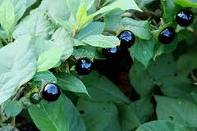
Belladonna, “Beautiful Lady” may have got its name from the fact that women have used it for centuries to dilate the pupils and give them more lustrous eyes. It can be used on the skin without ill effects but is deadly poisonous and should not be ingested. It belongs to the Solanaceae family of plants which include potatoes, aubergines, tomatoes (the wolf peach), Nipple fruit, red and green chilli peppers and the Physalis family of plants which includes the tomatillo and Cape gooseberry and Chinese lantern.
  It has been associated with magic for millennia and as it has psychotropic actions, may have been responsible for tales of witches flying, during the Spanish Inquisition and earlier in Europe.  It was believed that the Devil tended this herb carefully except on Walpurgis Night (30th April) which was supposed to be the night of the Witches Sabbath. It was called Devil’s Cherries and Devil’s Herb because of this belief. Walpurgisnachten or Walpurgis Night is still celebrated in Northern Europe and Scandinavia. It was once, in the Middle Ages, the end of the fiscal year, and celebrated by farmers and artisans. Now it is still a holiday and joined with 1st May and the modern Mayday celebrations, which of course have their origins in the Celtic festival of Beltane. On Walpurgisnachten there is a lot of noise made to frighten away witches and evil spirits, and there is trick or treating, so it is like a spring Halloween. Sprigs of ash, hawthorn, elder and juniper are made into three crosses and placed on barn and stable doors to protect livestock from witches. (These trees were sacred to the European pagans.)
  There are three main constituent alkaloids that are found in Deadly Nightshade, atropine, scopolamine and hyoscamine which are used in modern medicine. Atropine is named after the Latin name Linnaeus gave to the plant, Atropha, which was the name of one of the ancient Greek Fates, who was believed to hold the shears which cut the fragile thread of a human’s life. It is used to relax the smooth muscles in the gut, urinary tract and biliary tree prior to surgery. Scopolamine is used to prevent motion sickness, while hyoscamine is used to treat stomach and bladder problems as well as some heart conditions, Parkinson’s disease symptoms and rhinitis (runny nose).
  Atropine is now used in toxicology, ophthalmology, as well as a painkiller in gastroenterology. Hyoscamine is used in kidnapping and date rape, as it is a sedative and can cause amnesia in certain cases.
  The old Gaelic tribes used belladonna to stimulate them into a rage and give them courage for battle. It was known as the “herb of courage.”  In 68 AD Locusta was imprisoned and sentenced to death in ancient Rome for using her tincture of Belladonna to poison the Emperor Claudius, and it is said that it was the poison of choice of the infamous Renaissance poisoner, Lucrezia Borgia.
  Galen, the physician (129-201AD) thought belladonna was an effective cure for “terrible, unhealing ulcers” (on the skin).Now it is used to help in the treatment of asthma and hay fever, as is the Thornapple and other members of the Datura family which are also poisonous.
  In the time of Chaucer the herb was called Dwale from the French deuil meaning grief. Gerard called it ‘the sleeping nightshade’ saying that the leaves after being soaked in vinegar were laid on the forehead to stop a headache.
  Used topically it can soothe irritated skin, and relieve the pain of neuralgia, gout, and rheumatism. It was once thought to cure cancer if used externally. Hahnemann, often called the Father of Homoeopathy believed and seemed to have proved that it could protect against scarlet fever.
  It has recently undergone tests to ascertain its effectiveness against viral infections and one study in Kolkata’s School of Tropical Medicine and the Central Council for Research into Homoeopathy found that it protected chick embryos from infection by Japanese Encephalitis.
  There are many stories about the poisonous nature of Belladonna and as a child I remember being fascinated by the flowers, and my father and grandfather warning me not to touch the plant at all. This was sound advice as the whole plant can cause skin irritation. The best thing to do is admire its beauty at a safe distance.