LESSER CELANDINE, WORDSWORTH'S FAVOURITE FLOWER: HEALTH BENEFITS AND USES OF LESSER CELANDINE


LESSER CELANDINE, PILEWORT, FIG BUTTERCUP, RANUNCULUS FICARIA
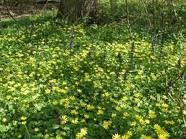
The lesser celandine is one of my favourite wild flowers although it is invasive in the US it is native to Europe including Britain, western Asia and North Africa. It appears early in February and by the end of April it has died back.  It is a member of the buttercup family, Ranunculaceae, but is easy to distinguish because it has nine or ten petals (the buttercup and marsh marigold (Calutha palustris) have five) and has a star-shaped flower. It likes moist shady places and can frequently be seen in hedgerows, and woods, although in Wales, it grows on mountains too, and is a welcome sight in spring. It forms a carpet of dark green heart-shaped leaves, sometimes kidney shaped, and with its shiny yellow flowers it look very attractive. The problem with it is the tubers which can spread and kill other plants.
   The Lesser Celandine, despite its name is no relation of the Greater Celandine, (Chelidonium majus) to which it bears little resemblance. They have different medicinal properties and should not be confused.
  Like the shrinking violet (banaf shah) and Tickle Me (choi moi), it is sensitive to weather conditions, as these lines from William Wordsworth’s poem, The Lesser Celandine show clearly:-
    “There is a flower, the Lesser Celandine,
      That shrinks, like many more, from cold and rain,
      And the first moment that the sun may shine,
      Bright as the sun himself, ’tis out again!”
Celandines are carved on Wordsworth’s tomb as they were said to be his favourite flower.
  Its Latin name comes from rana meaning frog, a reference to the moist places where it grows, and ficaria is from the Latin ficus or fig. This is presumably how it gets the name in the US of fig buttercup. It is called pilewort because for hundreds of years if not thousands, it has been used as a remedy for piles or haemorrhoids. The remedy can be either an ointment made from lard and the fresh bruised plant (whole) chopped, or taken internally as a tisane in wineglass full doses. The tisane is made with 1 oz of the fresh chopped herb to 1 pint of boiling water, left to steep for 20 minutes and then strained.
   The Lesser Celandine was well-known to herbalists in the Middle Ages and the first written reference we have is an illustration in the German herbalist’s “Kreutterbuch” (Rhodion) dating back to 1533. Gerard wrote about it, but as he may have got it confused with the Greater Celandine, I will only quote Culpeper the 17th century English herbalist
  “It is certain by good experience that the decoction of the leaves and roots doth
    wonderfully help piles and haemorrhoids, also kernels by the ears and throat called
    King’s Evil and any other hard wen or tumours.”
He went on to show how much regard he had for this little plant (it only grows to 2 inches under normal conditions)
   “The very herb borne about one’s body next to the skin helps in such diseases though it never touched the place grieved.”
  It is clear that the lesser Celandine was efficacious against piles but the Physicians of Myddfai had this remedy:-
   “Apply the calcareous droppings of a peacock (pounded) with fern roots and it will cure it.”
 The fern roots mentioned here were presumably those of bracken.
   The flower only opens at 9am and closes again at 5 pm, as well as being sensitive to the weather. Its buds can apparently be substituted for capers, but this is not to be recommended as all parts of the plant are slightly toxic, although the toxins can be removed by drying and exposure to heat in cooking. The young leaves have been eaten raw in salads, but they should not be consumed in quantities. Older leaves should only be eaten cooked. The young leaves and flower buds can be eaten like spinach but are best after boiling. You should collect the herb when it is in flower and dry it for later use. The leaves can be used in stews but they aren’t very tasty, others such as sorrel are much better. The tubers or bulbils as they are called may also be boiled and eaten as a vegetable. I’m told that the petals of the Lesser Celandine make good tooth cleaners, but can’t personally vouch for that. As far as I am concerned it makes and attractive and welcome appearance in early spring, and I have always loved to find the first celandine.


BORLOTTI BEAN MAKES A FASHION STATEMENT: HEALTH BENEFITS AND HOW TO COOK DRIED BORLOTTI BEANS


BORLOTTI BEANS or CRANBERRY BEANS, COCO ROUGE
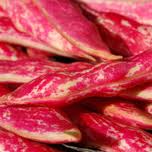
Borlotti beans are staples in Italian cuisine and are consumed in quantities in Greece, Turkey and Portugal. The best type is considered to be those grown in the Veneto region of Italy, with Lamon being particularly renowned for its production of borlotti beans. They are related to the green bean and kidney beans but are easily distinguished by their pods which are beige with pink, red or magenta streaks. In the Mediterranean where they are grown it is usual to buy them in their pods, but they can be found canned or bottled in supermarkets around the world. They are most frequently found dried, and as they also have pinky streaks on them they are easy to spot. Unfortunately they lose their colour when they are cooked and become a rather more boring brown. In the US they are called cranberry beans, presumably because the streaks on the pods and beans are the colour of cranberries.
   They originated in Colombia in the South American continent and were one of the crops that found their way into Europe with the Spanish and Portuguese explorers. (They are the cargamento bean.) The Italians, who were the first Europeans to embrace the tomato wholeheartedly, took to the borlotti bean too and now you can eat them in Italy in stews with polenta and in salads as well in appetizers along with prosciutto and lots of flat-leaved parsley and olive oil.
  These are very versatile beans with a nutty flavour reminiscent of chestnuts and with a meaty texture. They make very good beans on toast as a substitute for the more commonly used haricot beans.
  Borlotti beans are potassium rich so are good for the muscles and for the proper functioning of the kidneys. They contain other minerals which include sodium, zinc, selenium, copper, calcium, manganese, magnesium, iron and phosphorous as well as Omega-3 and -6 fatty acids. As for vitamins, they contain vitamin A and several of the B-complex vitamins including B1, 2, 3, 5 and 6. Borlotti beans also contain 18 amino acids along with dietary fibre and protein.
  They are good combined with other beans in a cold salad, and make a hearty addition to stews and casseroles. They are on of the essential ingredients in an Italian minestrone soup. You can add them to a Greek salad to make it more substantial.
  If you aren’t lucky enough to be able to buy fresh borlotti beans, then you will need to soak the dried ones in plenty of water overnight, and should cook them without adding salt to the water.

HOW TO COOK DRIED BORLOTTI BEANS
Ingredients
200 gr dried borlotti beans, soaked overnight and drained
3 or 4 cloves garlic, peeled and halved
3 tomatoes, roughly chopped
1 small bunch of fresh sage
2 tbsps olive oil

Method
Put the drained beans in a large pan with a tight-fitting lid. Add the other ingredients and stir to mix.
Add water so that the beans are just covered and put the lid on the pan.
This can be baked in a moderate oven or cooked over a low heat on top of the stove.
When the beans are soft but still retain their shape they are cooked.
Leave to cool if you are using them in a salad.
These have Taste and are a Treat.

RYE - SOURCE OF MALT AND WHISKEY: HEALTH BENEFITS AND USES OF RYE


RYE, SECALE CEREALE
Rye was one of the last grain crops to be cultivated; some believe that it was first cultivated around 400 BC by the Germanic tribes, although this may not be the case. Certainly rye features in German as well as Eastern European and Scandinavian cuisine and has dome for centuries. It is probably best known as the main ingredient of Pumpernickel bread, which is more dense than other breads, such as wheat because the gluten contained in rye is not as elastic as it is in other grains such as wheat.
  Malt is produced from rye, by germinating the seed grain and roasting it; malt is then extracted from the grains. This is used as a sweetening agent and in brewing beer. In North America, rye is used as a base for whiskeys. The roasted grain can also be used as a substitute for coffee.
   Like oats, rye comes in various forms, such as in flakes, when it looks like the oats used to make porridge, however the grain is also sold whole or cracked, and in the form of flour. Whole rye grains retain many of their nutrients because it is difficult to remove the rye germ and bran from the endosperm. The grain looks like wheat but can be longer and thinner, coming in shades of yellow-brown or grey-green. It is a member of the Poaceae family of plants which includes millet (bajra), oats, barley, sorghum and wheat as well as sugar cane and the grasses.
   Rye is probably a native of south-western Asia, and probably grew in fields of wheat and barley as a weed, until its crop value was recognized. It may have had Secale montanum as its ancestor, which can be found in southern Europe and nearby parts of Asia, or another possibility is that it came from Secale anatolicum in Syria, Iran, Armenia and Turkistan.
  It was taken to the northeastern parts of what is now the USA by early English and Dutch settlers.
  Like other whole grains it is full of nutrients, containing the B-complex vitamins, B1, B2, B3, B5 and B6 along with folate, vitamins A and E and the minerals calcium, iron, copper, manganese, magnesium, phosphorous (in which it is rich), potassium, selenium, sodium and zinc. It also has Omega-3 and -6 fatty acids and 18 amino acids along with flavonoids and phenolics which give it potent antioxidant properties, meaning that it can combat the free radicals that can damage cells and cause cancer. It has proven to be cardio protective as are other whole grains, and of benefit to post-menopausal women, who are advised to have six servings of whole grains per week in their diets to prevent high blood pressure and cholesterol levels and so protect the cardio-vascular system..
  Rye and other whole grains are also good for people with Type 2 diabetes, as they are rich in magnesium which is involved with the body’s use of glucose and insulin secretion. Whole grains can also help prevent this type of diabetes.
  Rye and rye bread contain a lot of fibre so make a good mild laxative, and the seeds have been used in poultices for tumours and cancers in some traditional medicine systems.
  The long rye stalks have been used for thatching, paper-making, weaving small items such as mats and hats, used in mushroom compost and in the manufacture of tiles and bricks. In industry it is used as biomass and fuel. The root systems are long and can go deep into the soil so are good to stabilize sandy soils and prevent soil erosion.
  Rye can grow up to 1.5 metres tall so a small person could hide in it, which is perhaps why J.D. Salinger chose to call his iconic novel “Catcher in the Rye” rather than in one of the other grass crops. Rye figures in the nursery rhyme, “Sing a song of sixpence”,
    “Sing a song of sixpence a pocket full of rye,
     Four and twenty blackbirds baked in a pie.
     When the pie was opened the birds began to sing,
     Oh wasn't that a dainty dish to set before the king?
     The king was in his counting house counting out his money,
     The queen was in the parlour eating bread and honey
     The maid was in the garden hanging out the clothes,
     When down came a blackbird and pecked off her nose!”
In this case rye was bought to feed the birds, and to lure them to the ground so that they could be caught and eaten, as they were considered a delicacy. Robert Burns, the Scots poet also wrote a poem whose chorus is “Coming thro’ the rye.” Rye clearly had a central place in Britain in centuries gone by.
   You can substitute rye grains for rice, but soak overnight before cooking and when you drain the grains rinse again under cold running water. Cook like rice until tender. You can also use rye flakes instead of oats for porridge.

FAT HEN - NOT JUST CHICKEN FEED: HISTORY, USES AND HEALTH BENEFITS OF FAT HEN


FAT HEN, LAMB’S QUARTERS CHENOPODIUM ALBUM
Fat hen gets its name because it was used to fatten poultry; it goes by many other names too, notably lamb’s quarters in the US and pigweed in Canada, as it was used for pig and sheep’s food. In Britain it was known as Midden Myles and Dirty Dick (no, just the name!) because it likes to grow on manure heaps in farmyards. (Middens were the old name for toilets or the dung heaps where excrement was thrown.) It’s a native European plant and also grew in the America, but it is not yet conclusive whether or not it is a native of the USA or was introduced via Mexico. It does seem to have been domesticated first in Mexico and then in the US by the Native Americans. It has certainly been used as food in Europe since Neolithic (New Stone Age times) according to archaeological evidence.
  As a member of the Chenopodium – goosefoot-species it is related to both the stinking goosefoot and quinoa.
  In Pakistan it is used for liver complaints and as a mild laxative, as well as to get rid of intestinal worms, and in India it has been used in traditional medicine for skin irritation (the powder from dried leaves is dusted onto irritated skin) wile the leaf juice is used to treat burns. A decoction is made from the above ground parts of the plant and mixed with alcohol, then rubbed onto joints affected by arthritis and rheumatism.
  In other parts of the world the tisane is used as a skin wash for irritated skin, while the leaves are used in poultices to relieve painful insect bites, as well as for sunstroke, and for swollen feet and rheumatic joints. The seeds may be chewed to help with urinary problems and for preventing semen being discharged with urine. The root juices have been used to treat bloody dysentery and a decoction of the above ground parts has been used for cavities in teeth, to relieve pain.
  The plant has no odour, and the new leaves are recognizable as being toothed while older leaves which grow as the plant mature are toothless. It can grow to heights of 3 feet with a diameter of 8 inches, and can grow anywhere. If it is growing in soils that have been treated with pesticides, don’t use it, as they will have been absorbed into the plant. As it is, the plant contains oxalates, so the leaves should be cooked rather than eaten raw, for safety’s sake. You can cook it like spinach and it makes a good substitute. However plants which grow in nitrogen rich soil will contain nitrates, which are OK in small quantities, but don’t eat too many leaves, as although a small amount of nitrates can help the respiratory system, too many can be lethal. As the leaves are bland, it is best to mix them with stronger tasting ones such as fenugreek leaves (methi). The seeds may also be eaten although they are best soaked first as they contain saponins and can be used as a mild soap substitute. They can be dried and eaten or ground into flour or rather meal, and used to make bread.
  Anita Pal et al published a research paper in February 2011 in the International Journal of Pharmacy and Pharmaceutical Sciences which shows that extracts of the plant are liver protective, vindicating its use for liver complaints in traditional medicine: “Hepaprotective Activity of Chenopodium Album Linn Plant against Paracetamol-induced Hepato injury in rats.” Another scientific study also published in 2011 by teams from the University of Southern Texas (USA) and University of Fort Hare South Africa, which showed that this plant has antioxidant and anti-bacterial properties. This study concludes that Fat Hen “should be used as a source of nutrients to support major sources [of food]” it goes on to say it “may be of great medicinal value.”
Young leaf
   Certainly it’s food for free and packed full of minerals, being especially rich in calcium and phosphorous and also containing potassium, magnesium, manganese, copper, zinc, nitrogen and sodium. As for vitamins, it has the three main B-complex ones, thiamin, riboflavin and niacin, as well as vitamin A. It has flavonoids and phenolic compounds responsible for its antioxidant properties it is thought.
  A good source of nutrition for free, as it is a weed!