FEVERFEW - NOT JUST FOR FEVERS: HISTORY, USES AND HEALTH BENEFITS OF FEVERFEW: FEVERFEW TISANE


FEVERFEW, TANACETUM PARTHENIUM
Feverfew is a member of the Asteraceae family and related to chamomile, which it resembles, as well as to the sunflower and daisy. Its botanical name has been changed several times and it has swapped genera 5 times. It has been called Chrysanthemum parthenium, Leucantheum parthenium, Pyrethrum parthenium and Matricaria parthenium although it is currently called Tanacetum parthenium. The parthenium Latin name may be because it was associated with the building of the Parthenon and the Acropolis in Athens, Greece, as there is a legend that tells how someone fell off the Acropolis hill during the building work, and was cured by feverfew. It may be that this herb was so revered by the ancient Greeks for its medicinal properties that it was associated with the goddess Athena, Greek goddess of wisdom, whose Temple was built on the Acropolis hill, or it might be that the word “parthenos” is Greek for virgin, and the herb can prevent irregular menstruation and ease the stomach cramps associated with it.
  Feverfew is a native of Greece and southeastern Europe and was used for a variety of ailments, including headaches and stomachaches. The ancient Greeks used it to treat “melancholy” with feverfew, and this could have meant headaches such as migraines as well as depression in ancient times. Melancholy was something that affected the head and brain. Dioscorides advocated its use for headaches and its early name febrifuga means fever reducer; this is how it comes to have the name feverfew in English as it can work against all types of fever.
  Feverfew according to traditional use has the ability to reduce fevers and that was generally what it was used for in Mediaeval times. It has proved effective in recent years against migraine attacks, and people who suffer from migraines should chew a few leaves of this plant every day to prevent the debilitating headaches they are prone to. You can eat them in between slices of bread as they are bitter and give some people mouth ulcers. It is not quite known how feverfew works to prevent migraines, but the whole leaf does help. Perhaps the compounds contained in it block the production of serotonin which is thought to trigger migraines. Chewing the fresh leaf also promotes the liver’s functioning possibly because of the bitter principles in the leaves. These also stop feelings of nausea and prevent vomiting.
  If you grow feverfew in the garden it repels insects, and you will probably notice that even bees shun it. If you want to protect other plants from the ravages of insects, feverfew might help.
  Feverfew can help with symptoms of the menopause and is used to reduce hot flushes, and it can also regulate the pains and contractions of childbirth. An infusion of the herb can cleanse the uterus after childbirth too so it is another useful herb for women like the Chaste tree and black cohosh, although it has different properties to these.
  The plant has anti-inflammatory properties and has been shown to help in cases of psoriasis. There are studies currently underway to assess its effects on rheumatoid arthritis. It may help to prevent some respiratory problems such as hay fever and asthma, as extracts of the plant have been found to block the release of histamine from mast cells.
   The herb has been used to treat many illnesses in traditional medicine around the world, as it has spread to South America, was introduced to North America in the 19th century, and is found in parts of Asia, Australia and New Zealand, among other countries. It is said to remove toxins and heat from the body, to relieve the pain associated with arthritis, to relieve nerve pain associated with neuralgia and sciatica, as an expectorant to remove phlegm and mucous, and as a nerve tonic.
  The 16th century English herbalist, John Gerard thought that feverfew was so powerful against fevers that even if you tied some around the pulse point on your wrist, fevers would be kept at bay. A tincture of the plant is good for insect bites as it reduces the swelling and stops itching. The plant contains essential oil containing camphor among other ingredients.
  You can make a soothing balm if you chop or bruise whole leaves and mix with melted fat, then allow it to cool. You can also make a hot poultice with the bruised leaves fried in a little oil and wine, and place the mixture directly on the part of your stomach affected by colic or other pains. (Put the hot leaves in muslin if you don’t like the thought of plastering them on your skin.) You can put some bruised leaves in cold water and put tired or swollen feet into this.
  A decoction of the above ground parts of the plant can be mixed with sugar or honey and used for coughs and respiratory problems. The tisane below is used cold, and is good for reducing fevers and to help with migraines, stomach cramps etc.

FEVERFEW TISANE
Ingredients
1 oz fresh herb (leaves and stems), chopped
1 pint boiling water

Method
Pour the boiling water over the chopped herb and leave until cold.
Strain and store the liquid in the fridge.
Use ½ a cupful three times a day. You may need honey or sugar to take away the bitterness.
This has Taste and is a Treat(ment).

HOLLY OR HOLM OAK: HISTORY OF USES AND MEDICINAL BENEFITS OF HOLLY OAK


HOLLY OAK, HOLM OAK, QUERCUS ILEX
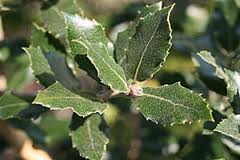
The Holly or Holm oak (Holm is an old word for holly) is a native of southern Europe and Greece and Italy in particular. It is called the Holly oak because its young leaves resemble those of the holly bush, with jagged teeth to deter grazing animals from stripping its lower leaves bare. The leaves at the top of the tree do not have the serrated edges. Currently there is conjecture that this tree may also be native to Ireland, although it is known not t be a native of the British Isles, but there it has become naturalized. It can also be found in forests on the Atlas Mountains in Morocco.
   It actually looks similar to the English or Common oak tree, Quercus robur, although the acorns are more elongated and pointed than those of the tree that is native to Britain. It is a member of the Fagaceae family which means that it is a close relative of the English oak and also of the sweet chestnut tree (Castanea sativa) and the common beech (Fagus sylvatica). It is a tree which is popular with people who have truffle orchards, as truffles have an affinity with this tree it would seem.
  The ancient Greeks revered the oak tree and this may have been the one they had at Dodona, where they believed Zeus, the Father of the gods spoke in the rustling leaves of the oak which was an oracle and foretold the future. Other myths of the Greek oaks were that the oak was Biblys, a princess from Miletus who lusted after her brother. When he spurned her advances, she threw herself off a mountain or cliff but the Nymphs took pity on her and transformed her into a Holm oak. She thus became a Dryad and a spring of her tears welled up from the base of the oak tree.
  In Roman mythology, Jupiter is supposed to have found shelter under a Holm oak when he was an infant.
  In ancient Greece the acorns from the oak trees were symbols of fertility and women wore jewellery with the acorn motif in the hope that they would be fertile.
  Like other oaks, the bark has astringent properties and so decoctions can be given for diarrhoea and dysentery. However it is the galls, the vacant larvae of insects that are used in medicine for their astringency. They are used to treat chronic diarrhoea, haemorrhages and dysentery.
  In Portugal and Spain a variant of Quercus ilex spp. ballota is cultivated for its sweet tasting acorns, as well as the wood from the tree which is strong, hard and durable. Acorns have to be leached of their tannins before using, and can then be ground and used with flour for baking, while the roasted acorns can be used as a coffee substitute, just as the root of chicory or the dandelion are. In ancient times the acorns would be put in cloth and left in a stream to get rid of the tannins, but you can leach these under cold running water. Another method of leaching the tannins out of the acorns was to bury them in marshy ground over winter, and then they would be dug up in spring and be ready to use.
  While the Greeks used the oak for foretelling the future, the Romans were more practical and used the wood for agricultural implements as well as cart and carriage wheels.  
  The trees are slow-growing but reach great heights, of up to 82 feet on average with a spread of 68 feet. They are mighty oaks just like the rest of their family.

SEA HOLLY, ERYNGOES, A MEDIAEVAL APHRODISIAC, HEALTH BENEFITS AND USES OF ERYNGIUM MARITIMUM


SEA HOLLY, ERYNGIUM MARITIMUM
Sea Holly reminds me of teazle, although the two are not related. As its name suggests in the wild Sea Holly grows along the coast of much of Europe, including Scandinavia, and can also be found along the Black Sea. Its name eryngium comes from the Greek meaning to cure flatulence, and maritimum means of the sea. There could be another reason for the plant to be called eryngium, though, as eeringos is also Greek for the beard of the Billy-goat and Plutarch has this strange tale about a goat which tried to eat Sea Holly. He wrote that if a female goat had sea holly in its mouth “it causes her first to stand still, and afterwards the whole flock, until such time as the shepherd takes it from her.”
  It is said to have aphrodisiac qualities, and a legend has it that the ancient Greek poetess, Sappho, wore it to attract the love of a particularly handsome Greek boatman, Phaon. It is mentioned by Falstaff for these qualities in “The Merry Wives of Windsor”, in Act V, scene v: -
      “Let the sky rain potatoes,
       let it thunder to the tune of Greensleeves
       hail kissing-comfits and snow eryngoes
       let there come a tempest of provocation…”
Sea Holly roots were used as sweets to sweeten the breath in Shakespeare’s day, hence the name “kissing-comfits”; Sea Holly was then known as eryngo. It has been used in the same way as angelica, candied, although it tastes like sweet carrots when eaten like this.
  This plant is a member of the Apiceae or Umbelliferae family and is closely related to rock samphire, sharing its coastal habitat. It is in the same family as the carrot, of which its root tastes a little, parsnip, fennel and lovage. The young plant’s shoots can be eaten, boiled like asparagus, and when the roots are baked or roasted, they taste like chestnuts or parsnips.
  I used to admire these plants when I was on the beaches of the Gower Coast, South Wales, and loved the frosted appearance of the leaves. This is due, I now realize, to a waxy covering which seals in moisture and protects the plants from the ravages of the sea “breezes” which are often gale force winds. They can still be found in the sand dunes along the Gower, although in some parts of the British Isles, such as the Somerset coast, they are extinct. There is some good news for them though, as they can be cultivated in gardens, and as they make a pretty ornamental they are currently in vogue.
  At first sight they look like a thistle, although nothing like a cardoon or a globe artichoke, being more reminiscent of a milk thistle. I have always thought they were fairy plants, probably because of their blue flowers and the frosting – I thought that fairies especially loved blue flowers such as bluebells.
  These plants grow to around a foot high and their roots have been used over the centuries as a diuretic, and to prevent the formation of kidney stones. They are also useful for cystitis and bladder infections and may help with enlarged prostate glands. The 17th century herbalist Nicholas Culpeper recommended that the distilled water made from the whole young plant should be taken for “the melancholy of the heart” and for fevers. It can promote sweating and so reduce temperatures. He also says that it is good for stiff necks.
  Earlier in the 16th century John Gerard thought that it was good for liver diseases, stomach cramps and epilepsy, while in the 1st century AD Dioscorides used it to relieve flatulence and indigestion.
  In medical trials it has been found to have some antioxidant properties, although not as many as rock samphire, and to have anti-bacterial ones. An extract of the rhizome showed anti-inflammatory properties when used on rats.
  In folk medicine it has been used as an antiscorbutic and its purgative properties, as well as for the other cures mentioned above. Studies are still being carried out on this plant. 

SWEET FLAG ( ACORUS CALAMUS) - USED FOR FOOD AND MEDICINE


SWEET FLAG, BACH IN URDU, ACORUS CALAMUS
The Sweet Flag under discussion here is the one native to the Indian subcontinent. It is different to the Sweet Flag grown in North America, which is Acorus americanus. The two plants are in the same genus so are closely related, but have different properties and constituents. Sweet Flag is in the Araceae or lily family so is related to taro (Colocasia esculenta), the Arum or Calla lily and the Cuckoo pint.
  The Sweet Flag which grows in the Indian subcontinent has been an important medicinal plant since early times, and is also a source of food, particularly in Bangladesh, where it is cultivated as well as growing wild. The volatile essential oil extracted from he rhizome of this plant is used in the perfume industry and the root and other parts of this plant are also employed in traditional medicine.
  This plant grows in marshy ground or on the banks of ponds, lakes and in water. Its leaves have been found to have anti-fungal properties and it has been used in Ayurvedic medicine for numerous ailments including bronchitis, for heart, lung, liver, kidney and gall bladder complaints. The roots are used as a remedy for diarrhoea and dysentery, to get rid of intestinal worms and as an anti-spasmodic for epilepsy and stomach cramps and catarrh. The flowers, or inflorescences as they are correctly called, are used for eczema, kidney and liver disorders and rheumatism.
  There are many other uses for the Sweet Flag in traditional systems of medicine, including to start menstruation, if a period is late, and it is said that it can relieve flatulence and aid digestion, as well as help in cases of fever by reducing the temperature by promoting sweating. The root is chewed to relieve toothache, and a potion is made with the plant to aid digestion and to ease anxiety as it is reputed to have sedative actions. It is also reputed to have aphrodisiac qualities.
  Sweet Flag also has other uses and is sometimes burnt as incense; the leaves can be woven to make mats and baskets, for thatch and were used as a strewing herb for floors. They smell a little like cinnamon as do the roots. The essential oil from the leaves is used in perfumery and can be used to flavour vinegar and other food. The leaves are also used as insecticide and insect repellants.
   The β-asarone found in the plant may be carcinogenic and toxic, but in small amounts has tranquillizing and antibiotic actions.
   The rhizome is starchy, but can be used like taro and is also candied and often washed, peeled and eaten uncooked. It is rich in starch like other edible roots such as the yam and taro. The powdered rhizome can be used as a substitute for cinnamon, ginger or nutmeg. Children eat the flowers for their sweetness. Sometimes the leaves are used like vanilla pods are for flavouring custards and milk puddings.