OX-EYE DAISY, SMALL HERB WITH MANY USES: HISTORY, USES AND HEALTH BENEFITS OF THE OX-EYE DAISY


OX-EYE DAISY, LEUCANTHEMUM VULGARE
The ox-eye daisy is native to Europe including the British Isles and the Russian parts of Asia, including Siberia. It is also known by a variety of other names including Maudlinwort, Dun Daisy, because of its association with the thunder god Odin, and goldenseal as well as marguerite and Moon daisy. It is a relative of the more common daisy, and was introduced into North America where it has now become naturalized and an invasive weed. It is a member of the Asteraceae or Compositae family of plants and has been used for centuries in folk medicine. Its other Latin name is Chrysanthemum leucantheum which comes from the Greek chrisos meaning golden and anthos meaning flower, while leuka means white. It is normally between one and two feet high but can grow up to three feet.                                                                                                              
  In Wales in the Middle Ages it was used to cure insanity, treat smallpox and for jaundice and skin diseases. The daisy and the ox-eye had a very special place in Celtic folklore as it was thought that the daisies were the reincarnation of children who died during childbirth, put on Earth to give comfort to grieving mothers.
  The ancient Greeks dedicated the ox-eye daisy to Artemis the goddess of women and used it for ‘female complaints’ such as menstrual disorders. A tisane of the flowers of the ox-eye daisy is said to relieve stomach cramps as does chamomile, another relative.
  Later Christianity chose to adopt the flower as the one which symbolized St. Mary Magdalene and this became corrupted to maudlin, so the plant was known as maudlinwort in the 5th century and earlier.
  The English herbalist, John Gerard writing in the 16th century had this to say of the ox-eye: -
  “Dioscorides saith that the floures of Oxeie made up in a seare cloth doe asswage and washe away cold hard swellings, and it is reported that if they be drunke by and by after bathing, they make them in a short time well-coloured that have been troubled with the yellow jaundice.”
  It was used for jaundice by country people for centuries, as a decoction drunk with ale.
Culpepper, writing in the 17th century in his “Complete Herball” writes that it is
“a wound herb of good respect, often used in those drinks and salves that are for wounds, either inward or outward' . . . and that it is 'very fitting to be kept both in oils, ointments, plasters and syrups.' He also mentions that the leaves, bruised and applied reduce swellings, and that
“a decoction thereof, with wall-wort (wall flowers) and agrimony, and places fomented or bathed therewith warm, giveth great ease in palsy, sciatica or gout. An ointment made thereof heals all wounds that have inflammation about them.”
  The Iroquois tribe of Native Americans used the herb for fevers, and for these made a tisane out of the flowers and leaves. In Britain the leaves were used in an infusion to relieve chronic coughs such as whooping cough and catarrh, but honey should be added to give it a better flavour if you are thinking of using this remedy. However if you are allergic to daisies or nasturtiums and other members of the Asteraceae family, don’t use it! The leaves are edible and taste a bit like Kos lettuce. The leaves are best eaten in spring before the flowers bloom and they are recognized because the ones that grow in a rosette at the base of the plant have long leaf stems (petioles) which are spoon-shaped with rounded teeth edges. The flowers are also edible.
 The distilled water of the flowers has been used as an eye wash for conjunctivitis (pink eye) and a poultice of the whole plant can be applied to the skin for a variety of skin problems, as mentioned by Culpeper. In North America the root has been employed for night sweats and consumption.
  However the whole plant contains an acrid juice which makes the herb bitter and makes it smell a little like valerian. The seed casings of the ox-eye daisy contain pyrethrins which are natural organic compounds that can be utilized as a natural insecticide, so the common ox-eye has many useful properties.
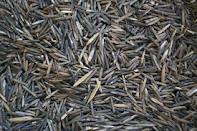
WILD RICE - GLUTEN-FREE GRASS SEED: HISTORY, HEALTH BENEFITS AND USES OF WILD RICE


WILD RICE ZIZANIA PALUSTRIS/AQUATICA
Wild rice isn’t technically rice, although it can be used like rice in pilafs and so on, but a grass seeds, with rice being a close cousin in the Poaceae or Gramineae family. This means it is also related to sorghum, oats, barley, rye, wheat, maize, sugar cane and millet. Zizania palustris grows in Michigan, Minnesota and Wisconsin in the US and in Canada in Alberta, Manitoba and Saskatchewan. Zizania aquatica is native to the Saint Lawrence River, and the Atlantic and Gulf coasts of the US. There is Zizania texana which grows in the Saint Marcos River, but this is close to extinction because of loss of habitat and pollution. The fourth type of wild rice (there are only four known) is Zizania latifolia or Manchurian wild rice, which is native to China.
  Wild rice gets its name from the way it grows; early settlers and explorers in North America were reminded of the way rice grows in paddy field when they saw the stems rising out of the water of the Great Lakes and French explorers in Canada called it “folles avoine” or ‘crazy oats’ allegedly because of the strength and hardiness of the Native Americans who lived in the woods. It was a staple of many Native American tribes and was gathered during the period of the “rice moon” in August to September then fermented for a week or two in the sun, so that it got its distinctive black colour. Unfermented rice varies in colour from tan and green through to mid-brown and black.
  Native Americans used it like brown rice in poultices for burns and scalds as well as for stomach problems and heart, lung and liver diseases.
  Wild rice has the edge on brown rice as far as its nutritional benefits go, with traces of vitamin A, and small amounts of vitamins E and K with the B-complex vitamins, B1 (thiamin), B2 (riboflavin), B3 (niacin), folate, pantothenic acid, choline and B6. It also has all 18 amino acids but is low in lysine, but a good source of Omega-3 fatty acid and Omega-6. As for minerals it is high in phosphorous and potassium, with a good amount of magnesium and also calcium, iron, sodium, zinc, copper and selenium. It is a good source of fibre and antioxidants, and helps to lower blood pressure and blood cholesterol levels.
  Wild rice became fashionable in the late 1960s and early 1970s when people began to think about food and health benefits. It was later used in Nouvelle Cuisine distinguished by small pretty portions. It has a nutty, slightly peaty flavour and a chewy texture. People usually cook it in pilafs along with brown rice both for its different flavour and texture as well as to make the dish look more attractive. When it is fully fermented you have the aroma of black tea, while if it is unfermented it smells more like green tea.
  To cook wild rice, you use 1 part wild rice to 3 of boiling water. Add the wild rice and bring the water back to the boil, then reduce it to a simmer and cover the pan. You will need to cook it for about 45 minutes or until it starts to burst open. Because it takes longer to cook than rice, you should cook them separately for the best results and combine them later, fluffing up the pilaf with a fork. You can fry onions, garlic and celery to mix with it and wilt some spinach or other leafy green vegetable in olive oil and mix into the rice. Sage and thyme are good herbs to use when you cook wild rice and adding some paprika is also good, but experiment and see for yourself what goes well with it. You can combine it in our biryani recipes too, so bon appetit!

PRIVET - NOT ONLY FOR HEDGES: HISTORY, USES AND HEALTH BENEFITS OF PRIVET


PRIVET, LIGUSTRUM VULGARE
We once had a privet hedge instead of a garden wall, but it didn’t recover after a very heavy snowfall and bad winter sometime in the 1960s in Britain. Privet is a semi-evergreen, and grows wild in Britain, the rest of Europe and North Africa. It is a medium to fast-growing shrub so was popular at one time as a hedge, although it has now been overtaken in the hedge stakes by Ligustrum ovalifolium which is apparently a more reliable evergreen species.
     In Britain its main claim to fame is that along with the Ash tree (Fraxinus excelsior), it is a member of the olive family of plants, the Oleaceae, of which only these two species are native. Wild privet is an invasive weed in North America, New Zealand and Australia and it has been banned from sale and cultivation in New Zealand because its pollen exacerbates asthma and eczema in sufferers of those ailments. The berries contain toxic substances although these usually only provoke vomiting and more often no symptoms at all are reported. The leaves can also provoke allergic reactions if taken internally, although at one time they were used as a stomachic, as was the bark of bigger plants.
  The leaves have astringent properties and can help cleanse wounds as they have detergent actions too. As well as this they can assist in wound healing, if they are bruised.
 The black or purple berries which form clusters are poisonous to horses and as they contain lignan glycosides, saponins, and seco-iridoid bitter substances these are deemed to be responsible. Unfortunately they are attractive to children too, as are the berries of the deadly nightshade.
  Despite the toxins the plant contains the Physicians of Myddfai employed privet in some remedies as this one shows:-
   “The mugwort, madder, meadow sweet, milfoil, hemp, redcabbage, and the tutsan, all these seven herbs enter into the composition of the medicine required.  Whosoever obtains them all, will not languish long from a wounded lung, or need fear for his life. Any of the following herbs may be added thereto, butcher's broom, agrimony, tutsan, dwarf elder, amphibious persicaria, centaury, round birth wort, field scabious, pepper mint, daisy, knap weed, roots of the red nettle, crake berry, St. John's wort, privet, wood betony, the roots of the yellow goat's beard, heath, water avens, woodruff, leaves of the earthnut, agrimony, wormwood, the bastard balm, small burdock, and the orpine.”
  Nicholas Culpeper writing in the 17th century also believed that privet could be beneficial and wrote this about the shrub:-
 “Government and virtues. The Moon is lady of this. It is little used in physic with us in these times, more than in lotions, to wash sores and sore mouths, and to cool inflammations, and dry up fluxes. Yet Matthiolus saith, it serves all the uses for which Cypress, or the East Privet, is appointed by Dioscorides and Galen. He further saith, that the oil that is made of the flowers of Privet infused therein, and set in the Sun, is singularly good for the inflammations of wounds, and for the headache, coming of a hot cause. There is a sweet water also distilled from the flowers, that is good for all those diseases that need cooling and drying, and therefore helps all fluxes of the belly or stomach, bloody-fluxes, and women's courses, being either drank or applied; as all those that void blood at the mouth, or any other place, and for distillations of rheum in the eyes, especially if it be used with tutia.”
  While Culpeper refers to the ancient uses of this shrub, he also points out that it was used in his day too. Times change though and the privet is no longer even used as much as it once was for a hedge.

OLEANDER - POISONOUS BUT A POSSIBLE SOURCE OF CANCER TREATMENT: HISTORY AND HEALTH BENEFITS OF OLEANDER


OLEANDER, NERIUM OLEANDER, KANER IN URDU 
You may not recognize the name but you will probably recognize this poisonous plant with its pink, white or red flowers which bloom from May to October, depending on where you live. It graces the roadsides in Greece, Sicily, Italy, Portugal, Pakistan (where it is still in bloom now although it is the end of November), the state of California in the US and other countries. It is useful because it seems not to mind the pollution; it is tolerant of salt and drought and prevents soil erosion as it has long, thick tap roots. It has naturalized in so many countries that no one is sure where it originated, although it might have come from South West Asia.
  Whenever I see these bushes growing in the middle of the motorways here in Pakistan I am reminded of Greece, both the mainland and the islands where these flowers abound. They also remind me of Steely Dan’s “Countdown to Ecstasy” album and the lyrics of “My Old School”. In other words I feel nostalgic when I see them.
  The oleander is toxic although not many deaths have been attributed to it, although I’m told that the seeds are particularly useful as a poison as it is not always noticed. Because all parts of this plant are toxic it is not recommended to use it as firewood or skewers for barbecues. It is poisonous for people and animals if ingested, but has been used in traditional medicine systems for centuries.
  Oleanders have leaves which look a little like those of the olive tree, but they are not related as the oleander is a member of the dogbane family or Apocynaceae family. It is believed to be the onotheras of Theophrastus who believed that the root when given to someone in wine improves their temper and makes them “gentle and cheerful.” Pliny concurred with Dioscorides that it could be an antidote to the bites of serpents, and this is what Dioscorides says of oleander in his De Materia Medica Book IV page 82 which was written in the first century AD.
  “Nerion, which some call Rododaphne, some Rhododendron . . . grows in enclosed greens and sea-bordering places; in places near rivers. But ye flower and the leaves have a power destructive of dogs; of Asses; of Mules; and of most four-footed living creatures, but a preserving one of men, being drank with wine against the bitings of venemous beasts; ye more if you mixed it with Rue, but ye more weak sort of living creature, as goats; sheep, die, if they drink ye maceration of them.”
  John Gerard the 16th century English herbalist tells us what Galen another ancient physician said about oleander, but omits to give credit to Dioscorides, if we compare the two pieces of text they are much the same. Gerard could be considered guilty of plagiarism. Here is what he wrote about oleander:-
"This tree being outwardly applied, as Galen saith, hath a digesting faculty; but if it be inwardly taken it is deadly and poisonsome, not only to men, but also to most kinds of beasts.
The flowers and leaves kill dogs, asses, mules, and very many of other four footed beasts: but if men drink them in wine they are a remedy against the bitings of Serpents, and the rather if Rue be added.
The weaker sort of cattle, as sheep and goats, if they drink the water wherein the leaves have been steeped, are sure to die."
  Oleanders were depicted in Roman murals quite frequently along with bay trees and myrtles. One famous mural is that in a subterranean chamber of Livia’s Villa in Porta Prima, Italy.
  In different traditional medicinal systems oleanders have been used in poultices to relieve backache; the fruit has been applied to the body to promote sweat in poultices according to the Hortus Sanitatis a 15th century herbal. It also says that the flowers provoke sneezing so could be used as snuff was. It was once believed that the plant was fatal to head lice and fleas.
  The macerated leaves were applied topically to promote hair growth and for syphilis symptoms and other skin diseases. Oleander has been used by herbalists for centuries to treat all kinds of illnesses from skin problems, to epilepsy, to induce miscarriages, as emetics and heart tonics. A decoction of the leaves has been used for gingivitis and oral problems. The plant contains the cardiac glycosides oleandrin and oleandrigenin which can be toxic when ingested, but they seem to boost the immune system of cancer patients when given in small controlled doses. It is believed that oleandrin might have antineoplastic activity and so can help in our fight against cancer.
  It has, in recent years been hailed as an alternative cancer treatment as the first phase of clinical trials have been a success reportedly. The US FDA has said that extracts of the leaves are safe enough to be administered orally and has approved clinical testing, which is now in its second phase as of 2011. Oleander contains cardiac glycosides which are the substances being investigated.
  As with aak (Calotropis procera) this plant can be fatal, but it can also be beneficial to our health.