DOG ROSE - USE THE HIPS FOR HEALTH: HISTORY AND HEALTH BENEFITS OF DOG ROSES


DOG ROSE, ROSA CANINA 
The dog rose can be found in hedgerows in Britain, mainland Europe, North Africa and south western Asia. It has been used in traditional medicine for centuries and as a beauty aid. Cleopatra is said to have soaked the sails of her barge with rose water to impress both Julius Caesar and Mark Anthony.
  It is thought that this wild rose originated in the East and spread to Persia (now Iran) and Babylon, then was taken by Arab traders to Egypt, from where it was transported to ancient Greece and Rome, where it flourished along with the wild damask rose. Roses were worn as garlands around the necks of ancient Romans and figured in feasts, orgies and marriages. The rose, particularly the red rose, has been a symbol of love for centuries. Wild roses are closely related with the cultivated ones and belong in the same Rosaceae family as plums, loquats, apricots, almonds and a multitude of other plants which provide us with fruit and nuts.
  The wild rose or dog rose gets its name from the Old word “dag” for dagger which refers to its thorns and the tale of the Devil who was tormented by the thorns when he fell from grace into a wild rose bush. Some believe that the word ‘dog’ came about as Pliny says that the Romans used the roots of the wild rose to cure the bites of rabid dogs.
  Nicholas Culpeper writing his herbal in the 17th century has this to say of the dog rose: -
   “Government and virtues. It is under the dominion of the moon. The flowers of the wild-briar are accounted more restringent than the garden-roses, and by some are reckoned as a specific for the excess of the catamenia. The pulp of the hips has a pleasant grateful acidity, strengthens the stomach, cools the heat of fevers, is pectoral, good for coughs and spitting of blood, and the scurvy. The seed has been known to do great things against the stone and gravel; and the same virtues are attributed to the spongy excresence which grows upon the stalk. The best way of preserving its virtues is, by keeping it conserved.”                                                                                           
  The German Commission E might agree with Culpeper’s last statement, as they have stated that the fruit loses a lot of its natural potency as regards health benefits soon after it is picked. This means that you should use freshly picked fruit – hips or dried powder. By “restringent,” Culpeper means astringent I believe and this is affirmed by modern science. The dog rose petals have more astringency as do the leaves than those of other roses. This means that they can be used to treat stomach upsets and can be applied to wounds. Usually this is done in the form of a wash.
  A tisane, syrup and rose water can be made with the parts of the dog rose, and rose petal jam is a good preserve. The fruit or hips can be eaten raw or cooked and this begins to appear in October but is sweeter and softer after a frost. The flowers are in bloom in June and July and decorate the hedges with their pink or pink and white, or more rarely white flowers. I used to be fascinated with these wild roses and was told that they were brought to Britain by the Romans. However this is made reference to so far as I have found on the Net. I liked to believe it was true, and of course, it may be. It can grow to 3 metres (9 feet) tall by the same dimensions wide.                                                                    
  The dried leaves of the dog rose can be powdered and made into a tisane, which is said to help with stomach upsets. The petals can be made into rose water, but it takes a long time. You can pick the flowers on a sunny day when they are at their most fragrant and put them into an enamel pan or a stainless steel one, and cover them with fresh spring water or distilled water. Cover the pan and put it on a low heat and bring it to a simmer. Turn the heat down as low as you can and heat it through for 10 minutes, lightly covered. Turn off the heat and allow the flowers to steep overnight, then, in the morning, strain the liquid and add a quarter of the volume of alcohol to preserve it. Bottle it in sterile glass jars or bottles and store in a cool dark place. This is a useful toner for the skin and can be used as a wash for acne and other skin blemishes. You can also use it in cooking and it is very good in milky puddings, such as rice pudding, or with fruit salads.
 Rose hip tisane has mild laxative properties, probably because of the malic and citric acids it contains along with pectin. You can make a jelly with rose hips as you can with crab apples.
  Rose hip oil is a good moisturizer and rejuvenates the skin. This is obtained from the seeds contained in the hips. These are rich in vitamin E and they can be ground and mixed with flour or added as a thickener to sweet dishes. However they are fiddly to deal with as you should really remove the tiny hairs that grow on the seeds. Boiled seeds have been used to treat the pains of rheumatism, arthritis and gout and should be boiled for at least an hour if you are thinking of using the remedy.
  In Anatolia the fruit is used in the treatment of diabetes, and a study by Orhan N. et al., published in 2009 in the Pharmacognosy Magazine Vol. 5 (20) pp 309-15 “Anti-diabetic Effect and Antioxidant Potential of Rosa Canina  Fruits” supported this traditional use. Other Turkish research has shown the anti-inflammatory effects of extracts of the fruit.                             
  Rose hips from the dog rose contain fatty acids, which is unusual for a fruit, and they have more vitamin C than oranges or any other citrus fruit (so was useful during the Second World War in Britain) as well as vitamins A, D, E and K, and the minerals, boron, sodium, calcium, copper, zinc, iron, potassium, magnesium, manganese and phosphorous. There are also bioflavonoids, tannin, carotenoids including β-carotene and some of the B-complex vitamins. As it is red, as are strawberries, tomatoes and watermelons, it contains lycopene, which reduces the risk of prostate cancer in men.
  A Danish study conducted by R. Christenson published in 2008 has suggested that the extracts of the rose hips of this particular wild rose may indeed soothe the pain of inflamed joints, and osteoarthritis.
  The following recipe is to be used with freshly picked rosehips and is a syrup which can be given to people suffering from colds, flu etc as it will boost the immune system and reduce the number of days the symptoms stay. It can also be used in winter as can the infusion of the hips to boost the immune system and so lessen the risk of colds and so on. However, it takes ages to make, although you don’t have to look after it while it simmers.


ROSE HIP SYRUP
Ingredients                                          
2 pints water 
4 ozs fresh rose hips
1lb sugar

Method          
Put the hips and water in a pan and cover it. Bring the water to the boil and boil, covered for 20 to 30 minutes.
Strain the liquid and clean the pan, then pour the liquid back into it.
Leave it uncovered on a very low heat until only 7 fluid ounces are left. (This is what takes the time.)
Add the sugar and still on a very low heat, simmer until it dissolves.
Allow it to cool a little before bottling it.
Store in a cool dark place.

DWARF ELDER: USED FOR MEDICINAL PURPOSES AROUND THE GLOBE: HISTORY, USES AND HEALTH BENEFITS OF DWARF ELDER


DWARF ELDER, (EUROPEAN), SAMBUCUS EBULUS 
The dwarf elder is in the same genus as the elder or common elder tree and in the Adoxaceae family of plants, although formerly it was in the Caprifoliaceae family. The Himalayan viburnums belong in the same family as does the Guelder rose (Viburnum opulis), making them relations of the European dwarf elder, which is different altogether from the plant called by the same name in the US; Aralia hispida of the Araliaceae family. This dwarf elder is native to Britain and mainland Europe as well as to the Mediterranean and eastwards to the Himalayas. Its cooked fruit is edible, and so are the leaves as they can be made into a tisane or infusion and have been used as a tea substitute.
  The Dwarf elder is also known as Danewort, Danesblood, and Walwort and there are legends surrounding these names. “Wal” means slaughter, and it was thought (or perhaps hoped) that the plant grew where the blood of invading Danes had been spilled in Britain. There are places called the Slaughters (Upper and Lower) in the Cotswolds and there are quite a lot of dwarf elders there still. It is also called Blood Elder or Blood Hilder and it was thought to have been brought to Britain by the Danes to lay on their graves.
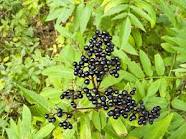
  The berries and leaves closely resemble those of the elder tree, but this is a plant which only grows to around three feet high and it dies back in winter. The stem of this plant is not woody and the white flowers are sometimes splashed with red and they have red anthers. They bloom in July and August, and like their relatives, the Himalayan viburnums, they don’t smell pleasant. In fact the whole plant when bruised, smells obnoxious, and does not have the musky smell of the elder. It is said that the plant repels moles and mice, so perhaps the leaves repel mice too.
  The plant has been found to have some anti-cancer properties, anti-inflammatory ones and have antioxidant properties; it is an anti-rheumatism plant and can be used as a remedy for piles according to some modern research. The flowers and berried contain essential oil. And the rest of the plant contains tannins, steroids, flavonoids, glycosides including sambunigrin and ebuloside and ebulin, along with caffeic acid derivatives and other substances. However, much more research needs to be done to find how this plant can be used effectively for human health.
  In Iranian traditional medicine the plant is used to treat sore throats, and bee and nettle stings as well as arthritis. Juice from the root is used to dye hair black, in some parts of the world, and a blue dye and ink may be obtained from the berries.
  In traditional medicine the root is used as a very effective and drastic purgative and this is not recommended! The leaves also can be used as a milder purgative. These have anti-inflammatory properties, can help to increase the flow of bile in the body and help remove it, act as an expectorant, and in fevers can promote sweat. They also have diuretic activities. The leaves can be placed on burns and scalds to help heal them and can also be made into a hot or warm poultice for sprains and swellings. It was thought that placing a bunch of dwarf elder leaves on the chest of someone who had just begun to get T.B. would help, and if a person had a fever, he or she might be laid on a sheet which had the leaves on it and then wrapped in a blanket to get rid of a fever. The physicians of Myddfai used it for fevers, as you can see from these ancient remedies of theirs: -
  “Fevers The mugwort, madder, meadow sweet, milfoil, hemp, red cabbage, and the tutsan, all these seven herbs enter into the composition of the medicine required. Whosoever obtains them all, will not languish long from a wounded lung, or need fear for his life. Any of the following herbs may be added thereto, butcher's broom, agrimony, tutsan, dwarf elder, amphibious persicaria, centaury, round birth wort, field scabious, pepper mint, daisy, knap weed, roots of the red nettle, crake berry, St. John's wort, privet, wood betony, the roots of the yellow goat's beard, heath, water avenswoodruff, leaves of the earth nut, agrimony, wormwood, the bastard balm, small burdock, and the orpine
This was a treatment for an intermittent fever such as malaria is: -
  “Take the mugwort, dwarf elder, tutsan, amphibious persicaria, pimpernel, butcher's broom, elder bark, and the mallow, and boiling them together as well as possible in a pot, or cauldron. Then take the water and herbs, and add them to the bath.”
  Nicholas Culpeper writing his herbal in the 17th century, much later than the old Welsh physicians, has this to say of the dwarf elder: -
  “The dwarf elder is more powerful than the common elder in opening and purging choler, phlegm, and water; in helping the gout, piles, and women's diseases, coloureth the hair black, helpeth the inflammations of the eyes, and pains in the ears, the biting of serpents, or mad dogs, burnings and scaldings, the wind cholic, cholic and stone, the difficulty of urine, the cure of old sores and fistulous ulcers. Either leaves or bark of elder, stripped upwards as you gather it, causeth vomiting. Also Dr. Butler, in a manuscript of his, commends dwarf elder to the sky for dropsies, viz to drink it, being boiled in white wine; to drink the decoction I mean, not the elder.”
  This plant has been used for centuries for various ailments, and it seems that it has far more benefits for our health than even the old herbalists gave it credit for.
  

FRENCH MERCURY NOT RECOMMENDED FOR USE BY CULPEPER: HISTORY AND MEDICINAL USES OF FRENCH MERCURY


FRENCH, GARDEN OR ANNUAL MERCURY, MERCURIALIS ANNUA
This Mercury, like dog’smercury is a member of the Euphorbiaceae or spurge family of plants along with Ricinis communis or the castor oil plant, cassava or manioc, and Croton tiglium or jamalgota among others. It is sometimes confused with Good-King-Henry, which is often called English Mercury to distinguish it from this plant which is poisonous. Garden mercury or French mercury has been used dried as a decoction in injections by the French, possibly for STDs, this is unclear, but it is best to take the advice of Nicholas Culpeper, the 17th century English herbalist and stay away from Mercuries. He had this to say of them: -
“This species of mercury has been confounded with others of the same name, with which it has been thought to agree in nature. But there is not a more fatal plant, native of our country, than this. The common herbals, as Gerard's and Parkinson's, instead of cautioning their readers against the use of this plant, after some trifling, idle observations upon the qualities of mercuries in general, dismiss the article without noticing its baneful effects. Other writers, more accurate, have done this; but they have written in Latin, a language not likely to inform those who stand most in need of this caution. This is one of the reasons for compiling of this work.”
  It is said that the young leaves can be used as a spinach substitute, as it would appear that they lose their poisonous principle if heat is applied to them. However to be on the safe side, don’t use this herb or dog’s mercury either. Raw leaves are poisonous. It is said that this herb was once used as a pot herb but I find this very hard to believe.
  The leaves have been chopped and boiled or fried in lard to make a moisturizing cream for dry skin, and the herb has been used for a number of purposes in ancient medicine. However it doesn’t smell at all pleasant, so why would anyone want to use it when sweeter smelling herbs can be employed for all the purposes it was used for. I guess it wasn’t terribly popular unless one was desperately in need of a purge, in which case it was less noxious to use than dog’s mercury.
  Best advice? Take that of Culpeper and stay away from the mercuries!
.


POINSETTIA - THE CHRISTMAS FLOWER: HEALTH BENEFITS AND USES OF POINSETTIA


POINSETTA, EUPHORBIA PULCHERRIMA
December 12th is National Poinsettia Day in the USA, and this seems a fitting time to write a post on this flower which has come to be associated with Christmas. It originated in Central America, and was introduced into the US in 1825 by Joel R. Poinsett for whom it was named in English.
  The red leaves attract pollinators to the insignificant flowers which reside in the centre of them. These upper leaves may be pink, white, pink and cream or white, and orange. There may be other colours too. The plant is not actually extremely toxic although if you eat enough of the foul-tasting leaves you might vomit. The sap from the plant has been used as a hair remover, and to stimulate lactation in nursing mothers. It is said that it was once used as an abortifacient too. It has antibacterial properties and has some reputation as a pain reliever particularly for toothache. The sap is also used to get rid of warts, pimples and other skin problems. As a member of the Euphorbiceae family it is related to Dog’s and French Mercury, as well as jamalgota, the castor oil plant, and cassava or manioc to name but a few of the plants in this spurge family.
  It is associated with Christmas due in part to a 16th century Mexican legend which tells of a young girl, too poor to give a gift to Jesus on his birthday (Christmas Day). An angel told her to gather weeds from the roadside and place them on the church altar. She did this and the poinsettia flowered from them. In 17th century Mexico the Franciscan friars also incorporated them into their Christmas decoration, claiming that the star-shape of the coloured leaves symbolized the Star of Bethlehem and the red leaves symbolized the blood of Christ, sacrificed for the human race.
  In the wild this shrub can grow to heights of 4 metres or 16 feet, but the kind we get in pots is rarely more than 2 feet high. In Spain it is called the Easter flower and it can be grown at this time as well as near Christmas. In Mexico it is “Noche Buenos” (Good Night) referring to Christmas Eve. In Greek it is papagallo or the parrot flower, while in Turkey it is the Ataturk flower.
  The Poinsettia cocktail is not made with the plant but with Prosecco a sparkling Italian wine (also used to make the peach cocktail, the Bellini), vodka and cranberries and sometimes an orange-flavour liqueuer such as Tripe Sec or cointreau.