SOLOMON'S SEAL - GOOD FOR "BOTH MAN AND BEAST": HISTORY, USES AND HEALTH BENEFITS OF SOLOMON'S SEAL


SOLOMON’S SEAL, POLYGONATUM ODORATUM, P. OFFICINALE
Solomon’s Seal is so called because of the marks or scars left on the rhizome when the stem has died back. Solomon’s seal was a ring given to the King who was reputed to be very wise by God or Allah. It symbolized human wisdom or super-wisdom as Solomon was thought to have and God’s grace.
  The plant is related to the lily-of-the-valley, and it certainly looks like a larger version of this, but it can have either white of creamy-yellow flowers. It is a member of the Liliaceae or lily family of plants so is related to the Arum lily too.
  It has been used in traditional medicine to help knit bones together when taken internally either in an infusion or a decoction, and the parts used are the rhizomes. The rest of the adult plant is poisonous, although the young shoots may be eaten in spring like asparagus. The pounded fresh root has been used to reduce the discolouration of bruising as John Gerard, the 16th century English herbalist points out.
“The roots of Solomon's Seal, stamped while it is fresh and greene and applied, taketh away in one night or two at the most, any bruise, blacke or blew spots gotten by fals or women's wilfulness in stumbling upin their hastie husband's fists, or such like.”
He goes on to add:
“As touching the knitting of bones and that truly which might be written, there is not another herb to be found comparable to it for the purposes aforesaid; and therefore in briefe, if it be for bruises inward, the roots must be stamped, some ale or wine put thereto and strained and given to drinke . . . as well unto themselves as to their cattle,' it being applied 'outwardly in the manner of a pultis' for external bruises.”
Nicholas Culpeper writing in the 17th century concurs with Gerard and adds some information of his own.
Government and virtues. Saturn owns the plant, for he loves his bones well. The root of Solomon's Seal is found by experience to be available in wounds, hurts, and outward sores, to heal and close up the lips of those that are green, and to dry up and restrain the flux of humours to those that are old. It is singularly good to stay vomitings and bleeding wheresoever, as also all fluxes in man or woman; also, to knit any joint, which by weakness uses to be often out of place, or will not stay in long when it is set; also to knit and join broken bones in any part of the body, the roots being bruised and applied to the places; yea, it hath been found by experience, and the decoction of the root in wine, or the bruised root put into wine or other drink, and after a night's infusion, strained forth hard and drank, hath helped both man and beast, whose bones hath been broken by any occasion, which is the most assured refuge of help to people of divers counties of the land that they can have. It is no less effectual to help ruptures and burstings, the decoction in wine, or the powder in broth or drink, being inwardly taken, and outwardly applied to the place. The same is also available for inward or outward bruises, falls or blows, both to dispel the congealed blood, and to take away both the pains and the black and blue marks that abide after the hurt. The same also, or the distilled water of the whole plant, used to the face, or other parts of the skin, cleanses it from morphew, freckles, spots, or marks whatsoever, leaving the place fresh, fair, and lovely; for which purpose it is much used by the Italian Dames.”
  As a tisane it is used for stomach disorders and for menstrual cramps and other ‘female problems.’ It has been used in this way by Native Americans for centuries. In recommending this herb for pimples and freckles, these old herbalists were echoing Galen (circa AD 130-200), so this wisdom goes back to ancient times.
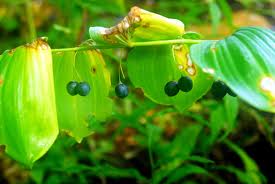
  The roots should be dug up in autumn when the above parts of the plant are dying and the berries are ripe. (These are very poisonous.)
   Clinical trials have been carried out, but very few, however some seem to show that the plant may be helpful in treating both diabetes and cancer, although the trials have only so far been conducted on animals in the lab.
  Solomon’s seal is also known as Lady’s Seal and the old herbalists called it Sigillum Sanctae Mariae or Saint Mary’s Seal. There are several Latin names for different plants which all go under the general name of Solomon’s seal, Polygonatum multiflorum, P biflorum, P. giganteum, P.canaliculatum, P. commutatum are among these names. Polygonatum means many-angled and refers to the root system of the plant.
  A tisane is made with one ounce of the chopped root to one pint of boiling water. Allow this to steep for 15 minutes and drink it for stomach cramps. It is also supposed to be good for the kidneys and was given for TB. The flowers and roots were used in love potions in the Middle Ages and Renaissance. This is not recommended these days, however, try dark chocolate instead!


LUPINS HAVE SO MANY POSSIBILITIES: HISTORY, USES AND HEALTH BENEFITS OF LUPINS

LUPINS, LUPINUS GENUS
Lupins, like hollyhocks can be found in many quintessential English gardens. It is believed that the white lupin, Lupinus albus originated in Greece, and spread from there to ancient Egypt and Rome. Whatever the case, lupins, or lupines as they are spelled in American English, have been cultivated around the world for between 3 and 4 thousand years, both for animal fodder and human food. They usually grow to heights of 2 to 3 feet but can grow up to 6 feet tall. They belong to the Fabaceae or Leguminoceae family of plants so are related to the green bean, pea, indigo, the pongam tree and the Monkey Pod tree, carob and the Butterfly pea, to name but a few.
  The word lupin comes from the Latin meaning wolf (lupus) as it was believed that the lupins stole fertile land which could have been used for other crops just as a wolf stole sheep from a shepherd. We now know that they are nitrogen fixers and actually increase the fertility of poor soil. Frederick the Great of Prussia seemed aware of this fact when, in 1781 he took large quantities of lupins from the Mediterranean and transplanted them in northern Germany to improve the fertility of the soil. By the 1860s there were lupins along the Baltic coastal plains and the soil was much improved.
  The Germans have been proponents of the lupin for centuries and in 1917 a German scientist, Doctor Thomas held a Lupin Fest or banquet in Hamburg for those with an interest in botany. The feast consisted of Lupin soup, Lupin beefsteak cooked in lupin oil and seasoned with extract of lupin, with bread made from 20 % lupin flour, lupin margarine to put on the bread, lupin cheese made from lupin albumen and all this was washed down after the meal with a lupin liqueur, and lupin coffee. If someone who attended the feast felt like writing a letter, then there was paper and envelopes (with lupin adhesive) made from the fibre of lupin stems and the whole meal was served on a tablecloth which- you’ve guessed it- was made of lupin fibres. They could also wash their hands after the meal with lupin soap.                                                                                      
  After such a tour de force interest was renewed in the lupin’s possibilities, and a less bitter type of lupin was developed for human consumption during the 1920s.
  On 3rd January, 2011, it was reported in news.softpedia that a German scientist, Dr. Peter Eisner of the Fraunhofer Institute for Process Engineering and Packaging IVV in Freising, Germany, had suggested that the lupin could be the answer to both the health of the environment and the Earth’s population, as it contained protein which was gluten-free and also lactose free so could be used in the preparation of ice-cream and cheese. He went even further when he pointed out that the protein content of lupin seeds or beans could be put to use as a meat substitute in the German wűrst (sausage). This would provide a low-fat cholesterol free sausage as the lupin bean or seed is full of healthy polyunsaturated fats and a source of Omega-3 and -6 fatty acids.
  Writing in his Natural History in the first century BC Pliny the Elder wrote: - “No kind of food is more wholesome and light in digestion than the White lupin, (Lupinus albus) when eaten dry. If taken commonly at meals, it will contribute a fresh colour and a cheerful countenance.” Lupin seeds were sold on street corners in ancient Rome as snacks with sunflower seeds. They were also used as props in Roman tragedies and comedies, substituting for money, so were known as a mere trifle. This use was also known in Mediaeval England as they were, according to Dr. Fernie, writing in his Herbal Simples in 1897 called “tristis lupinus” meaning the sad lupins by Virgil. That being said this epithet attached to them by Virgil, probably had nothing to do with them being regarded as no money at all, but was more likely to have been a reference to the fact that in ancient Greece pilgrims visiting the Oracle of the Dead on the banks of the river Acheron ate copious amounts of lupin seeds as it was believed that they would facilitate communication with the departed whom they wished to contact. In the ancient world, lupins were thought to aid communication with spirits in the afterlife.                                            
  It has been found that lupin seeds provide one of the best sources of the amino acid, arginine, which is believed to help the health of blood vessels and to reduce high blood pressure. It should therefore help men with erectile dysfunctions. They are a useful source of β-carotene as their colour asserts. They have antioxidant properties too and so are under scrutiny by scientists.
  In the Mediterranean areas of Italy, Greece and Portugal, you can buy lupin seeds which have been pickled in brine like capers and olives, and these may be added to breakfast cereals for extra vitamins, minerals and protein. In the Andes, lupin flour is mixed with fresh papaya juice while in Australia and beans are sprouted like alfalfa and mung beans to produce bean sprouts.
  Lupin flour is gluten free and can be used in cooking and baking as it is in the med. It may be used to thicken sauces and soups and stews, or used as a face pack to rejuvenate tired skin. The seeds are roasted and used as a coffee substitute which is probably preferable to dandelion coffee, and you can also make them into a poultice (bruise and crack them) for ulcers. Taken internally the seeds have diuretic properties and have been used in traditional medicine systems to regulate a woman’s periods. They can also help regulate blood sugar levels and have a reputation for being able to rid the body of internal worms.
  Seeds from an Arctic lupin species (Lupinus articus) found in lemming burrows in the Yukon, Alaska, were dated to around 10,000 years old and were successfully germinated. They are not the oldest seeds to have done so, though as this record is held by the lotus seeds (Nelumbo nucifera) which germinated after lying dormant for 13,000 years.
  If you use lupin seeds fresh and pick them yourself you should soak them in several changes of water before using them in any way as they contain some toxic alkaloids and tannins which could react badly in the body. Leaching the beans and discarding the water will help. However, the pickled beans are cheap and delicious too. Roasted they can be combined with melon and watermelon seeds for a healthy snack.

MOONWORT, ONE OF THE FERNS: HISTORY, SUPERSTITIONS AND HEALTH BENEFITS OF MOONWORT


MOONWORT, BOTYRCHIUM LUNARIA
Moonwort or common moonwort is a fern which grows throughout Europe, North and South America, parts of Asia and Australia. Botyrchium lunaria is sometimes called the common moonwort to distinguish it from others in the same family of Botrychiaceae, in the order of the Ophioglossales or adder’s tongue order of plants.
 Moonwort has long been a plant associated with magic and it is said that witches used to gather it by moonlight (preferably during the full moon) and use it in their spells and during incantations. Superstition has it (in the UK and as mentioned by Nicholas Culpeper) that it could unlock locks and unshoe horses which trod on it unwittingly. This is what Culpeper has to say abut this tiny fern, which grows to a staggering 3 inches high, which is why it is so difficult to spot in long grass.                                                               
spores of moonwort
“Government and virtues. The Moon owns the herb. Moonwort is cold and drying more than adder's tongue, and is therefore held to be more available for all wounds both inward and outward. The leaves boiled in red wine, and drank, stay the immoderate flux of women's courses, and the whites. It also stays bleeding, vomiting, and other fluxes. It helps all blows and bruises, and to consolidate all fractures and dislocations. It is good for ruptures, but is chiefly used, by most with other herbs, to make oils or balsams to heal fresh or green wounds (as I said before) either inward or outward, for which it is excellently good.
Moonwort is a herb which (they say) will open locks, and unshoe such horses as tread upon it. This some laugh to scorn, and those no small fools neither; but country people, that I know, call it Unshoe the Horse. Besides I have heard commanders say, that on White Down in Devonshire, near Tiverton, there were found thirty horse shoes, pulled off from the feet of the Earl of Essex's horses, being there drawn up in a body, many of them being but newly shod, and no reason known, which caused much admiration: the herb described usually grows upon heaths.”
  In some states in North America, moonwort is an endangered species, particularly in New England, where it is on the critically endangered list in the state of Maine. It has the distinction of being the only moonwort which grows in Britain where as Culpeper reports (writing in the 17th century) it was mainly used as a vulnerary or wound healer. John Parkinson (1567-1650), who was herbalist to King Charles I of Britain, says that the plant was used by alchemists who sought to change base materials into gold.   
  Because it is so small it is difficult to spot, but it has spores, which look a little like flowers, between the months of June and August, when you are more likely to detect it. It doesn’t have fronds like the maidenhair fern or bracken, but nevertheless it is a small fern.


HONEY AND ITS HEALTH BENEFITS


                                                        HONEY
Honey is very useful in the winter months as it can help protect us from coughs, colds and flu. In Pakistan children are given a spoonful of honey in hot milk for breakfast to keep them warm as honey has “hot” properties according to Eastern medicine systems. It also boosts the immune system and helps protect us from diseases. It is a natural antibiotic too which means that we can use it if our bodies and the invading viruses and bacteria have become immune to the effects of pharmaceutical antibiotics.                                               
  Raw honey is of course the best for our health. This is honey which has not been subjected to heating at 70 º C or more so still contains all the enzymes which the bees have in their honeycombs. This is difficult to obtain unless you happen to know a beekeeper or apiarist as they are known. The darker the honey, the stronger the flavour, the lighter, the less oomph it packs, although this is not to say that it doesn’t have health benefits.
  Commercially produced honey which you get from your supermarket shelves has been processed so that it has a longer shelf-life, which means that it doesn’t crystallize as quickly as raw honey. Crystallized honey can still be used to sweeten hot drinks and in cooking and baking, so don’t throw it away.
  When honey is heated for commercial use, it loses some of the nutrients such as yeast, bioflavonoids and minerals and vitamins. However, all of them are not lost. If you want to buy “pure” honey, then you should read the label on the jar or tin very carefully and choose honey that has not been adulterated with such ingredients as molasses, corn starch and so on. The best honey is that which has been produced from one source, lavender, or thyme flowers, orange flowers etc. If the honey is raw you should be able to get the aroma of the flowers when you open the jar or tin. Some people say that you can tell if honey is pure by rubbing a little of it on the palm of your hand, and if you have a slight burning sensation it is pure. The real test, it would seem, is to drop some honey into water and if it is difficult to get it to dissolve because it forms a solid mass at the bottom of the cup, then it is pure. Commercial honey will dissolve more quickly.
  Bees make a substance called propolis which means “defence of the city” in ancient Greek, and this is made by the bees chewing the resin which exudes from buds on trees, so mixing it with their saliva to make a natural antibiotic substance which they use to seal cracks in their hives so that the hive is protected against the elements and diseases and infections. It keeps the hive healthy and warm. Propolis is rich in nutrients and may contain bees’ wings and other flecks and is also used by its creators to seal and repair the honeycombs. It consists of 50 -70 % resins, 30% wax (beeswax), 10 % etheric oils and about 5% of pollen. The bees sting invaders of the insect world to death and then embalm them in this substance. Ancient Egyptians used the process for embalming in their mummification process. Propolis is rich in nutrients which include carotene (vitamin A), B-complex vitamins B1, B2, B3 and biotin and bioflavonoids (vitamin P). It has 500 times more bioflavonoids than an orange and also contains the minerals, calcium, potassium, phosphorous and magnesium. It promotes wound healing and the regeneration of tissue, and is a natural alternative to antibiotics such as penicillin.                                                                                                
  Raw honey also shares these properties as it contains propolis, and is a rich source of antioxidants, so having just a teaspoonful of honey a day will make you less susceptible to illnesses and honey does not increase the blood sugar levels as quickly as does sugar, making it comparatively good for diabetics. It also has anti-inflammatory properties as well as anti-fungal, anti-bacterial and anti-viral ones and if that isn't enough to convince you that it is good for you, it also contains selenium, the trace element that produces the feel-good factor.                                                                                                    
  A teaspoonful of honey mixed with lemon juice and ginger root juice is an excellent remedy for coughs, colds and sore throats, etc. In the UK people also add blackcurrant juice to this for extra vitamin C and vitamins A and E.
  Our ancestors, the hunter-gatherers used honey and so did the people of ancient civilizations. They gave honey as offerings to their gods, as well as eating it themselves if they foraged for it. Otherwise, honey was only available to the wealthy as it was expensive. This was true until commercially produced honey became available with the mechanized honey extractor.
  If you can get raw honey from a beekeeper this is the best way of ensuring your honey is pure; if you can’t check the label carefully for adulterants. Some of the best honey I have eaten was from Crete, and that from Athens was very good too, believe it or not. In Greece, it is used in thick natural yoghurt topped with seasonal soft fruit such as strawberries, bananas and kiwi fruit, which makes a wonderful breakfast dish.