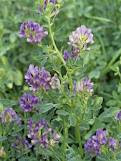
 ALFALFA, MEDICAGO SATIVA
Alfalfa is perhaps best known for the sprouted seeds which can be added to salads and soups, but this member of the Fabaceae or Leguminosae family (
pea and
bean family) has much to recommend it as long as you don’t suffer from gout or hormone-related cancer and are not pregnant or breast-feeding. It is also called
Lucerne or
Lucerne grass and has been hailed by some as a wonder supplement, although ingesting large quantities of the leaves may lead to liver problems and it may cause photosensitivity. The plant has a purple flower and is not as obvious as the
Butterfly pea to which it is related, and grows to a height of around one metre or three feet and three inches. It is valued for the fact that it can improve the soil, as can
lupins, (another relative, as the
Pongam tree,
indigo, the
Monkey Pod tree and
carob are),
and is primarily grown for animal fodder. The name
Medicago is believed to have come from Medea, as the ancients considered it to be from the country of the Medes. It is now thought to have originated in the Mediterranean region and spread from there to the rest of
Europe including into the
British Isles where it is more or less naturalized.

In 2010 alfalfa sprouts were thought to be the cause of a salmonella outbreak in the USA when six people were hospitalized after consuming contaminated sprouts, so you have to clean them thoroughly before using, or sprout your own from alfalfa seeds.
The leaves are primarily used in medicine and can be used fresh or dried. They can be made into a tisane, but it isn’t very pleasant to drink as people who have drunk this say that it tastes a lot like old socks.
A poultice can be made from the seeds, which need to be heated, and applied to the ear to stop earache, but personally I think eardrops would be better or warm
olive oil. The leaves have antioxidant properties and contain
vitamin A, some of the
B-complex ones such as B1 (thiamin), B2 (riboflavin), and B3 (niacin), vitamins C and K. The
minerals calcium, iron and phosphorous are also present, with some manganese, sodium and chlorine, along with potent
bioflavonoids which contribute to their antioxidant properties. They have a mild pain relieving action and have antibacterial properties, so it is ironic that they caused an outbreak of salmonella. The expressed juice from the leaves has been used to produce vomiting and the tisane is a mild laxative, and diuretic. The root has been used to reduce fevers and is also credited with helping urinary problems which cause highly coloured urine to be produced. The plant is prescribed when people were suffering from weakness while recovering from an illness, and for anaemia, and internal haemorrhages. The plant’s extracts have proved to have neuroprotective properties
in vitro in experiments, but it is too early to say that this would apply in humans.

While it is true that alfalfa has been used in traditional medicine systems around the world for centuries, it is sadly the case that there have been few trials carried out on this plant by people who do not have a vested interest in the sale of this plants seeds, sprouts or extracts. Certainly it is a good source of protein and has been viewed as such by many ancient people - but as animal feed not for humans primarily. However the plant is being genetically engineered so that the saponins-like substances are removed from it, so ultimately making it a better source of protein and vitamins for people. As it is if you cook the leaves and change the water once, then you should not suffer any ill-effects. It has been said that alfalfa is the world’s most foraged for plant, for human consumption, so if it were altered so that it were safer to eat this would be beneficial.

In the past and it is claimed in the present, the plant has been used to help disperse calculus which gathers around the joints causing inflammation, and the bioflavonoids in the leaves seem to have anti-bacterial properties which can help the digestive system. The oestrogenic properties of the plant mean that it may be helpful in women suffering the symptoms of the menopause and painful or irregular menstruation. The high magnesium and calcium levels present in it are believed to help to relieve migraines, and the tisane has natural laxative and diuretic properties. It is also claimed that it can lower ‘bad’ cholesterol levels in the blood and promote good cholesterol. It is also said to be effective in the removal or dispersal of kidney stones.

The plant began to be cultivated in
Britain in the 16
th century and was used for digestive ailments, and for this purpose it was taken by the early settlers to
North America, where the Native Americans used the seeds as a thickening paste to enrich the nutrient content of their dishes. In the 19
th century herbalists in the
US used this plant for a number of purposes including to stimulate milk flow in breast-feeding women, although today this group of people are particularly warned against taking alfalfa.
Probably the best use for alfalfa for humans is to put sprouts in salads and sandwiches as well as in soup.
`


 “Government and virtues. It is under the Moon. The roots of Burnet Saxifrage are hot and dry, carminative expelling wind, and are good for the colic, and weakness of the stomach; they are likewise diuretic, and useful aginst the stone and gravel, as also for the scurvy. They possess the same properties of the parsleys, but in provoking urine and easing the pains thereof, are much more effectual. The roots or seed used either in powder or decoction, help the mother, procure the courses, remove tough phlegm, and cure venom, &c. The distilled water thereof, boiled with castoreum, is good for cramps and convulsions, and the seed used in comfits (like carroway seeds) will answer the same purposes. The juice of the herb dropped into grievous wounds of the head, dries up their moistures, and heals them.”
 Nowhere did I find the lesser burnet saxifrage mentioned as being used as a wound healer.
 However it would seem that this pant, like the lesser one, can be used in a tisane made from the chopped root, dried or fresh, which can also be used to clear the skin of blemishes and rejuvenate older skin. This one is not seemingly used for culinary purposes, the lesser one being the herb of choice in the past. However in most ways it can be used as its smaller relative if you can’t find that one.


