INDIAN OR COUNTRY MALLOW, HERB WITH PAIN-KILLING PROPERTIES: HISTORY, HEALTH BENEFITS AND USES OF INDIAN MALLOW


INDIAN OR COUNTRY MALLOW, ABUTILON INDICUM 
Indian mallow has been used for centuries in traditional medicine systems and is native to the Indian subcontinent from where it has spread, becoming invasive in some Pacific islands. In ancient Sanskrit writings it is called Atibala and has been used to treat a number of illnesses including jaundice, piles, leprosy, headaches, peptic ulcers and gastro-intestinal problems as well as being used as a laxative, aphrodisiac and to increase semen production. It has the reputation of being an aphrodisiac for both genders.
   In some countries it has been cultivated as an ornamental and flowers between June and September. The seeds then ripen until November, and the pod as you can see from the picture, gives it the appearance of a seal so it is called “mudra” in some parts of India. It is a member of the Malvaceae family of plants and so is related to the common mallow and to hibiscus, durian fruit, okra and the red silk cotton tree.  Like the Evening primrose, it opens its flowers in the evening and these may be bright yellow or orange-yellow.
  In previous times the powdered plant was given to prospective brides, mixed with honey and taken once a day for six months before marriage to ensure a quick and safe pregnancy and delivery.
  The leaves are used for bladder infections and gonorrhoea as well as the ailments listed above and as a poultice for piles. It has been found that a petroleum ether extract of the plant can kill mosquito larvae which, is very useful in countries which are stricken with dengue fever such as Pakistan.
  It is said that the plant has rejuvenating properties in that it is a strong tonic for the heart and body. The roots have analgesic properties and in a study Tripathi P. et al. 2011, “Anti-inflammatory activity of Abutilon indicum extract” conclude that the extract used was comparable with the action of “standard ibuprofen” and “The results prove the traditional use of the plant in the treatment of inflammation.” More studies are needed of course to verify the claims.
  This plant has been the subject of various research studies with the leaves being tested in most of them. In The International Journal of Biological and Medical Research, 2011 Vol.2 (4) pp. 908-11 Ganga Suresh P. et al “Evaluation of wound healing activity of “abutilon indicum” Linn in wister albino rats” state “…the petroleum ether extract of “Abutilon indicum” Linn had greater wound healing activity than the ethanol extract.”
    Further studies include that of Dashputre N.L. and Naikwade N. S. 2011, International Journal of Pharmaceutical Sciences and Drug Research “Evaluation of Anti-Ulcer Activity of Methanolic Extract of Abutilon indicum Linn Leaves in Experimental Rats” conclude “the anti-ulcer properties of the extract may be attributed to the presence of phytochemicals like flavonoids (quercetin), alkaloids, and tannins present in the plant extract with various biological activities.” In other words it seems to work but more research is needed to discover how it works.
  Quercetin is found in many pants with good concentrations in red apple skins and is known to have antioxidant properties.
  Dashputre N.L.et al also published research in the International Journal of Pharmaceutical Sciences and Research in 2010, Vol. 1 (3) “ Immunomodulatory Activity of Abutilon Indicum Linn on Albino Mice” and conclude that the “aqueous and ethanolic extracts of Abutilon indicum leaves may be beneficial in the treatment of impaired immunity.”
  The plant has also shown antifungal and anti-bacterial activity although more research is needed to establish the mechanisms of how it works in the human body. However it is clearly a plant that has some excellent health benefits, which have been shown in traditional medicine systems over thousands of years.

BERGAMOT ORANGES - PRODUCERS OF BERGAMOT OIL: HISTORY, HEALTH BENEFITS AND USES OF BERGAMOT ORANGES


BERGAMOT ORANGE, CITRUS BERGAMIA
Like lemons and oranges, the bergamot orange is a member of the Rutaceae family of plants. It is though to be a hybrid of the Seville orange (bitter orange) and either citron, Citrus medica or the lemon tree, or Citrus limetta, the latter would account for its slight pear shape. It is cultivated for its essential oil found in its peel rather than to eat. It is somewhat confusing because bergamot oil is also the name given to the essential oil obtained from bee balm, Monarda didyma, a member of the mint of Labiateae family, and not related to this citrus fruit.
  It is actually a native of tropical Asia, and appeared in Italy sometime before 1700, where it is now cultivated in Reggio Calabria in southern Italy and to a lesser extent in Sicily. Some say that Christopher Columbus took it to Italy from the Canary Islands. It has been used in Italy in the regions in which it grows, at least since 1725 in folk medicine, to treat tonsillitis, sore throats, respiratory and urinary tract infections. It is also used for oral problems including halitosis and for skin. It aids wound healing too.
  If you have drunk Earl Grey tea or Lady Grey you will have experienced the taste of bergamot oranges as this is what gives Earl Grey in particular its distinctive flavour. It is also used in ice cream, liqueurs and soft drinks.
  Today it is cultivated in Greece in the Vlachata region, the Ivory Coast, Morocco and Iran, but Calabria has the biggest share of the world market. In Greece it is used as a preserve with the peel being boiled in sugar syrup; this is also eaten in Turkey and Cyprus. In Sicily it is used to make marmalade too.
  It is not known if the fruit is actually eaten, although it is nutritious. It is bitter and acidic, more so than a grapefruit, and a little like a bitter orange, which is only used in cooking not eaten raw.
  In aromatherapy the essential oil is used for depression and stress and it is used in the perfume industry although 100 oranges yield only 3 ounces of bergamot oil. This contains two types of flavonoids, flavones and flavanones with the main components being linalool and limonene.
  Research has shown that the oil has antiseptic, and antibacterial properties as well as anti-fungal and antioxidant ones. It may also protect neurons from excitotoxicity according to a report (13th September 2011) from the European Medicines Agency and research into the oil is ongoing.
  The roots are aromatic and seem to protect neighbouring plants from having their roots attacked by pests, so it is good in gardens as a companion plant. It can be found in sun creams and lotions as it has cooling properties and new research has suggested that it may be of use for sickle cell anaemia sufferers and it could also be cholesterol–lowering and so protect the heart.
  In some Scandinavian countries the peel is used in snuff and in smokeless tobacco, apparently.


SCARLET BEE BALM - VALUED FOR ESSENTIAL OIL: HEALTH BENEFITS AND USES OF BEE BALM


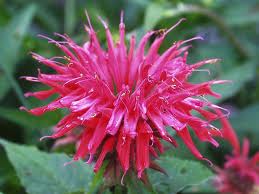
SCARLET BEE BALM, MONARDA DIDYMA 
There are several plants in the Monarda genus, but this one, didyma is the one used in tisanes for colds, flu, flatulence, menstrual problems, coughs, digestive problems and to combat loss of appetite. It is native to North America but has naturalized in parts of Europe and Asia and flourishes in Pakistan, where the petals are added to milk when butter and lhassi or ayran (a yoghurt drink) are being made. This gives both a distinctive red colour, and doubtless adds interest as well as health benefits. This particular bee balm has the highest concentration of bee balm oil in its leaves.
  This bee balm is sometimes called bergamot, but the oil it yields is not the bergamot oil from the citrus fruit the bergamot orange which is used to flavour Earl Grey tea; that is Citrus bergamia and not to be confused with this herb.
  However bee balm essential oil is used in aromatherapy to reduce stress and calm frazzled nerves. The oil is extracted from the leaves, which when dried are good with lavender in pot pourris. I always associate bee balm with lemon balm probably because in German the plant is called gold Melissa. It is actually a member of the mint family the Labiatae or Lamiaceae which includes peppermint, spearmint, thyme and oregano among other herbs.
  The Native Americans used bee balm as tea, and when the English put a tax on tea (the cause of the Boston tea party) the colonists used bee balm tea or Oswego tea instead of black tea. This was undoubtedly better for their general health as bee balm tisane or tea, prepared with 1 tablespoon of fresh leaves and flowers or 1 teaspoon of dried to one cup of boiling water, steeped for 10 minutes, assists oral hygiene and health and is also good for the health problems mentioned above as well as for mild fever and headaches.
  The plant flowers between June and September and the seeds ripen from August until October. It is best picked when the flowers are blooming and dried for later use, although you can simply harvest the leaves before the flowers bloom.
  As the tisane can stimulate menstruation it is best not used if pregnant and those with thyroid problems should also avoid it. It contains linalool and thymol which is anti-microbial, antibacterial, antifungal and antiseptic.
  The flowers are edible and can be used as garnishes for salads and fruit salad, while the leaves and young shoot tips may also be eaten either cooked or raw. If you add a couple of leaves to China tea, you will get a similar flavour to that of Earl Grey tea. The leaves can also be added as flavouring to jelly and if you put the flowers in it too it will look really attractive and guests will certainly find it a talking point.
  Native Americans used the crushed leaves in poultices to heal wounds and treat some skin problems. Today it is used in attempts to ward off shingles, chicken pox and other diseases.
  It is certainly an attractive herb for a garden and can be grown indoors too although it won’t reach the height of 150 centimetres which it can do outdoors. It has health benefits as well as being attractive and smells good too, although the flowers don’t have a perfume, this comes from the leaves.
  

DEVIL'S HORSEWHIP -PLANT WITH LOTS OF POTENTIAL: HEALTH BENEFITS AND USES OF DEVIL'S HORSEWHIP


DEVIL’S HORSEWHIP, ACHYRANTHES ASPERA 
Devil’s Horsewhip or Prickly (Chaff) Flower has been used since time immemorial in the Indian subcontinent for a number of ailments. It has edible leaves and seeds, and as the plant is an amaranth, like Elephant’s Head or Kang Kong, it can be used as a substitute for spinach which is in the same family. It has been naturalized in southern Europe and grows in East Asia through to Australia.
  The whole plant is used medicinally and is an important medicinal plant in Nepal where it is used for eye complaints including night blindness among other health problems. It is believed to be efficacious due to its triterpenoid saponins which may account for its astringent, diuretic and antispasmodic properties.
  It is widely used for stomach complaints, including diarrhoea and dysentery, as a laxative and purgative as well as an emetic, and the smoke from the burnt plant is inhaled for asthma and coughs. The powdered root and seeds are also burned and inhaled for the same purposes. The seeds taken with milk are said to be good if you want to lose weight; to reduce fat in the organs, the expressed juice of the leaves is mixed and heated in sesame oil and placed on the skin over the parts where fat needs to be removed. This is also used for many skin problems.
   The powdered seeds are mixed with powdered salt and used to whiten the teeth and stop bleeding gums. The stems of the plant may also be used as toothbrushes. With pepper and garlic the leaves, ground to a paste are made into pea sized balls and dried and given to reduce fever, while the crushed leaves mixed into an ointment with ghee are used for piles.
  The seeds may be eaten and are rich in protein, and the plant is a food crop in China. The leaf is sometimes used as a pot herb to flavour dishes.
  The plant contains betaine and achyranthine an alkaloid, along with tannin, glycosides and triterpenoid saponins (mentioned above) and yields essential oil. Scientific studies have found that the plant has anti-inflammatory, analgesic antibiotic, anti-fungal, cholesterol-lowering, immuno-stimulatory, wound healing, and anti-bacterial properties. It also is anti-allergenic, supports the kidneys’ functions, is spermicidal and anti-parasitical.  It also seems to kill mosquito larvae.
   It is used for snake bites and those of poisonous insects and bites from rabid dogs. A decoction of the powdered leaves mixed with honey or gur is given for diarrhoea and dysentery, and the roots are used in the treatment of cancer, bladder stones, and stomach problems. The seeds are used for leprosy and bronchial problems and for the kidneys, and he crushed plant boiled in water is used for pneumonia. The flowering tops or seeds are used for snake bites night blindness and ground into a paste with water for application to skin problems. The root is ground into a paste with water and applied to snake bites, or given internally to produce vomiting.
  Clearly it is a beneficial plant to grow although it is not necessary to cultivate it in the Indian subcontinent as it grows profusely on wasteland. More scientific studies are needed before the medical world accepts the usefulness of this plant, but studies so far have supported many of the traditional uses of this plant.