COSTMARY OR ALECOST - ONCE A MUCH-USED HERB IN COOKERY AND MEDICINE: HISTORY AND HEALTH BENEFITS OF COSTMARY


COSTMARY OR ALECOST, BALSAMITA VULGARIS / MAJOR 
Costmary gets its name from the oriental herb Saussuria costus or Indian orris which is an aromatic herb which Theophrastus mentions in regard to its use in perfumes in ancient Greece. Its leaves have a eucalyptus-like aroma which has been alternatively described as being rather like camphor, or like garden mint with hints of balsam. The Latin name costus comes from the Sanskrit, kustha.
  In the past it was known as Tanecetum balsamita which comes from the Greek anathasia meaning immortality which is perhaps a reference to its long-lasting odour. It is a member of the Compositae or Asteraceae family (daisy family) and is a close relative of feverfew and tansy. It is a native of Western Asia, but was commonly grown in British gardens by the 16th century because of its value as a medicinal, strewing and ale-making plant. It was also added to salads and soups so had culinary value too. The name Alecost was given to it as it was added to ale long before the arrival of hops for beer in Britain at least, as it gave ale flavour and cleared and preserved it.
  Another name for this plant was Bible leaf as it was used as a scented bookmark in colonial times in North America, as was tutsan. The smell from the leaves may have helped to prevent congregations falling asleep during lengthy sermons and chewing on the leaves was believed to temporarily at least assuage the appetite.
  It was used in mediaeval times as a strewing herb not only because of its pleasant smell which masked bad smells, but because it has insecticidal properties. Putting a bruised leaf on an insect bite or stem will help soothe the pain too.
  This semi-evergreen plant is also known as mint-geranium, balsam herb, balsam-mint and balsam-tansy. In France it is herbe Sainte-Marie, or Saint Mary’s herb, another herb of the Virgin Mary.
  It was used in medicine, and Nicholas Culpeper, writing in the 17th century in his “Complete Herbal” has this to say about its uses:-
“Government and virtues. It is under the dominion of Jupiter. The ordinary costmary, as well as maudlin, provoketh urine abundantly, and moisteneth the hardness of the mother; it gently purgeth choler and phlegm, extenuating that which is gross, and cutting that which is tough and glutinous, cleanseth that which is foul, and hindereth putrefaction and corruption; it dissolveth without attraction, openeth obstructions, and healeth their evil effects, and is a wonderful help to all sorts of dry agues. It is astringent to the stomach, and strengtheneth the liver, and all the other inward parts, and if taken in whey worketh the more effectually. Taken fasting in the morning, it is very profitable for pains of the head that are continual; and to stay, dry up, and consume, all thin rheums, or distillations from the head into the stomach, and helpeth much to digest raw humours that are gathered therein. It is very profitable for those that are fallen into a continual evil disposition of the body called cachexia, being taken, especially in the beginning of the disease. It is a good friend and helps to evil, weak, and cold livers. The seed is familiarly given to children for the worms, and so is the infusion of the flowers in white wine, given them to the quantity of two ounces at a time: it maketh an excellent salve to cleanse and heal old ulcers, being boiled with olive oil, and adder's tongue with it; and after it is strained, to put in a little wax, rosin, and turpentine, to bring it to a convenient consistence.”
  It can be made into a tisane with a quarter cup of fresh leaves with five or six whole cloves to one cup of boiling water, left to steep for five to ten minutes before straining and drinking with honey for coughs, colds, catarrh, and stomach cramps.
  Costmary leaves can be added to lemonade and other drinks for the flavour which is actually refreshing. The leaves can also be infused in boiling water and left to steep for a few hours and used in rinse water after washing clothes. Lavender can also be added to this water. The dried leaves may also be added to sleep pillows with dried rose petals, lemon balm and cloves, or to pot-pourri. The leaves are best collected when the flowers are in bloom along with the flowering tops and dried for later use. The plant flowers between July and September.
  In cookery the leaves can be added to stuffing for veal or poultry and can be chopped and used with butter to flavour peas and new potatoes in place of mint. They can be laid on the base of cake tins and cooked with fruit cake and a few- but use sparingly because of their somewhat overpowering taste- may be added to salads.
  Costmary or Alecost is an old-fashioned herb that deserves more consideration in modern times.


THE CHRISTMAS ROSE: HISTORY OF USES AS MEDICINE, NO LONGER USED


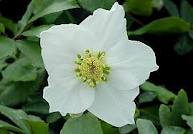
THE CHRISTMAS ROSE, BLACK HELLEBORE, HELLEBORUS NIGER 
The Christmas rose is also called the Lenten rose, as some flower in December and January while others are a little tardy and bloom in February or March the period of Lent which begins with Carnival and is a period of fasting until Easter. Black hellebore as the plant is also known, a direct translation of the Latin name of its genus, was once used in medicine as a cardio stimulant in much the same way as digitalis (from the foxglove) is. However it is highly toxic and is no longer used. It is not, as the English name suggests a member of the rose family, although the flower does resemble that of the wild dog rose, but a member of the Ranunculaceae or Crowfoot family, which means that it a relation of the buttercup, marsh marigold, black cohosh, goldenseal and the Lesser Celandine.
  It is a native of south-eastern Europe where it can be found in woods and thickets and sometimes in open grassland.  Its roots have, in the past, been used to get rid of intestinal worms, as a diuretic, emetic and to bring on women’s menstrual flow, but it was principally still used in the Middle Ages and Renaissance for melancholy and madness.
  Pliny the Elder writing in his Natural History says that
  “The fame of Melampus is well known for his skill in divination. One kind of hellebore was named after him and is called Melampodiam. Some relate, that a shepherd of the same name invented it having observed his goats to purge by eating it, and that, by giving their milk to the daughters of Proetius, he cured them of their madness.” Its fame for curing madness then goes back to ancient Greece.
  In 1621 Robert Burton’s “Anatomy of Madness” was first published, (he was an Oxford don) in which are these lines: -
  “Borage and hellebore fill two scenes
    Sovereign plants to purge the veins
    Of melancholy and cheer the heart
    Of those black fumes which make it smart.”
If you feel depressed it would be better to try borage though as hellebore is extremely toxic. The name Hellebore comes from the Greek, elein meaning to injure and bora meaning food, so it is harmful food.
  John Parkinson (1567-1650) wrote that black hellebore is
   “…good for mad and furious men, for melancholy, dull and heavie persons, and briefly for all those with blacke choler, and molested with melancholy.”
   Nicholas Culpeper writing his “Complete Herball” in the 17th century had this to say of it: -
  “Government and virtues. It is an herb of Saturn, and therefore no marvel if it has some sullen conditions with it, and would be far safer, being purified by the art of the alchymist than given raw. If any have taken any harm by taking it, the common cure is to take goat's milk. If you cannot get goat's milk, you must make a shift with such as you can get. The roots are very effectual against all melancholy diseases, especially such as are of long standing, as quartan agues and madness; it helps the falling sickness, the leprosy, both the yellow and black jaundice, the gout, sciatica, and convulsions; and this was found out by experience, that the root of that which grows wild in our country, works not so churlishly as those do which are brought from beyond sea, as being maintained by a more temperate air. The root used as a pessary, provokes the terms exceedingly; also being beaten into powder, and strewed upon foul ulcers, it consumes the dead flesh, and instantly heals them; nay, it will help gangrenes in the beginning. Twenty grains taken inwardly is a sufficient does for one time, and let that be corrected with half so much cinnamon; country people used to rowel their cattle with it. If a beast be troubled with a cough, or have taken any poison, they bore a hole through the ear, and put a piece of the root in it, this will help him in 24 hours time. Many other uses farriers put it to which I shall forbear.”
  John Gerard had no such scruples and writing a century earlier says that the “old farriers” used to “cut a slit in the dewlap and put in a bit of Beare-foot and leave it there for daies together.”
  The root that Culpeper writes about that grows in Britain is that of Stinking Hellebore, Helleborus foetidus while the other hellebore native to the British Isles is Helleborus viridis, the green hellebore.
  The leaves of the plant contain the bioflavonoid compounds of quercetin and kaempferol among others, and the plant contains protoanemoin or ranunculin which is of an acrid taste and can cause mouth ulcers and a burning sensation in the throat, eyes and mouth. The plant reputedly kills parasites such as body lice and fleas, but is dangerous to use because of its toxicity and the fact that it causes irritation to the skin.
  In the past, where the flower grew wild it was used for strewing in houses to ward off evil and witches, although it was also believed that witches used it to make themselves invisible (as bracken seeds could be used).
  There is a legend which says that the flower sprouted from a young girl’s tears as she was crying because she was too poor to buy a gift for the baby Jesus, but took the Christmas roses to him after they had sprouted.

WATER FENNEL - DON'T USE AS HOME REMEDY: HISTORICAL HEALTH BENEFITS OF WATER FENNEL


FINE-LEAVED WATER DROPWORT, OENANTHE AQUATICUM  
Fine-leaved water dropwort is more commonly known as Water Fennel in Britain, as well as, less commonly these days, Horsebane and it also has two other Latin synonyms for its genus, Phellandrium aquatica and Oenanthe phellandrium. Oenanthe means honey-wine flower in Greek, and aquatica, of the water. As its name suggests it grows in wet places and is native to Europe and western Asia.
  Water fennel is a member of the Apiaceae or Umbelliferae family of plants, making it a relative of the carrot, fennel, dill, anise, caraway, angelica, (its odour is similar to that of water fennel), cowparsley, celery and many other plants which have flower heads which are clusters or umbels of flowers, and have fine, feathery leaves. Flowers of this plant have five white petals. In the British Isles the plant flowers from July through to September.
  The leaves are poisonous to grazing cattle as it can cause paralysis, and it is said to contain myristicin which is supposedly a psychotropic substance. However the dried leaves lose this dangerous property. The oil from the fruit it produces only every alternate year contains phellandrine and is used for chronic chest infections such as bronchitis, lung problems, such as consumption, and asthma. This has expectorant properties so can clear phlegm and catarrh.
  You can easily overdose on the fruit of this plant although it is not as dangerous as the consumption of Oenanthe crocata, a close relative. The symptoms will be intoxication, vertigo and other possible narcotic effects.
  In the past the herb was used for intermittent fevers, such as malaria, and as a diaphoretic to promote sweat and so lower the temperature of the body during a fever. Externally the plant was also used to cure ulcers on the skin and internally was taken as a remedy for dyspepsia.
  The roots were sometimes pulverized and used to treat piles but if the root is ingested by accident it could prove fatal.
  This post is for information only as the plant is considered too dangerous for use and should only be used as directed by qualified (and trusted) homoeopathists.

YELLOW IRIS - RARE NOW IN UK BUT INVASIVE IN USA: HISTORY, HEALTH BENEFITS AND USES OF THE YELLOW IRIS


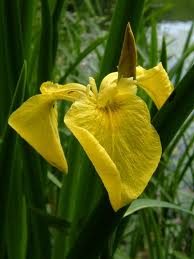
YELLOW IRIS, YELLOW FLAG, IRIS PESUDOACORUS 
The Yellow water iris or flag as it is known is no longer a resident of the reens ( a water channel flowing in this case to the sea; rhewyn or rhewin in Welsh) I used to visit when I was a child, but they can still be found growing wild in some parts of Britain. They are native to western Europe, north-west Africa and western Asia and live on river banks, close to ponds, lakes, in ditches and other wet places.
  The flowers don’t actually have a scent, although the roots when dried do, causing John Parkinson (1567-1650) to write that they were good powdered and used to wash “hand-gloves” and other items of clothing as well as the powder being good in clothes and cloth that was stored, to make them smell sweet.
  The roots are fairly acrid to taste but on drying lose this property and become astringent, so they were used dried for diarrhoea among other things.
  The flowers are symbols of the old French kings and appeared on their shields as fleur de Luce (light) or Lys and as such they are also symbols of the Prince of Wales.
  The name Pseudacorus was given to this plant because the sword-like leaves are similar to those of the sweet flag, Acorus calamus, although they are not related and when the flowers bloom, they actually don’t look at all alike. As members of the Iridaceae family of plants they are actually related to the crocus from which we get saffron, Crocus sativa.
  In Chaucer’s time they were known as “Gladyne” probably because they made the eyes happy when they saw them, with their bright yellow colour which is similar to that of daffodils. In some British dialects they are called “segg(s)” which was the Anglo-Saxon name for a small sword, because of the shape of their leaves. For the same reason in other parts of the British Isles they are called Jacob’s sword.
  John Gerard, the 16th century English herbalist recommended their use as a cosmetic thus:-
“The root, boiled soft, with a few drops of rosewater upon it, laid plaisterwise upon the face of man or woman, doth in two daies at the most take away the blacknesse and blewnesse of any stroke or bruise…”
However he goes on to add a note of caution to anyone who uses them, writing that if the skin is sensitive:-
“…it shall be needful that ye lay a piece of silke, sindall or a piece of fine lawne betweene the plaister and the skinne for otherwise in such tender bodies it often causeth heat and inflammation.”
 He also recommends it for the following medicinal purpose:-
“an oil made of the roots and flowers of the Iris, made in the same way as oil of roses and lilies. It is used to rub in the sinews and joints to strengthen them, and is good for cramp.”
  Nicholas Culpeper writing his “Complete Herball” a century later has this to say of the medicinal uses of this beautiful flower:-
“Government and virtues. It is under the dominion of the Moon. The root of this Water-flag is very astringent, cooling, and drying; and thereby helps all lasks and fluxes, whether of blood or humours, as bleeding at the mouth, nose, or other parts, bloody flux, and the immoderate flux of women's courses. The distilled water of the whole herb, flowers and roots, is a sovereign good remedy for watering eyes, both to be dropped into them, and to have cloths or sponges wetted therein, and applied to the forehead. It also helps the spots and blemishes that happen in and about the eyes, or in any other parts. The said water fomented on swellings and hot inflammations of women's breasts, upon cancers also, and those spreading ulcers called Noli me tangere, do much good. It helps also foul ulcers in the privities of man or woman; but an ointment made of the flowers is better for those external applications.” (N.B “noli me tangere” in Latin means “don’t touch me”)
  Unfortunately, while the yellow iris is becoming rare in the UK, its native habitat, it is classed as an invasive species in many states in the USA where it was introduced. It is another example of a plant that damages an eco-system in which it is not native.