GUINEA HEN WEED - POSSIBLE SOURCE OF ANTI-CANCER TREATMENT: HISTORY, HEALTH BENEFITS AND USES OF GUINEA HEN WEED


GUINEA HEN WEED, ANAMU, PETIVERA ALLIACEA 
Guinea hen weed is a member of the pokeweed, Phytolacceae family of plants native to the Amazon rainforest, Central and South America, the Caribbean, parts of Africa, Florida and parts of Texas in the USA.
  In the South American continent it is used both for medicine and magic by shaman of indigenous Indian tribes. Its roots particularly have a strong garlicky odour, which is why, presumably it shares the Latin name for garlic, allium. Perhaps because of this smell it is used, as is garlic to ward off evil and witches. Shamans use it for magic too, so it is a highly regarded herb. The root, which smells more strongly than the leaves, is believed to be the most potent part of the plant in traditional medicine systems.
  In Cuba herbalists use the plant to treat both diabetes and cancer tumours, although the Indians mainly use it for its efficacy to remedy coughs, colds and flu. For these ailments an infusion is made from the leaves or roots of anamu.  The Caribs in Guatemala use the crushed root for relieving sinusitis, while in Peru it is used to relieve pain from stings and rashes and other skin problems. The leaves are pulverized into a paste which is applied on the skin to relieve headaches, rheumatic pains and other pain as well as to kill insects.
  In Brazil the plant is used as an antispasmodic, diuretic, to stimulate menstruation, to promote sweating in fevers, for oedema, arthritis, malaria, rheumatism and many other complaints.
  A leaf decoction is used for digestive tract problems such as flatulence and the plant which has so many uses, including as an abortifacient, an analgesic to relieve labour pains, to support the immune system, for lung and respiratory problems and even, it is rumoured, as an aphrodisiac.
  The plant can grow to around a metre high, and has dark green leathery leaves which are close to the ground; the mall white flowers grow on a tall spiky stem and all the plant smells of garlic which is why it also has the name garlic weed. It is also known as tipi, pipi, mucara and a host of other names.
  Because of its uses in traditional medicine it has come to the attention of scientists, who have endeavoured to prove its efficacy for the treatment of cancer and diabetes. However the results have so far been inconclusive, with the best results only in in vitro experiments. It has been shown to have analgesic (mild pain-killing) effects, and to have antimicrobial, antifungal and antiviral properties. One article “A fraction from Petivera alliacea induces apoptosis via mitochondria-dependent pathway and regulates HSP70 expression” (Universitas Scientarum Vol.14 (2-3) May-Dec 2009, pp 125-134, Maria Claudia Cifuentes et al. Pontificio Universidad Javieriana, Colombia) found that it has anticancer properties and can inhibit the growth of cancerous cells and kill them. Other studies have also indicated these properties, but they have been limited.
  A screening of 1,400 plants undertaken at the University of Illinois found that Guinea hen weed was one of thirty–four plants to have phytochemicals that can kill cancer.
  Extracts of the plant have also shown anti-inflammatory actions, but there is still some speculation regarding which chemicals in the plant are responsible for all its actions. Research is ongoing and hopefully it will provide some new treatments for the diseases we suffer from.
  

EARLY PURPLE ORCHID: HISTORY, HEALTH BENEFITS AND USES OF EARLY PURPLE ORCHID


EARLY PURPLE ORCHID, ORCHIS MASCULA 
The early purple orchid is native to Europe including the British Isles, North-West Africa, the Middle East and western and northern Asia. It is one of the Orchidaceae family from which the drink salep is made. This is a starchy drink made from the dried and powdered tuber of a number of orchid types, but this one grows in Britain, where it was used in salep shops in London in the 17th century and later.
  There are two similar orchids which are native to the British Isles, this one, Orchis mascula, which flowers between mid-April and mid-June and Orchis maculata. The latter flowers later in June and July, and has reddish spots, (which gives rise to the common name for this the spotted orchid) with a tuber which is in two or three parts, earning it the title Dead Men’s Fingers. This one gets a mention in Shakespeare’s Hamlet when Gertrude the queen and Hamlet’s mother sees the dead Ophelia with them on her robe:-
 “Of crow-flowers, nettles, daisies, and long purples
That liberal shepherds give a grosser name,
But our cold maids do dead men's fingers call them…” (Act 4, scene 7)
(Crow-flowers were the name of buttercups.)
  In Ayurvedic medicine this Orchis mascula, the Early Purple orchid is used not only for the root’s nutritious farinaceous properties, but also it is used as an aphrodisiac. The powdered root can be made into a kind of gel which is also used for gastro-intestinal problems as it is mucilaginous and useful for diarrhoea.  Its nutritional qualities make this an ideal food for invalids who are convalescing as well as for children.
  It has been used as a substitute for arrowroot and has similar qualities. Salep, being a warming winter drink is substituted for coffee in countries which do not have a coffee-drinking tradition.
  One part salep powder to fifty parts of water makes the gel for internal use. The root should be harvested after the seeds have fallen and well after it has flowered. It contains the minerals potassium and calcium among others and research carried out by Aziz, N. et al, has shown that it is antihypertensive, so can lower blood pressure, is anti-dyslipidemic, so can control fats and cholesterol from building up in the body, and it also helps regulate the single layer of cells which line the organs and cavities of the heart. This one piece of research was published in Hypertension Research, Vol. 32 (11) pp 997-1003 in 2009, “Antihypertensive, antidyslipidemic and endothelial modulating effects of Orchis mascula.” The paper concludes “…further studies are required to identify the active constituents of this plant.”
  Nicholas Culpeper writing in the 17th century had this to say of the plant and Orchis maculata: -
“Government and virtues. They are hot and moist in operation, under the dominion of Dame Venus, and provoke lust exceedingly, which, they say, the dried and withered roots do restrain. They are held to kill worms in children; as also, being bruised and applied to the place, to heal the king's evil.”
The “dried and withered roots” were supposed to stop lust and any unlawful sex. The name Orchis comes from the name of the son of a nymph and a satyr who insulted (possible raped) a priestess of Bacchus; for his crime he was turned into an orchid. The fresh roots were used to promote true love in witches’ potions. Dioscorides writing in 79 AD records that eating the tubers could determine the sex of a couple’s unborn baby.
  Whatever the case, they are pretty plants, although their smell doesn’t match their appearance as they have an unpleasant odour during the evening, although some are odourless. Best stay downwind of these flowers! Follow the link for our recipe for salep.

STINKING HELLEBORE, ATTRACTIVE, IF SMELLY: HISTORY OF USES AND HEALTH BENEFITS OF STINKING HELLEBORE


STINKING HELLEBORE, BEAR’S FOOT, HELLEBORUS FOETIDUS
This stinking hellebore is a native of the British Isles and western and Central Europe and is so named because of the unpleasant odour it emits from its leaves if they are bruised. It is semi-evergreen and flowers in winter from December through to April and is distinctive in woodland with its erect stem which can grow to around 60 centimetres and even a metre after a few years, and its bell-shaped green flowers with their purple-tinged petals. Its other names are Ox heel and Stinkwort. One plant will have perhaps hundreds of single flowers during its blooming period, so it is well-liked by gardeners because it gives colour to a garden in winter.
 Like its relative the Christmas or Lenten rose (Helleborus niger) it has been used medicinally with elderly heart patients because it has an action similar to that of digitalis from the foxglove. However it is now only used in homeopathic medicine as a remedy for problems of the spleen, rectum and sciatic nerve. The whole plant is poisonous and the toxins can be absorbed through the pores of the skin, so it is best avoided or wear gloves when handling it.
  It is a member of the Ranunculaceae family so is related to buttercups, marsh marigolds, black cohosh, goldenseal and the Lesser Celandine.
  It has been used traditionally to lower high blood pressure, as it contains the alkaloids, nervine, pseudo-nervine and veritridine, which are found in the root, harvested in the autumn and dried for later use. It has similar properties to the Christmas rose. Dioscorides used Hellebore for skin problems and the juice was suggested as being a cure for deafness if dropped into the ears, although it would be very unwise to try this.
  It should be remembered that the old apothecaries knew what dosages were safe, while we as laypersons don’t, and they probably knew through trial and error which meant some fatalities.
  Hellebore is mentioned in Chaucer’s “Canterbury Tales” in the Nun’s Priest’s Tale:-
 “A day or two ye shul have digestyves
 Of wormes, er ye take youre laxatyves
 Of lawriol, centaure, and fumetere,
 Or elles of ellebor, that groweth there,”
 Hellebore was used as a laxative and to get rid of intestinal worms in the Middle Ages, but it is a drastic purgative (even more so than jamalgota) and not to be tried. In this quotation Chaucer refers to the herbs that were used in his time (14th century) for these properties, namely:-laurel (the bay leaf tree), centaury, fumitory and this hellebore (ellebor).
  The root is violently narcotic and despite this was used to regulate a woman’s periods, as a purgative, diuretic, for nervous problems and hysteria and a local irritant – which means that people used it as the Roman soldiers in Britain reportedly used nettles, to escape from one pain to another.
  It is becoming rare in Britain, but despite its harmful properties, it makes an attractive ornamental plant.

TANSY: HEALTH BENEFITS AND USES OF TANSY AND TANSY TISANE RECIPE


TANSY, TANECETUM VULGARE  
Tansy is native to Europe including the British Isles and has become naturalized in North America where it has become and invasive species in some states. It has been used medicinally for centuries as have its close relatives, feverfew and costmary or alecost.
  It is believed that the name Tanacetum (from athanasia in Greek meaning immortal) refers to either that in legends it was given to Ganymede to make him immortal or because it was used to preserve corpses and prevent from rapidly decaying, or because its odour is long-lasting and was used in perfumes in the ancient world.
  It can grow to around a metre high and is quite a distinctive plant when in flower as it has yellow flowers which are long-lasting. It was used as a strewing herb both for its smell and for the fact that it repels insects especially when mixed with elder leaves (Sambuccus nigra). It belongs to the daisy family of plants the Asteraceae family so is also related to chamomile.
 Young tansy leaves and eggs were once used to make tansy cakes, which were eaten at Easter time as they were believed to purify the bodies’ humours after fasting during Lent. Later they became symbols of the bitter herbs such as horehound which were used during the Jewish Passover meal. The plant was used for fevers and hysterical and nervous disorders and such remedies must have been safer than those which employed Stinking Hellebore or the Christmas rose (Helleborus niger). In cookery it was used as a substitute for the more expensive spices, nutmeg and cinnamon, although I doubt it had the same results!
  The plant and its essential oil can be used - but in small quantities only as it is considered poisonous in large doses, for flatulence and spasms. In some oil from tansy plants thujone is present although it is not present in oil from all tansy plants. The roots were at one time made into conserves with honey or sugar and given for gout. In Scotland the dried flowers and seeds were used for this complaint. The green leaves can be pulverized and used as a poultice for swellings and to relieve pain and the bruised leaves can be applied to skin problems to bring relief.
  Clearly it was in favour as a medicinal herb in the Middle Ages and in the 17th century as Culpeper writing then in his Complete herbal waxes lyrical on common tansy which he distinguishes from “garden tansy”.
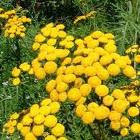
 “Government and virtues. This herb is undoubtedly under the government of Venus. It is an agreeable bitter, a carminative, and a destroyer of worms, for which case a powder of the flowers should be given from six to twelve grains at night and mornings. Worms are often the cause of putrid fevers and epileptic fits, and sometimes bring on a consumption. The medicines usually administered against these are often ineffectual, and many of them very mischievous. Hellebore has brought on convulsions; and ever one knows the danger of mercurials. Besides, it is from these deleterious compounds that half the defective teeth in young people are owing. The flowers are the part to be used, and they should be given in powder, but there requires care in the collecting of them, to obtain all their virtue. Clip off a quantity of Tansy flowers, before they are over blown, close to the stalk. This must be done in the middle of a dry day; spread them on the bottom of a hair sieve turned upside down; shake them often about, and let the wind pass through them, but keep them from the sun, and thus you may have them always. The leaves only are used, and are accounted restringent and vulnerary, good to stop all kind of fluxes and preternatural evacuations, to dissolve coagulated blood, to help those who are bruised by falls: outwardly it is used as a cosmetic, to take off freckles, sun-burn, and morphew; as also in restringent gargarisms. The powder of the herb taken in some of the distilled water, helps the whites in women, but more especially if a little coral and ivory in powder be put to it. It is also commended to help children that are bursten, and have a rupture, being boiled in water and salt. Being boiled in water and drank, it eases the griping pains of the bowels, and is good for the sciatica and joint-aches. The same boiled in vinegar, with honey and alum, and gargled in the mouth, eases the pains of the tooth-ach, fastens loose teeth, helps the gums that are sore, settles the palate of the mouth in its place, when it is fallen down. It cleanses and heals ulcers in the mouth or secret parts, and is very good for inward wounds, and to close the tips of green wounds, and to heal old, moist, and corrupt running sores in the legs or elsewhere. Being bruised and applied to the soles of the feet and handwrists, it wonderfully cools the hot fits of agues, be they never so violent. The distilled water cleanses the skin of all discolourings therein, as morphew, sun-burnings, &c. as also pimples, freckles, and the like; and dropped into the eyes, or cloths wet therein and applied, takes away the heat and inflammations in them.”
   In more recent medicine it has been found that tansy possesses potent antioxidant properties, probably due to the phenolic compounds and flavonoids in the plant. It has also been the subject of research as an antiviral herb and it may be a treatment for the herpes simplex virus. (Wiley - Blackwell (2011, February 22). Old folk remedy revived: How tansy may be a treatment for herpes. ScienceDaily. Retrieved January 28, 2012)
  The tisane below may be used for colds, stomach pains, cramps, and also it has been used in the past to get rid of children’s intestinal worms, especially effective when combined with wormwood. However that was probably a stronger infusion than the one here. For a stomach ache you can combine tansy with chamomile too.
  The young leaves of tansy yield a green dye while a combination of leaves and flowers produce a yellow one. For medicinal use the leaves and flowers should be collected when the plant is in flower during June through to September, and then dried for later use. The flowers were used to flavour Chartreuse.


TANSY TISANE
Ingredients
1 tsp dried herb, leaves only or leaves and flowers OR
1 tbsp fresh herb
1 cup boiling water
a little honey to taste

Method
Pour the boiling water over the herb and leave to steep for 10 minutes.
Strain, flavour with honey and drink twice a day only for colds and stomach cramps.
This has Taste and is a Treat(ment).