FINGERROOT OR CHINESE GINGER - USED FOR MEDICINAL AND CULINARY PURPOSES: HEALTH BENEFITS AND USES OF FINGERROOT


FINGERROOT, KRA CHAI, BOESENBERGIA ROTUNDA
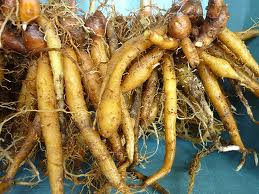
Fingerroot is used in China only for its medicinal properties, whereas in Thailand it is cultivated for culinary and medicinal purposes. It is a member of the Zingiberaceae family so is related to ginger, zedoary (kachur) or white turmeric (Curcuma zedoaria), turmeric, and kulanjan (Alpinia galangal). It is also known as Chinese ginger, or Chinese keys, as the rhizome resembles keys on a key ring, with a globe at the top of the key-like roots or fingers which extrude from it.
  It is also known as Curcuma rotunda, Gastrochilus rotundus and Boesenbergia pandurata. It has a spicy flavour and is eaten in Thailand as a vegetable and used as a spice. The plant can grow to 60 centimetres high and is located in its wild state in dense forests. However it is cultivated throughout south-east Asia and has naturalized in many countries. The leaves are edible as is the root and rhizome, and medicinally it has been employed for many purposes in traditional medicine systems in India, Malaysia, Indonesia and other countries. Its leaves are used with those of the teak tree (Tectona grandis) to wrap tempeh in. (Tempeh is the traditional fermented soya bean cake which is eaten in Indonesia.)
  In the West this plant is grown as an ornamental as it has attractive pink flowers and is aromatic. The finger-like roots are bright yellow and their aroma comes from the camphor, methyl cinnamate, d-borneol and 1-8 cineol mainly although there are also other aromatic substances in them.
  The crushed roots and rhizomes are applied to painful parts of the body to ease rheumatic pains, and they are used internally to dispel flatulence, improve the appetite and digestion, as a remedy for dry mouths, coughs and ulcers. After giving birth a post-partum tonic is prepared from them and a paste may also be made from the roots and applied externally to the body after childbirth. The paste is also applied to piles and a lotion made from them is used for rheumatism, and muscle pains. They are also used for diarrhoea and dysentery.
  In Thailand they are used to increase male libido and are touted as being able to increase sperm and improve its quality. Tests carried out in vivo on male rats did not bear out these uses, but the rats’ testicles did increase in weight and size.
  Scientific evidence suggests that the roots may have anticancer properties, and research is still underway on these properties. They are also believed to have analgesic (mild pain relieving) properties, as well as antibacterial, antifungal, antipyretic, anti-inflammatory, antispasmodic and insecticidal properties.
  There have been investigations which suggest that the flavonoids in the roots can prevent an occurrence of dengue fever (Biorganic and Medicinal Chemistry Letters Vol. 16 (12) June 2006 pp.3337-40).
  Its anti-ulcerogenic properties have also been tested and found to be supported (“The methanolic extract of Boesenbergia rotunda (L) Mansf. and its major compound pinostrobin induces anti-ulcerogenic property in vivo: Possible involvement of indirect antioxidant action”, Siddiq I. Abdelwahab et al. Journal of Ethnopharmacology, July 2011).
  Its anti-cancer properties were documented in a study by Chandra Kirana et al in the Journal of Natural Medicine Vol. 61 (2007) pp. 131-137 “Anticancer properties of panduratin A isolated from Boesenbergia pandurata (Zingiberaceae)” which concluded with the statement that this “may have a protective effect against colon cancer” but it needed further investigation for this claim and to ascertain if it was effective against other types of cancer cells particularly those of breast cancer.
  In 2011 Shiau-Chuen Cheah et al showed that the tests were valid in an article “Panduratin A Inhibits the Growth of A 549 Cells through Induction of Apoptosis and Inhibition of NF-KappaB Translocation” published in Molecules, 2011 Vol.16 pp.2583-2598.
  Research is still continuing into this Chinese medicinal herb.

WHITE DEAD NETTLES- ONE OF THE OLD ARCHANGELS: HISTORY, USES AND HEALTH BENEFITS OF WHITE DEAD NETTLES


WHITE DEAD NETTLES, LAMIUM ALBUM 
White dead nettles are so-called because although they resemble the stinging nettle very closely, they don’t sting. They are not true nettles in the Uriotica genus, but a separate genus in the Lamiaceae or Labiatae family. This makes them relatives of mint, clown's woundwort, marjoram, basil, Holy basil, oregano, savory, thyme, lavender, lemon balm, as well as bugle, motherwort, self-heal, catnip, the chaste tree, ground ivy, Jupiter’s sage, wall germander, Fragrant premna and hyssop. In Nicholas Culpeper’s time (17th century) they were classes as one of the Archangels along with the purple and the yellow deadnettle.
   This white dead nettle is also called the Bee Nettle because bees love it. Their stems are hollow and square, unlike those of the stinging nettle, and were called Archangels because they thought they flowered on Archangel Michael’s day which was May 8th in the Julian calendar but would be April 28th now. “Laimos” is an ancient Greek word meaning throat, which refers to the shape of the flowers – take a close look at the pictures to see the resemblance. The plant has astringent properties and edible leaves and flowers. The leaves can be eaten raw in salads or cooked like spinach. They can also be used to flavour soups and stews. You can make a tisane with the flowering tops which is said to be an excellent tonic (containing vitamin A) and which acts as a blood purifier and to help with menstrual problems.
  The leaves and flowers are used in a hot compress for piles and varicose veins, while the distilled water of the flowers has been used traditionally as an eye lotion. The flowering tops have been used for bladder and kidney problems too. The herb is best harvested in summer when it is flowering and it does so between May to December, although may come into bloom earlier, depending on where you live.
  It has been used to induce sleep, and the flowers boiled in water were used for bronchial problems while the roots, boiled in wine were used to disperse kidney stones. They are currently used for benign prostate hyperplasia (BPH) and leucorrhoea as well as for gastro-intestinal problems.
  The English herbalist, Nicholas Culpeper, has this to say of the Archangels:
“Virtues and use. The archangels are somewhat hot and drier than the stinging nettles, and used with better success for the stopping and hardness of the spleen than they, by using the decoction of the herb in wine, and afterwards applying the herb hot into the region of the spleen as a plaister, or the decoction with spunges. Flowers of the white archangel are preserved or conserved to be used to stay the whites, and the flowers of the red to stay the reds in women. It makes the head merry, drives away melancholy, quickens the spirits, is good against quartan agues, stancheth bleeding at mouth and nose, if it be stamped and applied to the nape of the neck; the herb also bruised, and with some salt and vinegar, and hog-grease, laid upon an hard tumour or swelling, or that vulgarly called the king's evil, do help to dissolve or discuss them; and being in like manner applied, doth much allay the pains, and give ease to the gout, sciatica, and other pains of the joints and sinews. It is also very effectual to heal green wounds, and old ulcers; also to stay their fretting, gnawing and spreading. It draweth forth splinters, and such like things gotten into the flesh, and is very good against bruises and burnings. But the yellow archangel is most commended for old, filthy, corrupt sores and ulcers, yea, although they grow to be hollow, and to dissolve tumours.”
  It has been found that the aqueous extract of the flowering tops and the lamiridosins of the white dead nettle is effective against the Hepatitis C virus, and there are ongoing studies into its possible other medicinal benefits.

STAR GRASS OR TRUE UNICORN ROOT: HEALTH BENEFITS AND USES OF STAR GRASS


TRUE UNICORN ROOT, STAR GRASS, ALETRIS FARINOSA 
Star grass is a member of the Liliaceae family which includes the Tiger lily and the tulip. It should not be confused with the false unicorn root which is Helorias luteum or Chaemaelinum luteum which has different properties to this, Aletris farinosa. This is a native of North America and gets its name Aletris from the name of a slave girl in ancient Greece who was a grinder of corn, and farinosa means flour or meal, which is said to relate to the flower’s mealy appearance after it has passed maturity.
  Jacob Bigelow writing in 1820 in his American Medical Botany said of Star Grass, “I know of no plant which surpasses the Aletris farinosa in genuine, intense and permanent bitterness.” However he goes on to say that “in a collection of American medicinal vegetables it should not pass unnoticed.”
  It has potential oestrogenic properties and this supports its principle uses in traditional medicine systems both in North America and across the Atlantic. It has been used for female problems, for prolapsed uterus and other problems and was given to prevent miscarriages for women who had a history of them so that it could strengthen the womb before conception. It was also used for menstrual problems and so should not be used by pregnant women.
  The Native Americans in the Carolinas used the root in a tisane for diarrhoea and in Appalachia an infusion was used as a tonic, for general weakness, for rheumatism and a sedative.
  It is known by several other names such as Ague root, Aloeroot (referring no doubt to its bitterness), Starwort and a variety of other names. The white bell-shaped flowers bloom between May and August and the stem on which they grow can reach heights of a metre or so. The fresh root if used can have unpleasant side effects such as nausea and vomiting, and is thought to be narcotic in large doses, but these properties appear not to be prevalent when the root is dried.
  The plant is now rare in its native habitat and is protected so you shouldn’t attempt to dig it up. Interestingly, despite its taste, which has been described as soapy and very bitter, it has been cooked and eaten as a vegetable in the past.
  The root contains diosgenin which has anti-inflammatory, oestrogenic properties which may account for its use for the treatment of rheumatism when it is dried. An infusion of the leaves has been used for colic and upset stomachs as well as for dysentery, but there are other remedies for these, so there is no need to take chances with this bitter plant.

TROPICAL FIG TREE, FICUS SEPTICA: HEALTH BENEFITS AND USES OF AWAR-AWAR OR HAULI


FIG TREE, AWAR-AWAR, HAULI, FICUS SEPTICA  
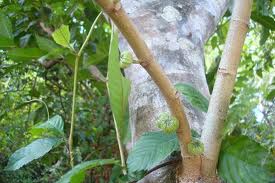
This fig tree grows in the tropics, from Northern India and Pakistan through south and southeast Asia to Queensland, Australia. It is an evergreen inhabitant of rainforests, and called awar-awar in Indonesia and Hauli in the Philippines. Like other fig trees it bears figs, but does not have drooping leaves like Ficus religiosa, the sacred fig or peepal, or leaves like the larger one of the European fig, (Ficus carica), but is more like the Punjab fig, Ficus palmata, and is also related to the banyan tree, Ficus bengalhensis and others. It is one of the Moraceae family of plants so is also related to the mulberry, and shahtoot mulberry, as well as to the Jackfruit.                                                
  It is a small tree or a shrub which can grow to heights of 25 metres. White or yellowy dots appear on the skin of the figs when they are ripe. The latex from the tree is usually yellow and this is used in traditional medicine in the Philippines for some herpes viruses.
  A decoction is made from the roots of this fig tree which is used as a diuretic, while the roots are boiled or heated and used as a poultice for boils and other skin eruptions. The fresh leaves are used to promote sweating during fevers, and are also used to get rid of headaches. They are also laid on places where rheumatic pains are.
  Medical research has found that the stem bark is active against tumour cells and leaf extracts have antimicrobial and cytotoxicity actions. This evidence is published in the Journal of Medicinal Plants Research, Vol.4, January 2010, “Antimicrobial activity, cytotoxicity and phytochemical screening of Ficus septica Burm. and Sterculia foetida L. leaf extracts” Pierangeli G. Vital et al. which concludes that extracts from the leaves have “potential to be developed as an anticancer agent in breast cancer.”
  In another report, “Ethanolic extract fractions of Indonesian plant Ficus septica Burm. F. on human breast cancer T47D cell lines” Agung Endro Nugroho et al. International Journal of Phytomedicine Vol3 2011 pp216-226 in which cytotoxicity is reported in alkaloids from the roots.
  More research is clearly needed to discover exactly how the extracts from this particular fig tree can help in our fight against cancer.