WATER PEPPER - CULPEPER'S HOT ARSSMART: HISTORY, USES AND HEALTH BENEFITS OF WATER PEPPER


WATER PEPPER, MARSHPEPPER, SMARTWEED, HOT ARSSMART, POLYGONUM HYDROPIPER
Water pepper is Culpeper’s hot arssmart and the seeds of this plant are said to taste similar to Sichuan pepper. It is another member of the Polygonaceae family along with its close relatives, Lady’s Thumb (mild arssmart), bistort, water smartweed, and also to buckwheat, sorrel, rhubarb, arrowleaf dock, common dock, red dock and yellow dock. The name water pepper comes directly from the genus name hydro meaning water and piper, pepper. Polygonum means “many jointed.”
  Water pepper is native to Europe, North Africa and North America, with a subspecies macrophyllum found in Asia. In Japan it is used in cooking; the leaves are put into soups and sauces, and the seeds made into a spicy condiment. The taste has been described as giving a biting, prickling heat and the bitter principle contained in the leaves has been identified as rutin, also found in rue, another bitter herb. The pungency probably comes from tadeol. The seeds, stems and leaves can be used cooked or raw in garnishes for salads, but they are hot, so be warned.
  Rutin is known to strengthen the capillaries, so helping to prevent bleeding.  The plant has been traditionally used in Eastern and Western folk medicine for a number of ailments including epilepsy when used with other tonics and gum myrrh, and a cold water infusion with one ounce of the herb to one pint of water mixed with plantain (isphagol) or wheat bran has been used for bowel complaints. The cold water infusion has been used to disperse gravel in the organs although it is not recommended these days for this treatment because of the oxalic acid present in some plants in the Polygonum family.
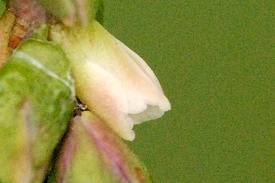
  In North America a hot decoction of water pepper was used for cholera patients, with a sheet being soaked in the decoction and then wrapped around the patient. The fomented leaves were once used in poultices for ulcers and piles. (Perhaps giving rise to the word Ars-smart!) Simmered in water or vinegar the resulting liquid was used to prevent gangrene spreading.
According to a recent Chinese study water pepper was 20th in a list of plants which could have potential as contraceptives. Other studies have found that it has antioxidant flavonoids in its leaves, and also has anti-inflammatory properties. It is also a useful astringent and styptic, so is a good wound healer and encourages damaged tissue to heal. The plant has also been used as a diuretic, for troublesome periods, and the seeds are said to be stimulants and they also help with flatulence.
 Culpeper writing in the 17th century has this to say about water pepper:-
“The hot Arssmart is called also water-peper, or culrage….that which is hot and biting, is under the dominion of Mars…
   It is of a cooling and drying quality and very effectual for putrified ulcers in man or beast, to kill worms and cleanse the putrified places. The juice thereof dropped in, or otherwise applied, consumeth all cold swellings, and dissolveth the congealed blood of bruises by strokes, falls, &c. A piece of the root, or some of the seeds bruised, and held to an aching-tooth, taketh away the pain. The leaves bruised and laid to the joint that hath a felon thereon taketh it away. The juice destroyeth worms in the ears, being dropped into them; if the hot Arssmart be strewed in a chamber, it will soon kill all the fleas; and the herb or juice of the cold Arssmart, put to a horse or other cattle's sores, will drive away the fly in the hottest time of summer; a good handful of the hot biting Arssmart put under a horse's saddle, will make him travel the better, although he were half tired before…
  The hot Arssmart groweth not so high or tall as the mild doth, but hath many leaves of the colour of peach leaves, very seldom or never spotted; in other particulars it is like the former, but may easily be known from it, if you but be pleased to break a leaf of it cross your tongue for the hot will make your tongue to smart, so will not the cold. If you see them both together, you may easily distinguish them, because the mild hath far broader leaves…”
   Doctor William Salmon, another 17th century herbalist wrote this of water pepper:-
  “It is known by manifold and large experience to be a peculiar plant against gravel and stone. The Essence causes a good digestion, it is admirable against all cold and moist diseases of the brain and nerves, etc., such as falling sickness, vertigo, lethargy, apoplexy, palsy, megrim, etc., and made into a syrup with honey it is a good pectoral. The oil dissolves and discusses all cold swellings, scrofulous and scirrhous tumours, quinsies, congealed blood, pleurisies, etc.”
  It was clearly well-used in former times, and also mentioned in the first century A.D. by Dioscorides.

KIWANO OR HORNED MELON: EDIBLE, NUTRITIOUS AND HEALTH-GIVING: HISTORY, USES AND HEALTH BENEFITS OF HORNED MELONS


HORNED MELON, KIWANO, CUCUMIS METULIFERUS
The horned melon is a native of southern Africa, and the World Health Organization hopes that it will become a more acceptable food for the people who are suffering from malnutrition in the still-developing world.
  The horned melon was taken to Australia and New Zealand in the 1930s and was renamed the kiwano because of its slight internal resemblance to the kiwi fruit, to which it is no relation. As a member of the Cucurbitaceae family it is related to the pumpkin, cucumbers, courgettes, butternut squash, bottle gourds, petha or ash gourd, melons, watermelons and marrows. It is possible that it was renamed kiwano so that the name would make it more appealing to consumers. The name Horned melon may have made it a flop in the market as happened to the soursop.
  The tribal peoples in its native countries only eat it roasted, although they use the boiled roots to treat gonorrhoea, and eat the boiled leaves as we would spinach. A decoction of the root is given to women after childbirth for pain relief, and the leaves are sometimes eaten mixed with maize or corn meal. The pounded roots are mixed with fat and used to cover the body in the belief that this will keep ghosts and evil spirits at bay.
  The seeds and pulp of the kiwano are very nutritious as the seeds contain Vitamin A in the form of carotenoids such as Beta-carotene, which promotes the health of the eyes, and skin as well as having free-radical scavenging properties and boosting the immune system. The seeds contain oleic and linoleic fatty acids too making them very good for blood pressure and overall health.
  The fruit is a good source of vitamin C, potassium and iron and also contains vitamins B1, B2 and B3, along with the minerals magnesium, phosphorous, zinc, copper, calcium and sodium. The organic vitamin E found in the fruit is a good source of free-radical scavenging antioxidants, so this fruit is good for protection against cancer and cardiovascular diseases.
  If you find one in your local supermarket treat it as you would a passion fruit. You can cut the melon in half and scoop out the seeds and blend them and the pulp to make a refreshing drink, adding lime or lemon juice and honey to enhance the flavour if you want to. You could simply scoop out the flesh and pour it over natural yoghurt or ice cream, and it is said that the seeds can taste like bananas, melon, lime, or even cucumber.
  The Latin name for this fruit, metuliferus, comes from two words, metula meaning little pyramid and ferus meaning bearing; these names refer to the spiny skin or the ‘horns’ on this melon. It is ripe when the skin is bright orange, and may be stored at room temperature for best nutrition, but can also be stored in the fridge.
  Why not try it and let us know what you think?

BISTORT, USED AS FOOD AND MEDICINE: HISTORY, USES AND HEALTH BENEFITS OF BISTORT


BISTORT, POLYGONUM BISTORTA
Bistort is a close relative of water smartweed and arssmart, and the synonym for the botanical name is Persicaria bistorta while in English it is also known as Adderwort and snakeweed, which refers to the twining nature of its roots. To the older herbalists this was known as Serpentary Dragonwort, (a truly wonderful name I think!) again because of the twining or writhing nature of its roots. It was also called Dracunculus and Serpentaria among other names. Bistorta comes from the Latin words which means twice twisted, while the genus name Polygonum is from the Greek meaning to have many joints (or knees!).
  Bistort is native to Northern Europe and Siberia through to Japan and the Himalayas. It is a member of the Polygonaceae family of plants or the buckwheat family, making it a relative of such plants as sorrel, rhubarb, arrowleaf dock, common dock, red dock and yellow dock as well as to the water pepper (Polygonum hydropiper) among others.
  Its leaves are edible and the plant has been cultivated for its medicinal properties, with the roots being particularly prized, as well as for culinary purposes. The young leaves are a bit chewy, but may be eaten raw, although they are best when cooked and eaten as you would spinach. The leaves contain vitamins A and C so were useful additions to diets in earlier times as was scurvy-grass.
  The leaves are added to a pudding traditionally eaten at Lent in northern England called Easter ledger pudding. However the roots contain starch and tannin,so when the root has been soaked well and then roasted to remove the tannin in them they are said to taste quite good. These have been used as famine food in Siberia, Iceland and doubtless other cold countries.
  In Chinese traditional medicine the bistort root has been used for epilepsy, fever, tetanus, cramps and scrofula as well as for a number of other ailments including diabetes.
  Bistort plants have been used to treat Irritable Bowel Syndrome, peptic ulcers, and excessive menstruation as well as catarrh, chronic cystitis and other illnesses.
 If you add 1 teaspoon of the powdered root to a pint of boiling water and boil this down to a half a pint, then a tablespoon every two hours is useful for diarrhoea. This decoction is also a good gargle and mouth wash for mouth ulcers as well as a vaginal douche. It makes a good lotion for pus-filled ulcers too.
  The tannin content of the root means that it has been employed in past times for tanning leather, and this also makes it a good wound healer, and stops internal and external bleeding.
  The powdered leaves were once used to get rid of children’s intestinal worms.
  Writing in the 17th century the English herbalist, Nicholas Culpeper had this to say of bistort:-
Government and virtues. It belongs to Saturn, and is an operation cold and dry; both the leaves and roots have a powerful faculty to resist all poison. The root in powder taken in drink expelleth the venom of the plague, the small pox, measels, purples, or any other infectious disease, driving it out by sweating. The root in powder, the decoction thereof in wine being drank stayeth all manner of inward bleeding, or spitting of blood, and any fluxes in the body of either man or woman, or vomiting. It is also very availing against ruptures, or bursting, or all bruises or falls, dissolving the congealed blood, and easing the pains that happen thereupon; it also helpeth the jaundice.
  The water distilled from both leaves and roots, is a singular remedy to wash any place bitten or stung by any venomous creature; as also for any of the purposes before spoken of and is very good to wash any running sores or ulcers. The decoction of the root in wine being drank, hindereth abortion or miscarriage in child-bearing. The leaves also kill the worms in children, and is a great help to them that cannot keep their water; if the juice of plaintain be added thereto, and outwardly applied, much helpeth the gonorrhea, or running of the reins. A drachm of the powder of the root taken in water thereof, wherein some red hot iron or steel hath been quenched, is also an admirable help thereto, so as the body be first prepared and purged from the offensive humours. The leaves, seed, or roots, are all very good in decoctions, drinks, or lotions, for inward or outward wounds, or other sores. And the powders strewed upon any cut or wound in a vein, stayeth the immoderate bleeding thereof. The decoction of the root in water, whereunto some pomegranate peels and flowers are added, injected into the matrix, stayeth the immoderate flux of the courses. The root thereof with pelitory of Spain, and burnt alum, of each a little quantity, beaten small and made into paste, with some honey, and a little piece thereof put into a hollow tooth, or held between the teeth, if there be no hollowness in them, stayeth the defluction of rheum upon them which cause the pains, and helps to cleanse the head, and void much offensive water. The distilled water is very effectual to wash sores or cancers in the nose, or any other parts; if the powder of the root be applied thereunto afterwards. It is good also to fasten the gums and to take away the heat and inflammations that happen in the jaws, almonds of the throat, or mouth, if the decoction of the leaves, roots, or seeds bruised, or the juice of them be applied; but the roots are most effectual to the purposes aforesaid.”                                                                       
  Modern clinical trials have found that extracts of bistort have antioxidant properties as well as reducing fever (antipyretic), and it also has antioxidant properties and anti-inflammatory ones. Once again, the old herbalists seem to have known what they were doing with plants.


KALINGAG,UNIQUE TO PHILIPPINES: HEALTH BENEFITS AND USES OF KALINGAG


KALINGAG, CINNAMOMUM MERCADOI
Kalingag is the usual name of this cinnamon tree which only grows in forests in the Philippines, from the Babuyan Islands and northern Luzon to Mindao. In the past it was used for timber as well as for medicine and this felling of these trees means that it is now on the IUCN Red list and is listed as ‘vulnerable’. The tree is small to medium sized with the trunk reaching a little more than 60 centimetres in diameter. It has small fruit after an ochre coloured flower has bloomed.
  As a member of the Lauraceae family of plants it is related to culinary cinnamon, sassafras and the bay tree. It is unusual in the cinnamon family in that its essential oil consists of large amounts of safrol, whereas other oils of cinnamon contain cinnamaldehyde. The oil of Kalingag, from the leaves and bark, smells like sassafras, and is pale yellow.
  The bark of the tree and leaves are used in traditional medicine in the Philippines, with the bark being chewed to aid digestion and cure flatulence, as an expectorant, and for stomach pains. It is soothing for the stomach and is also a stimulant with astringent, antiseptic, antifungal and antiviral properties. It has been found that cinnamaldehyde is an analgesic comparable to the actions of aspirin, and it also has antifungal and anti-diarrhoea properties, as well as having the ability to kill parasites such as head lice.
  The bark is used powdered to prevent the onset of diabetes, and a decoction of the leaves is also a remedy for flatulence. It is said that the leaf decoction also helps women with menstrual problems. A paste made from the powdered bark is applied externally to parts affected by neuralgia and to the forehead for severe headaches. It is also said to be effective against yeast infections such as candida.
  The sassafras aroma and taste means that the leaves and bark may be added to root beers to give them flavour. Kalingag is also said to help to improve loss of appetite and be both a diuretic and stop diarrhoea and dysentery as well as being useful for promoting sweat in fevers.
  Clearly this is a valuable tree for health in the Philippines, but as it has a reputation as an aphrodisiac, it may verge on the brink of extinction as men in the West seek ways of improving their erections. Sad isn’t it?