YELLOW HORNED POPPY - RESEMBLES LARGE BUTTERCUP: HISTORY, USES AND HEALTH BENEFITS OF THE YELLOW HORNED POPPY


YELLOW HORNED POPPY, GLAUCIUM FLAVUM 
The yellow horned poppy is a member of the Papavaraceae or poppy family of plants and so is related to another British wildflower, the Greater Celandine as well as to the poppies. The 16th century herbalist John Gerard (1545-1612), describes it very well so I have reprinted his description here:
 “The yellow horned poppy hath whitish leaves very much cut or jagged, somewhat like the leaves of garden Poppie, but rougher and more hairie. The stalks be long, round, and brittle. The floures be large and yellow, consisting of foure leaves; which being past, there come long huskes or cods, crooked like an horn or cornet, wherein is conteined small black seede. The roote is great, thicke, scalie, and rough, continuing long.”
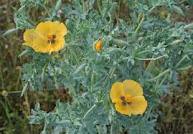
  So now you know why it is called the horned poppy- its seed pods are swollen and pointed, sometimes with horn-like pieces coming from them.
  The yellow horned poppy is a protected species under the UK’s Wildlife and Countryside Act of 1981, so please don’t pick this flower. It is believed to have the largest seed pod of any of Britain’s native plants. It can live for up to five years and only flowers in its second year of growth during the months of June to September. It lives on single banks close to the sea and has also been called the Sea poppy. Its botanical synonym is Glaucium luteum.
  It is psychoactive and there is one report from the Royal Society of 1698 of a man who mistook this plant for that of sea holly or eryngoes. He baked the root in a pie and ate it hot, whereupon he became a victim of its hallucinatory and cathartic actions and mistook the content of his chamber pot for gold!
  The plant contains a yellow latex in its stems, and the seeds are oil producing. The oil has been used for lighting purposes as it burns cleanly and has also been used in soap-making. It contains the alkaloids glaucine, protopine, chelidonine, chelerythrine and cordine as well as fumaric and chelidonic acids.
  Glaucine is known to be a good ingredient for cough medicine and it has also been investigated for its ability to inhibit the growth of cancerous cells in vitro. Studies are being carried out around the world to investigate these actions and those of the other alkaloids present in the yellow horned poppy further. It has been found to have antiviral and antibacterial properties and to be effective against coughs and to help with bronchial problems.
  Writing in the 17th century, Nicholas Culpeper had this to say about the medicinal properties of the plant:-
Virtues. Like its species, it is under the Sun in Leo; and is aperitive and cleansing, opening obstructions of the spleen and liver, and of great use in curing the jaundice and scurvy: some reckon it cordial, and a good antidote against the plague. Some quantity of it is put into aqua mirabilis. Outwardly it is used for sore eyes, to dry up the rheum, and take away specks and films, as also against tetters and ringworms, and scurfy breakings-out. The root dried and powdered, is a galsamic and sub-astringent. It is given against bloody-fluxes, and in other hæmorrhages, half a drachm for a dose.”

COMMON DUCKWEED - NOT ONLY FOR DUCKS:HISTORY, USES AND HEALTH BENEFITS OF COMMON DUCKWEED


COMMON DUCKWEED, LEMNA MINOR
The Common or lesser Duckweed is often found on garden ponds and is the bane of gardeners who don’t want to get rid of it by using chemicals. It can spread on the feet of aquatic birds and on their bills. However it does have some uses and may be a useful source of biomass and biofuel in the future. It also has some surprising health benefits.
  The ancient Welsh Physicians of Myddfai had these two remedies which include it: -
“For swelling or hardness of the stomach. Boil duckweed in goat's milk, and foment it therewith frequently…
If the bowels become so constipated that they cannot be moved, take duckweed, boiling it briskly in a pot, then cast it into a pan, and fry with a quantity of blood and butter, eating it hot.”
  William Turner (c.1508-1568) often called the “Father of English Botany” had this to say of it, calling “duckis meate” for fairly obvious reasons, I suppose.
 “Duckis meate hath a cooling nature, whereof it is good to be laid to imposthumes and gatherings of the humours that run to one place, to the wildfire and great burnings, to the gouty members both alone and also with the meal of parched barley. It glueth or bindeth, or maketh fast the bowels of young chider. Galen writeth that duckis meate is of a cold and moist temperature and in manner is both cold and moist in the second degree.”
  Nicholas Culpeper, writing in the 17th century has this to say of it:-
Government and virtues. Cancer claims the herb, and the Moon will be lady of it; a word is enough to a wise man. It is effectual to help inflammations, and St. Anthony's fire, as also the gout, either applied by itself, or in a poultice with barley-meal. The distilled water by some is highly esteemed against all inward inflammations and pestilent fevers: as also to help the redness of the eyes, and swelling of the scrotum, and of the breasts before they be grown too much. The fresh herb applied to the forehead, easeth the pains of the head-ach coming of heat.”
  It has been used as a poultice as the common mallow and marsh mallow are for inflammations and swellings.
  It has often been used as poultry food and may have some value to the food industry in the future, one Turkish study published in 2010 showed that common duckweed has antioxidant, antibacterial and anti-candidal properties ( Ilhami Gűlçin et al. Turkish Journal of Biology Vol.34 pp 175-188); this study also found flavonoids such as quercetin and phenolic compounds which have antioxidant properties.
 Kiosov P.A.(2001) in Comprehensive Catalogue of Medicinal Plants ( EKSMO-Press: Moscow), states that duckweed has been used as raw material for the production of analgesic and antipyretic remedies. It is also used in pellet form in homeopathic remedies for asthma.
 Duckweed has been classed in the Araceae family of plants, having formerly been in the Lemnaceae, so as such is the relative of Gloriosa superba or the Flame Lily, the Calla Lily, taro, the Elephant’s foot yam, cuckoo-pint and the sweet flag.
   

HORSEMINT USEFUL FOR BOWEL PROBLEMS: HISTORY, USES AND HEALTH BENEFITS OF HORSEMINT


HORSEMINT, MENTHA LONGIFOLIA 
Horsemint is a wild mint and related to garden mint and as a member of the mint family is also related to purple, yellow and white dead nettles, marsh woundwort, the teak tree, marjoram, basil, Holy basil, oregano, savory, thyme, lavender, lemon balm, Scarlet bee balm as well as bugle, motherwort, self-heal, catnip, the chaste tree, ground ivy, Jupiter’s sage, wall germander, Fragrant premna and hyssop. It is native to Europe including Britain and Siberia. The leaves are used both as a tisane and a condiment, as well as being eaten raw in salads or cooked as a flavouring for dishes, just like garden mint.
  If you plant it near cabbage or tomato plants in your garden it will keep them free of insects pests and rats and mice hate it too which is why it was once used as a strewing herb in granaries and homes.
  The leaves and flowering tops may be used in a tisane either fresh or dried, and added to green tea, really improve its flavour. The stem, leaves and flowering tops have stimulant, antispasmodic, anti-asthmatic and carminative properties, so it is a good aid to digestion, and can cure flatulence. The leaves bear an essential oil which is a good antiseptic. It is used as a food flavouring as it has a peppermint flavour.
Nicholas Culpeper the 17th century English herbalist had this to say of horsemint:-
“It is good for wind and colic in the stomach.... The juice, laid on warm, helps the King's evil or kernels in the throat.... The decoction or distilled water helps a stinking breath, proceeding from corruption of the teeth, and snuffed up the nose, purges the head. It helps the scurf or dandruff of the head used with vinegar.”
  The tisane has been used for headaches, stomach problems, and fevers, but it is not advisable to take it in large doses if pregnant. It is a good remedy for diarrhoea and on study has supported this use; “Calcium channel blocking activity of Mentha longifolia L. explains its medicinal use in diarrhoea and gut spasm” Shah, A. J. et al. Journal of Phytotherapy Research, 2010 Vol. 24 (9) pp. 1392-97. This study concludes that it showed “indirect evidence for its medicinal use in diarrhoea and spasm.”
  Other research studies have shown that it has antibacterial properties Rahmat Ali Khan et al.2011 African Journal of Pharmacy and Pharmacology Vol. 5 (12) pp. 1530-32 “Phytotoxic and antibacterial assays of crude methanolic extract of Mentha longifolia (Linn.)” Also in another study the apigenin derivatives (flavonoids) found in the plant were discovered to have antimutagenic properties; Ozlem Baris et al.   Journal of Food Science, Nov-Dec 2011 Vol76 (9).Yet another study published in 2011 found that horsemint does help symptoms of Irritable Bowel Syndrome, and it was superior to nut grass (Cyperus rotundus) in it action.(Ahmed Salih Salib et al.) Another study published in 2009 has confirmed its antimicrobial properties and so supported its use for the treatment of mouth ulcers and other oral problems. (Firas A. Al-Bayedi)
  Scientists in the West, where the use of herbal medicine had largely fallen into disuse are lagging behind those scientists in countries where herbal medicine is still used in discovering alternatives to pharmaceutical drugs.

PARSLEY PIERT, SMALL AND EDIBLE: HISTORY, USES AND HEALTH BENEFITS OF PARSLEY PIERT


PARSLEY PIERT, FIELD LADY’S MANTLE, APHANES ARVENSIS 
Parsley piert is a tiny plant that can be easily overlooked in its wild habitat, as it grows only to around four inches high. It is no relation to true parsley, but its leaves look similar. It is a close relation to Lady’s Mantle, hence the name Lady’s Field Mantle, and is a member of the Rosaceae or rose family of plants. That being so it is also related to the soft fruit, plums, peaches, apricots, loquats, sloes, quinces, blackberries, strawberries, raspberries as well as to almonds, apples, pears, the dog rose and a whole host of other plants.
  It is native to Europe, North Africa and western Asia and has been introduced to North America. It only grows to around four inches high, so you can easily overlook it. This is how Nicholas Culpeper, writing in the 17th century describes it: -
“The root, although it be very small and thready, yet it continues many years, from which arise many leaves lying along on the ground, each standing upon a long small foot-stalk, the leaves as broad as a man's nail, very deeply dented on the edges, somewhat like a parsley-leaf, but of a very dusky green colour. The stalks are very weak and slender, about three or four fingers in length, set so full of leaves that they can hardly be seen, either having no foot-stalk at all, or but very short; the flowers are so small they can hardly be seen, and the seed as small as may be.”
  It was a popular remedy for dispersing gravel and stones in the body’s organs, and eaten as a salad green as it is a useful source of vitamin C and minerals. It gets the name parsley piert from the French, perce-pierre which means piercing stones, and this is a name for it in English too, Parsley Breakstone or Parsley Piercestone. Here is what Nicholas Culpeper wrote about it in his 17th century herbal: -
“Government and virtues. Its operation is very prevalent to provoke urine, and to break the stone. It is a very good sallad herb. It were good the gentry would pickle it up as they pickle up Samphire for their use all the Winter. I cannot teach them how to do it; yet this I can tell them, it is a very wholesome herb. They may also keep the herb dry, or in a syrup, if they please. You may take a dram of the powder of it in white wine; it would bring away gravel from the kidneys insensibly, and without pain. It also helps the stranguary.”
  It was used with broom, pellitory-of-the-wall, juniper berries, parsley root (true parsley) for a more powerful diuretic action to remove gravel, and to soften the passage of the stones it was often combined with marsh mallow, hollyhock flowers, those of mullein, gum Arabic or slippery elm bark.
  The infusion was made with a handful of the whole herb, chopped to one pint of boiling water, steeped for 10 minutes, then strained and drunk in half a tea cupful doses three or four times a day.
  One scientific study has found that parsley piert is safe for human consumption and has “strong antioxidant activity.” (“Antioxidant and Cytotoxicity Activities of Aphanes arvensis Extracts” Journal of Plant Foods for Human Nutrition 2010, Vol. 65 (1) pp.44-49 Ismail Hamad et al.) However there have been few scientific studies carried out on this plant.