LUNGWORT - ANCIENT USES BORNE OUT BY RESEARCH: HISTORY AND HEALTH BENEFITS OF LUNGWORT


LUNGWORT, PULMONARIA OFFICINALIS  
Lungwort is a herb in the Boraginaceae family, so is a relative of borage, comfrey, the alkanets, fragrant manjack and lasora as well as viper’s bugloss among many others. There is another plant called lungwort, (Lobaria pulmonaria) but that is a moss or lichen which is also called oak moss, because it grows on or under oak trees.
The flowers of this lungwort look like those of comfrey but the plants are distinguishable very easily by the leaves. The flower buds begin pink, a then as they mature turn to lilac, with both colours seen on the same stem. They are called Soldiers and Sailors for this reason; they are also called Jerusalem Cowslips, because of the shape of the flowers, I suppose.                                     
  In the Mediaeval Doctrine of Signatures, herbalists believed that plants looked similar to the parts of the body they could be used to cure. The leaves of the lungwort plant looked to these early herbalists like lungs, as they decayed, and so they were used to cure lung problems. As it happens, modern research has discovered that the plant is indeed a useful remedy for lung problems.
  An infusion of the leaves of this lungwort is used to help coughs and catarrh. Use a tsp of dried herb to a cup of boiling water and leave to steep for 15 minutes before straining and drinking. This is said to be beneficial for inflammation and lung problems.
   The leaves can be eaten raw or cooked, although they are mucilaginous and so not to everyone’s taste, as they are slimy when cooked (cook like spinach).The plant is used to flavour vermouth, and mixed with coltsfoot is a common cough remedy in herbal shops. This mixture is also said to be excellent for children’s whooping cough.
  The plant contains allantoin which is known to have wound healing properties so this supports the plant’s traditional use for skin problems such as eczema. The plant also has antibiotic properties which means it can kill the bacteria which cause lung and chest infections. It also contains the bioflavonoids, quercetin and kaempferol and research has shown that it exhibits some anti-tumour activities.                                                         
   The plant has also been used in traditional medicine to treat kidney problems and gastro-intestinal ones too- As it has astringent properties it should be a useful agent against diarrhoea. However it is not advised to take the plant internally as it contains pyrrolizidin alkaloids.
   Lungwort is believed to have originated in Central Europe and is now naturalized in Britain where it was cultivated for its ornamental value and its health benefits. If you harvest it, this is best done in springtime, and you should harvest only the young leaves and dry them for later use. However, if you do this, make sure that you are not breaking any laws, and only take the herb under the supervision of a physician.

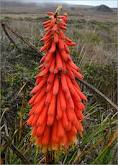
RED HOT POKERS: TALL GARDEN PLANTS WITH HEALTH BENEFITS


RED HOT POKER, KNIPHOFIA UVARIA
I grew up with red hot pokers and goldenrod in the garden, both wonderful plants for bees, and the red hot pokers I know now are full of nectar. In South Africa, where they are a native species, they are eaten and are said to taste like honey. There are many species of these plants which are also called the Torch Lily or Tritoma, some are yellow and lime green others white, but K. uvaria is red-orange with tinges of yellow on the lower flowers.
   They stand tall and are impressive garden flowers in the same way as lupins and hollyhocks are. They are grown in Europe for their beauty and curiosity value, as well as to make an impressive backdrop for smaller flowers. The leaves are evergreen in most species, although in some they die back to grow again in the following year and the flower spikes can grow to around six feet tall.           
  They are members of the sub-family Asphodelaceae and the family of the Xanthorrhoeaceae, and as such are related to the asphodel, bog asphodel and aloe vera. In fact they were thought to be members of the aloe family at first, and were in the genus Aloe uvaria.
   In South Africa the juice of the flowers from this plant is used in cosmetics, and the root is used as a cleanser for the skin to rid it of spots and other skin eruptions. The root is also used in traditional medicine as a medicine to cleanse the uterus and so prepare it for pregnancy.
  An infusion of the root of some Kniphofia species is used for chest complaints such as asthma and bronchitis. Other species figure quite prominently in traditional medicine. Although this one has limited uses it would seem.                                                     
  The Kniphofia genus was named after a distinguished 18th century German professor at Erfurt University, Johann Hieronymous Kniphof (1704-1763). It consists of more than ten species, which are mainly found in South Africa, although there is one native of Yemen and two or possibly three native to the island of Madagascar. K. uvaria is an invasive weed in some parts of Australia where it was introduced previously as a garden plant.

GARDEN CRESS- SALAD HERB: HEALTH BENEFITS OF GARDEN CRESS


GARDEN CRESS, LEPIDIUM SATIVA 
Garden cress has naturalized in Britain, but may have originated in Iran. It is cultivated across south Asia and is used both as food and medicine. It is a member of the Brassicaceae or Cruciferae family of plants and so is related to savoy cabbage, mustard, cauliflower, red cabbage, kale, kohlrabi, watercress, nasturtiums, field penny cress, broccoli, turnips, swedehorseradish, shepherd’s purse, scurvy-grass and flixweed and many other plants.
  Along with scurvy-grass it is antiscorbutic with a high vitamin C content and also contains good amounts of vitamin A. It also contains the minerals iron and calcium and three of the B-complex vitamins, B1 (thiamin), B2 (Riboflavin) and B3 (niacin).
  It tastes peppery a bit like a peppery parsley, or watercress, and is useful if added to salads in small amounts. The fruits of the plant look a little like capers.         
  It has been shown to be helpful in the treatment of asthma and bronchitis which are two traditional uses for the seeds, which contain oil which is edible and can be used for lighting. Studies have shown that the plant has analgesic (mild pain relief) and anti-inflammatory properties, as well as helping to lower blood pressure. A paste made from the seeds has been used for centuries for relief from rheumatic pains when applied externally on joints. The same paste is used for skin problems.
  In Ayurvedic medicine it is to prevent post-partum problems, and to increase the milk flow in breast-feeding mothers. However the seeds should not be use during pregnancy. In Arabic the herb is known as “Hab–al-Rashood” or “Thufa” and a cold infusion of the seeds is used in some Arab countries to relieve asthma and bronchitis.
     The seeds are also reputed to have aphrodisiac qualities and to improve the quality of a man’s sperm. The plant has diuretic properties and is an expectorant. The woody root has been used to treat secondary syphilis traditionally in Asia.
  One study by F. Kassie published in 2002 showed that the juice or sap of the plant had chemopreventive effects, and it was said that the amounts of the juice needed for these effects to be felt was the same as the amount in the herb used in a salad and eaten in normal amounts.
  There have been several studies of this plant and some are ongoing as they have prove of interest to the medical fraternity.
  The fresh or dried seed pods of the plant may be eaten and used as a condiment or as a flavouring for soups and sauces. The seeds can also be sprouted and used in salads. This may be a good addition to a garden!

BEAR'S BREECHES OR OYSTER PLANT: HISTORY AND HEALTH BENEFITS OF ACANTHUS MOLLIS


BEAR’S BREECHES, OYSTER PLANT, ACANTHUS MOLLIS 
Bear’s breeches is a fanciful name given to this plant which has flowers rather like those of snapdragons. They are pollinated by bees which have to force their way between the top and bottom parts of the flower. They are not relations of snapdragons however, as these are in the Acanthaceae family of plants, so are related to the Marsh Barbel among others.
   Bear’s breeches are native to the Mediterranean region and are cultivated in Britain, although some appear to have naturalized in Cornwall. In the 17th century, these were called Brank-ursine, meaning bear’s claws, which referred, possibly, to the shape of the flowers. They contain mucilage and tannin, which makes or rather made them useful in traditional medicine systems in Europe.                                                                           
  The plant has been used as a wound healer and internally taken to soothe the mucous membranes in the digestive and urinary tracts. The crushed leaves have been used in poultices and placed on burns or scalds to relieve the pain. The plant has astringent qualities and has been used to treat diarrhea and to heal wounds, as well as being used to clean wounds. It has been taken internally to purify the blood and to calm the stomach. It is also said to have expectorant properties.
  The 17th century herbalist, Nicholas Culpeper has this to say of the plant he called Brank-ursine: -
“Government and virtues. It is an excellent plant under the dominion of the Moon; I could wish such as are studious would labour to keep it in their gardens. Its leaves being boiled, and used in clysters, is excellent good to mollify the belly, and make the passage slippery; the decoction, drunk, is excellent good for the bloody flux: the leaves being bruised, or rather boiled and applied like a poultice, are exceeding good to unite broken bones, and strengthen joints that have been put out; the decoction of either the leaves or roots being drunk, and the decocted leaves applied to the place, is excellent good for the king's evil that is broken and runneth, for by the influence of the Moon it reviveth the ends of the veins which are relaxed; there is scarcely a better remedy to be applied to such places as are burnt with fire than this is; for it fetcheth out the fire, and healeth it without a scar; it is also an excellent remedy for such as are bursten, being either taken inwardly, or applied to the place; in like manner used, it helps the cramp and the gout; it is excellent good in hectic fevers, and restores radical moisture to such as are in consumptions.“
  Perhaps this plant’s claim to fame is as a motif at the top of Corinthian columns. Vitruvius write in his treatise “On Architecture” that there was a maiden from Corinth who died of a disease. Her grieving family had a monument made to her and her nurse took a basket, filled with the goblets she had loved in life to her grave. She inadvertently placed the basket with a tile covering it to protect the goblets from the ravages of the weather, on a root of Acanthus (mollis or spinosis), so in spring, the plants put forth its leaves and twined them around the basket. The people who passed remarked on the beauty of this and praise the architect who was thus inspired to make other columns for the Corinthians and so the fashion for such columns and their distinctive motif was begun.
  Inspired by these columns the artists of the Renaissance incorporated the leaf from the columns into some of their sculptures and architecture too. Bear’s Breeches thus is important in the history of architecture.