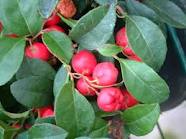
WINTERGREEN - USED TO RELAX MUSCLES: HEALTH BENEFITS OF WINTERGREEN


WINTERGREEN, GAULTHERIA PROCUMBENS    
As I write this I can smell the distinct aroma of wintergreen oil which was a favourite of my father’s for massage. He used a gel-like substance which heated and relaxed muscles and when he was giving someone a massage, the whole house was filled with the spicy, tangy smell which hits the back of your throat in much the same way as the combination of eucalyptus and menthol (essential oil of mint) does. I also remember just one time when the person who had come for a massage didn’t get one; my father said he couldn’t do anything for him and advised him to go to a doctor. The poor man died some weeks later from cancer.                                     
  Wintergreen is also called Checkerberry and Teaberry, and is native to eastern North America. It has synonyms for its botanical name too, including Gaultheria repens, G. humilis and Brossaea procumbens; its accepted name is Gaultheria procumbens. Wintergreen is a member of the Ericaceae family of plants and so is related to bilberries, blueberries, cranberries, the strawberry tree and the Greek strawberry tree, among other plants. There is one site in Scotland where it was introduced and has taken hold. However in Britain there are other species of “wintergreen”.
   The fruit and leaves are edible and the leaves may be snacked on raw, although they are bland, but pleasant to eat. The leaves may be used fresh or dried in a tisane, to get rid of the discomfort caused by flatulence.
  The essential oil distilled from the plant is toxic in large doses, so care should be taken if it is used. It may cause dermatitis too and you shouldn’t use it if you are allergic to aspirin, as the plant is a source of methyl salicylate which is closely related to the substance which gives aspirin its anti-inflammatory properties. It is used to flavour toothpaste, mouthwashes and chewing gum among other items.
    The red berries are also edible, although these have that flavour that I attempted to describe in the first paragraph, it has been described as like a spicy medicinal taste, but people make pies and jams with it, so perhaps it isn’t as bad as all that! The bell-shaped white flowers of wintergreen remind me of single lily-of-the valley flowers.                                                                                                          
  This wintergreen is an evergreen shrub which grows to heights of around eight inches but which creeps (hence the species’ name procumbens) along the ground, providing excellent ground cover. The berries are said to be best for eating after a frost, and the fruit, if the birds don’t eat it, or browsing deer, will remain on the plant all winter.
 Native Americans used the leaves to help their respiration and as a stimulant while hunting or carrying heavy loads. The leaves and oil were used to promote women’s menstrual flow and as an analgesic. As the plant has anti-inflammatory properties it was also used to ease the pains of neuralgia, sciatica, rheumatism and other inflammatory health problems. 

WALL RUE - LITTLE USED FERN NOW: HISTORY OF HEALTH BENEFITS OF WALL RUE


WALL RUE, WHITE MAIDENHAIR FERN, ASPLENIUM RUTA-MURARIA 
Wall rue is native to Europe and Britain and Ireland, eastern North America and parts of Asia, and is a fern which you can find in crevices on walls, as you can the true maidenhair and adder’s tongue. As a fern it is distantly related to adder’s tongue, common polypody, hart's tonguebracken, common club moss, horsetail, moonwort, and all other ferns. It grows to around two or three inches high, and resembles maidenhair.
  Like most ferns it has no flowers, but the spores can be seen on the underside of the leaves or fronds, being brown and then black when mature.                                                                      
  It is similar in colour to garden rue, which is perhaps why it gets its name. It was a specific for rickets in traditional medicine in Britain, and was especially used for coughs in children and also for children’s ruptures.
  In some parts of Europe it was infused in milk to treat epilepsy, and a decoction of the fronds was given for kidney complaints. It was also used to staunch bleeding from minor wounds, as it has a fairly high tannin content.
  Distilled water made from the fronds has been used as eye lotion for a variety of eye problems.
  The fronds may be harvested in late spring and dried for later use, although it may not be possible to do this if the plant is listed as endangered or protected in your country.
  The English herbalsit, Nicholas Culpeper, writing in the 17t century linked wall rue closely with maidenhair fern, and had this to say about the properties of each.
 “The decoction of the herb Maiden-Hair being drank, helps those that are troubled with the cough, shortness of breath, the yellow jaundice, diseases of the spleen, stopping of urine, and helps exceedingly to break the stone in the kidneys, (in all which diseases the Wall Rue is also very effectual). It provokes women's courses, and stays both bleedings and fluxes of the stomach and belly, especially when the herb is dry; for being green, it loosens the belly, and voids choler and phlegm from the stomach and liver; it cleanses the lungs, and by rectifying the blood, causes a good colour to the whole body. The herb boiled in oil of Camomile, dissolves knots, allays swellings, and dries up moist ulcers. The lye made thereof is singularly good to cleanse the head from scurf, and from dry and running sores, stays the falling or shedding of the hair, and causes it to grow thick, fair, and well coloured; for which purpose some boil it in wine, putting some Smallage seed thereto, and afterwards some oil. The Wall Rue is as effectual as Maiden-Hair, in all diseases of the head, or falling and recovering of the hair again, and generally for all the aforementioned diseases. And besides, the powder of it taken in drink for forty days together, helps the burstings in children.”

SEA ASTERS - CULPEPER'S SEA STAR WORT: HISTORY OF USES AND HEALTH BENEFITS WITH RECIPE FOR SEA ASTERS AND SCALLOPS


SEA ASTER, ASTER TRIPOLIUM
The sea aster was known to Nicholas Culpeper the English herbalist of the 17th century as the Sea Star-wort. However in the previous century, John Gerard had called it tripolium, and had this to say about it:-
  “It was reported by men of great fame and learning that it doth change the colour of his flowers thrice a day.”
  It doesn’t, but it comes in a range of colours from white to lilac to a deep lilac and blue. The three great men-“tri-polis” (three citizens) were probably Hippocrates, Galen and Dioscorides, whom John Gerard relied heavily upon for his remedies.
  He also said that it grew in the Isle of Wight, (a small island off the south coast of Britain) and Battersea, near the Thames in London, although it doesn’t now.                                        
  The plant looks like a Michaelmas daisy, but it isn’t as that one blooms in September and the sea aster blooms from June through to October, depending upon where it grows. It is a member of the daisy or Asteraceae or Compositae family of plants so has many relatives such as pellitory or Roman chamomile, marigolds, purple goat’s beard (salsify), yellow goat’s beard, elecampane, the ox-eye daisy, holy thistles, costmary, tansy, feverfew, groundsel, fleabane and yarrow, to name but a few.
   Aster means star, and it gets this name from the appearance of its flowers. There are several legends about asters, one being that Astraea, a goddess associated with the constellation of Virgo, left the Earth and looking down at it, wept sorrowful tears for it, which became asters. Another legend says that the goddess Virgo scattered stardust on the Earth and this turned into asters.
  The leaves and stems of this plant are edible and may be substituted for marsh samphire. It is sometimes sold in fishmongers in Britain. They can be pickled or used as a vegetable as in the recipe below.                                          

  The sea aster is a native of northern Europe, including Britain and Ireland, and may also be found in North Africa and lake shores of Central Asia. It lives on rocky cliffs in crevices and in salt marshes.

  Today is it used as a wash for the eyes and is said to be good for the sight. However this is what Nicholas Culpeper has to say about this plant which he called Sea Star wort; according to him it was an aphrodisiac and useful for a variety of complaints.
 “Government and virtues. This is …under the dominion of Mercury. The leaves are accounted cooling, and good for burns, scalds, and inflammations, in any part. The seed is narcotic and soporiferous, and rarely used. A slight tincture or infusion of the plant promotes perspiration, and is good in feverish complaints. The juice boiled into a syrup with honey, is excellent in asthmatic complaints, and other disorders of the lungs; and outwardly applied is a cure for the itch, and other cutaneous disorders. A strong decoction given as a *glyster, with the addition of a little oil, eases those colicky pains which arise from the stone and gravel; on infusion of the leaves drank constantly in the manner of tea, is a strengthener, and provocative to #venery, and is supposed to be a cure for barrenness.”
*enema, #lust

SEA ASTER AND SCALLOPS
Ingredients                                                                    
4 oz/ 200 gr. smoked salmon, shredded
3 oz butter
8 scallops, cleaned, corals removed from the white meat and the latter thinly sliced.
5 fl oz /150ml white wine
7 fl oz double (thick) cream
200 gr sea aster leaves and tender stems, or marsh samphire

Method
Melt half the butter in a hot frying pan and add the thin slices of white scallop meat. Fry for one minute and be careful not to overcook it as, like squid and octopus, scallops are tough and rubbery if overcooked.
Remove from the pan and reserve.
In the same frying pan add the sea aster and fry for two to three minutes, tossing frequently.
Melt the remaining half of the butter in a clean frying pan over a medium heat and add the scallop corals and fry for 1 minute.
Add the white wine, and bring to simmering point. Simmer until the liquid has been reduced by half.
Add the cream and bring back to a simmer for 1 minute. Remove from the heat and transfer to a blender.
Blend the coral mixture until smooth. Then pour this into the pan containing the sea aster, add scallop meat and smoked salmon slivers and gently heat through, so that the cream doesn’t boil.
Serve with pasta of your choice.
This has Taste and is a Treat.

OIL OF TURPENTINE FROM THE EUROPEAN SILVER FIR: USES AND HEALTH BENEFITS OF OIL OF TURPENTINE


OIL OF TURPENTINE, FROM THE EUROPEAN SILVER FIR (ALBIES ALBA) 
Oil of turpentine is manufactured from the resin of the European Silver fir and used extensively in the paint industry, as a solvent. The residue from the process, the rosin oil is used for making varnishes, lacquers and carbon black which is a pigment used in inks and paints. Distilled, it is used in the food industry as a flavouring. In the cosmetics industry it is used to make soaps and bath products as it is said to be good to ease muscle and joint pains and the pains associated with rheumatism, sciatica and neuralgia. Sometimes it is used as a rub because it is a counter-irritant to relieve pain.
  The early physicians, Hippocrates, Dioscorides and Galen recommended its use for lung problems and for obstruction in the internal organs, such as stones in the gall bladder which it was thought to dissolve.                                                                                            
  However it is lethal in large doses, and as Paracelsus pointed out, “Sola dosis facit venerum” which roughly translates as “only in the dosage lies the poison.” For example in low doses it is good for the kidneys and liver, but in high doses it is very bad for them. High doses can cause nervous system disorders such as convulsions and loss of balance.
  The main ingredients of the oil are ά- and β- pinene, which have been found to be effective insecticides, especially against female cockroaches and their eggs, with β- pinene, being the more effective. They are both useful against Candida yeast infections and have a similar action to tea tree oil from Melaleuca alterifolia.
  Theses two compounds have also shown in vitro cytotoxic activities against human cancer cells. It has been speculated that ά-pinene might be helpful in the treatment of Alzheimer’s disease as it has shown to have some positive effects on cognition and memory, although scientists say that it is only useful if combined with essential oils from other plants.
  It has antioxidant, anti-inflammatory, antispasmodic properties  and soothes the muscles of the intestine, and these properties support the use of the oil in traditional medicine systems in Germany and Poland where it has been used to treat diarrhoea, coughs and asthma.
  In modern phytotherapy oil of turpentine is used to treat bronchial problems, as an antispasmodic, analgesic, for cystitis and other genito-urinary tract problems, for dissolving gall stones, as a haemostatic for use to relieve the pains of rheumatism and so on and as a diuretic as well as to remove worms from the gastro-intestinal tract. It is also used as an antidote to phosphorous poisoning.                                                                                      
  β- pinene is anti-inflammatory and analgesic, and antibacterial, especially good for clearing flora from the mouth. However it is best used with ά-pinene to get rid of bacteria.
  The European Silver Fir provides us with many health-giving products, as well as its wood. Next time you see one, you may view it in a different light than you did before.