EUROPEAN MICHAELMAS DAISY: HISTORY OF HEALTH BENEFITS OF THE MICHAELMAS DAISY


EUROPEAN MIACHAELMAS DAISY, ASTER AMELLUS  
The European Michaelmas daisy gets its name because it blooms around the time of St. Michael’s day (Michael the archangel) which is celebrated on the 29th September. It is also called Italian starwort and in Italian is Astro di Vergilio, or Virgil’s Aster. This is no doubt because Virgil mentions it in his Georgics written more than 2,000 years ago. This is a translation of the passage in which the asters are mentioned


“There is a useful flower                                                                     
Growing in the meadows, which the country folk
Call star-wort, not a blossom hard to find,
For its large cluster lifts itself in air                                                   
Out of one root; its central orb is gold
But it wears petals in a numerous ring
Of glossy purplish blue; ’tis often laid
In twisted garlands at some holy shrine.
Bitter its taste; the shepherds gather it
In valley-pastures where the winding streams
Of Mella flow. The roots of this, steeped well,
In hot, high-flavored wine, thou may’st set down
At the hive door in baskets heaping full.”
  From this passage we assume that it was placed on some altars to the ancient gods, perhaps because It was a late bloomer, although there are other legends associated with the aster such as the one that when Astraea a goddess fled Earth with the rest of the gods, she looked down at it and wept for the folly of mankind. Another legend says that Virgo scattered stardust on Earth and asters bloomed where it fell.
  It does indeed have a bitter, acrid taste, but the leaves of the young plant are cooked and are nutritious, containing vitamins A and C they were useful against the onset of scurvy, and they also contain some of the B-complex vitamins, particularly thiamin (B1), riboflavin (B2) and niacin (B3). They are potassium rich and also contain the minerals calcium, iron and phosphorous.
These plants are native to Europe and East Asia and have been cultivated in Britain at least since 1596, as we know that they grew in John Gerard’s Holborn Physic garden then.
  Mediaeval herbalists used this plant to treat tumours, obstruction of the bowels, hysteria and epilepsy- some very diverse diseases. They actually can help with coughs, and have anti-inflammatory properties, and can help eliminate toxins from the body. They are used to treat bronchial and chest complaints and to check bleeding.
  Pliny believed that a tisane made with asters was good for snakebites and he encouraged people who suffered from sciatica to wear an amulet of these plants. The ancient Greeks burnt the leaves to get rid of evil spirits and snakes.
  Michaelmas daisies mean ‘farewell’ in the Language of Flowers. They are members of the daisy, Asteraceae or Compositae family and so are related to pellitory or Roman chamomile, marigolds, bur marigoldspurple goat’s beard (salsify), yellow goat’s beard, the Sea Aster or Sea starwort (which they closely resemble) elecampane, the ox-eye daisy, holy thistles, costmary, tansy, feverfew, groundsel , fleabane and yarrow, just to list a few of its relatives.
 

FRAGRANT WATER LILY- NORTH AMERICAN NATIVE; HEALTH BENEFITS OF THE FRAGRANT WATER LILY


FRAGRANT WATER LILY, NYMPHAEA ODORATA   
The fragrant water lily or Beaver root, is native to North and Central America, and also Cuba. Another indigenous American water lily is Nelumbo lutea the American lotus. However, this white, fragrant water lily is an invasive weed in Washington State and other parts of the U.S. but it has been used in traditional medicine by Native Americans for centuries.
   It is a member of the Nymphaceae family of plants, and lives in slow-moving streams and rivers, as well as in ponds, lakes, marshes, in ditches and canals. It comes into flower during the months of July and August, with its seeds ripening between August and October. It is grown by many people with water gardens as it has a wonderful fragrance, although the flower only opens in the morning; it closes in the afternoon.                                                                           
  Almost all parts of the fragrant water lily plant are edible; the young flower buds can be pickled or cooked in a similar way to the flower buds of the kachnar or Mountain orchid tree. The leaves may be eaten either raw or cooked and can be added to soups and stews. The root can be boiled or roasted while the ripe seeds can be cooked and eaten, or ground into flour. The young flowers are also edible and make wonderful garnishes.

  The root and leaves are the main parts of the plant used in medicine. A tisane made from the roots has been used to treat T.B. and chronic bronchial complaints, but has to be taken over a prolonged period of time, and there are some health concerns regarding the prolonged use of the root. The root has antiseptic and astringent properties, probably because of the presence of gallic and tannic acids. The tannins and gallic acid would explain why the root was used for diarrhoea, dysentery, to stop bleeding, for inflammation and gastro-intestinal problems. It was also used as a remedy for gonorrhoea and vaginal discharge.
  A hot poultice of the roots was used on swellings and tumours, as well as on inflamed skin. It is best to harvest the roots after the plant has died back, and these may be dried for later use.
  There have been a few studies conducted on this plant, as it is also used in the Ayurveda system of medicine in the Indian subcontinent. It is used traditionally there to get rid of stones in the bodily organs. One study, by Ramesh S. Deoda et al. “Antilithiatic Activity of Leaves, Bulb and Stem of Nymphaea odoratata and Dolichos lablab Beans” in the Research Journal of Pharmaceutical, Biological and Chemical Sciences, Vol. 3 (1) Jan- March 2012, concludes that the leaves and bulbs of the fragrant water lily have good antilithiatic activity.
  Another study in the International Journal of Pharmacy and Pharmaceutical Sciences March 2012, Vol.4 (2) suggests that the “leaf extract possesses promising antidiabetic effects”.

  Trials have also been conducted on the use of the fragrant water lily extracts n cosmetics. Clearly more research needs to be done to discover how the plant can benefit our health.

WINTERGREEN - USED TO RELAX MUSCLES: HEALTH BENEFITS OF WINTERGREEN


WINTERGREEN, GAULTHERIA PROCUMBENS    
As I write this I can smell the distinct aroma of wintergreen oil which was a favourite of my father’s for massage. He used a gel-like substance which heated and relaxed muscles and when he was giving someone a massage, the whole house was filled with the spicy, tangy smell which hits the back of your throat in much the same way as the combination of eucalyptus and menthol (essential oil of mint) does. I also remember just one time when the person who had come for a massage didn’t get one; my father said he couldn’t do anything for him and advised him to go to a doctor. The poor man died some weeks later from cancer.                                     
  Wintergreen is also called Checkerberry and Teaberry, and is native to eastern North America. It has synonyms for its botanical name too, including Gaultheria repens, G. humilis and Brossaea procumbens; its accepted name is Gaultheria procumbens. Wintergreen is a member of the Ericaceae family of plants and so is related to bilberries, blueberries, cranberries, the strawberry tree and the Greek strawberry tree, among other plants. There is one site in Scotland where it was introduced and has taken hold. However in Britain there are other species of “wintergreen”.
   The fruit and leaves are edible and the leaves may be snacked on raw, although they are bland, but pleasant to eat. The leaves may be used fresh or dried in a tisane, to get rid of the discomfort caused by flatulence.
  The essential oil distilled from the plant is toxic in large doses, so care should be taken if it is used. It may cause dermatitis too and you shouldn’t use it if you are allergic to aspirin, as the plant is a source of methyl salicylate which is closely related to the substance which gives aspirin its anti-inflammatory properties. It is used to flavour toothpaste, mouthwashes and chewing gum among other items.
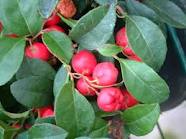
    The red berries are also edible, although these have that flavour that I attempted to describe in the first paragraph, it has been described as like a spicy medicinal taste, but people make pies and jams with it, so perhaps it isn’t as bad as all that! The bell-shaped white flowers of wintergreen remind me of single lily-of-the valley flowers.                                                                                                          
  This wintergreen is an evergreen shrub which grows to heights of around eight inches but which creeps (hence the species’ name procumbens) along the ground, providing excellent ground cover. The berries are said to be best for eating after a frost, and the fruit, if the birds don’t eat it, or browsing deer, will remain on the plant all winter.
 Native Americans used the leaves to help their respiration and as a stimulant while hunting or carrying heavy loads. The leaves and oil were used to promote women’s menstrual flow and as an analgesic. As the plant has anti-inflammatory properties it was also used to ease the pains of neuralgia, sciatica, rheumatism and other inflammatory health problems. 

WALL RUE - LITTLE USED FERN NOW: HISTORY OF HEALTH BENEFITS OF WALL RUE


WALL RUE, WHITE MAIDENHAIR FERN, ASPLENIUM RUTA-MURARIA 
Wall rue is native to Europe and Britain and Ireland, eastern North America and parts of Asia, and is a fern which you can find in crevices on walls, as you can the true maidenhair and adder’s tongue. As a fern it is distantly related to adder’s tongue, common polypody, hart's tonguebracken, common club moss, horsetail, moonwort, and all other ferns. It grows to around two or three inches high, and resembles maidenhair.
  Like most ferns it has no flowers, but the spores can be seen on the underside of the leaves or fronds, being brown and then black when mature.                                                                      
  It is similar in colour to garden rue, which is perhaps why it gets its name. It was a specific for rickets in traditional medicine in Britain, and was especially used for coughs in children and also for children’s ruptures.
  In some parts of Europe it was infused in milk to treat epilepsy, and a decoction of the fronds was given for kidney complaints. It was also used to staunch bleeding from minor wounds, as it has a fairly high tannin content.
  Distilled water made from the fronds has been used as eye lotion for a variety of eye problems.
  The fronds may be harvested in late spring and dried for later use, although it may not be possible to do this if the plant is listed as endangered or protected in your country.
  The English herbalsit, Nicholas Culpeper, writing in the 17t century linked wall rue closely with maidenhair fern, and had this to say about the properties of each.
 “The decoction of the herb Maiden-Hair being drank, helps those that are troubled with the cough, shortness of breath, the yellow jaundice, diseases of the spleen, stopping of urine, and helps exceedingly to break the stone in the kidneys, (in all which diseases the Wall Rue is also very effectual). It provokes women's courses, and stays both bleedings and fluxes of the stomach and belly, especially when the herb is dry; for being green, it loosens the belly, and voids choler and phlegm from the stomach and liver; it cleanses the lungs, and by rectifying the blood, causes a good colour to the whole body. The herb boiled in oil of Camomile, dissolves knots, allays swellings, and dries up moist ulcers. The lye made thereof is singularly good to cleanse the head from scurf, and from dry and running sores, stays the falling or shedding of the hair, and causes it to grow thick, fair, and well coloured; for which purpose some boil it in wine, putting some Smallage seed thereto, and afterwards some oil. The Wall Rue is as effectual as Maiden-Hair, in all diseases of the head, or falling and recovering of the hair again, and generally for all the aforementioned diseases. And besides, the powder of it taken in drink for forty days together, helps the burstings in children.”