TOMATILLO - HUSKY GREEN TOMATO: HEALTH BENEFITS AND USES OF TOMATILLO: MEXICAN SALSA VERDE EASY RECIPE


TOMATILLO, PHYSALIS PHILADELPHICA, PHYSALIS IXOCARPA-BROT
As you might expect from the name, the tomatillo is related to the tomato as they are both members of the Solanaceae (nightshade) family of plants, which means the tomatillo is also related to the potato, aubergine  and Nipple Fruit. It is native to the South American continent and is widely cultivated in Mexico and Guatemala where the wild and domesticated versions can be found. The wild variety often grows between cultivated crops of maize (corn), beans and gourds, such as the ash gourd or petha. The wild fruit is picked and sold locally.
  It is a fruit with seeds, which grows inside a calyx, so it comes off the plant prepackaged. If you buy the fruit before it is fully ripe it can be stored in its calyx (the husk which covers it) for up to a year. It tastes a little like a gooseberry, although more like the Indian gooseberry than the European one and is related to the Cape gooseberry, Physalis peruviana. Because of the calyx it is also called the husk tomato and is known as tomate verde (green tomato) in Spanish. It is used with chillies in various salsas (sauces) as it takes away some of their hotness. It contains quite a lot of pectin, so is often used to thicken soups and sauces to give them a thicker consistency. The name comes from the Nahuatl “tomatl” which is a generic word that is used for fruits that are watery, round and seed-bearing, and which are sometimes enclosed in a calyx. They come in a variety of colours ranging from green to yellow and through to purple, although this one has been given a separate name, Physalis ixocarpa- BROT, presumably because it contains ixocarpalactoneA, which is a withanolide, in its stem and leaves. This purple tomatillo is mainly consumed in western Mexico. It has been found to be a good safe source of antioxidants and has been subjected to much research. It has antibacterial activity against respiratory infections caused by Staphylococcus bacteria and has potential for developing an anti-cancer drug. It contains carotene, vitamin C in the form of ascorbic acid some B-complex vitamins and the minerals calcium and iron and copper, magnesium, manganese, potassium, phosphorous, zinc, selenium and Omega-3 and -6 fatty acids.. The raw fruit also contains vitamins A, E and K as well as flavonoids,
  In folk medicine, the juice from the fruit is used as eyewash, and in Guatemala it is used for gastrointestinal problems and respiratory disease. The husk is not always discarded as it can be made into an infusion which is used in tamale dough to give it a spongy consistency and to give flavour to white rice; the infusion is also used to tenderize red meat.
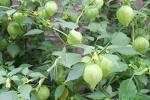
  The tomatillo has been cultivated in Mexico and Guatemala for centuries and it is believed that its first cultivation began in Mexico, certainly before the arrival of the Spaniards, who were probably responsible for taking the tomatillo to the Caribbean where it is cultivated. It was taken to Spain and cultivated, but this was stopped as the tomato became much more popular.

MEXICAN SALSA VERDE
Ingredients
1 lb tomatillos, husks removed
1 large onion, finely chopped
4 garlic cloves, finely chopped or minced
2 green chillies, very finely chopped
2 tbsps fresh coriander leaves, shredded
1 tbsp fresh oregano, chopped or 1 tsp dried
½ tsp cumin seeds, dry fried and ground
salt to taste
2 cups water

Method
Put everything in a pan and bring to a boil over a high heat.
Reduce the heat to medium-low and simmer for 10-15 mins or until the tomatillos are soft.
Puree in batches in a blender.
Serve as a dip or side dish to give some extra flavour to chicken or meat dishes.
This has Taste and is a Treat.

STINKING GOOSEFOOT - INFORMATION: HEALTH BENEFITS AND HOW TO USE STINKING GOOSEFOOT HERB


STINKING GOOSEFOOT, CHENOPODIUM VULVARIA OR CHENOPODIUM OLIDUM-CURT
The name stinking goosefoot is apt for this little herb, as its leaves like other Chenopodium species slightly resembles a goose’s webbed feet, and when bruised the leaves stink, not to put too fine a point on it. They are actually edible, but no one would want to, given the stench. The seeds are also edible but as they contain saponins they have to be soaked overnight and then rinsed before roasting or dry frying, then grinding to mix with wheat flour to make bread. Culpeper, writing in the 17th century, describes the smell from the bruised leaves in this way: “It smells like rotten fish, or something worse.” It goes by a number of derogatory names, such as Dog’s Arrach or Orache, and Stinking Motherwort.
  Its leaves used to be made into a conserve with sugar and used for nervous complaints for women. It was probably a good way to stop a fit of the hysterics given the smell. A tisane was made of the dried leaves with 1 ounce to 1 pint of boiling water, given in wineglass doses for obstructions in the monthly flow, or blood clots during a woman’s periods. In fact it was another Female herb along with the chaste berry tree.
  It is a plant that grows up to 40 centimetres, but it might not be upright, some trail along the ground. It is rare now in southern England and the Channel isles, although it was once abundant throughout the British Isles, and is native to northern Europe. The tisane of dried leaves made from this plant is said to be antispasmodic so was good for menstrual cramps.
  It should not be confused with the true Orach(e) or Arrach, which was thought to be beneficial for gout. It has small green flowers without petals but with 5 sepals and stamens. The word Chen comes from the Greek meaning goose and podi meaning foot. The other goosefoots native to Britain are known as Fat Hen and Good King Henry, but there are many others that grow in different parts of the world.
  The physicians of Myddfai used it in combination with other herbs as in this remedy for profuse menstruation: -
“A woman who is subject to profuse menstruation, should take the reddish bastard balm, small burdock, orpine, stinking goose foot, pimpernel, water avens, with the ashes of a hart's horns, that has been killed with his antlers on, boiling them, as well as possible in red wine, straining the liquor carefully, and drinking it daily, till it is finished, abstaining (the while) from stimulating food. Being restrained by the above means, the blood will be habitually diverted to the thighs and ankles.”

PRUNELLA VULGARIS ( SELF-HEAL) - INFORMATION: HEALTH BENEFITS AND USES OF PRUNELLA VULGARIS


SELF-HEAL, PRUNELLA VULGARIS
Self –Heal is also called All-Heal, Prunella, Brunella, Heart of the Earth and Blue Curls, among other names. It’s native to Europe, Asia and North America, and is used in the Unani (Greek) medicine system in Kashmir. It grows in the Sichuan province of China and has been used in traditional Chinese medicine for centuries. It’s a common plant in Britain, and was much esteemed by both John Gerard and Nicholas Culpeper, the two major British herbalists of the 16th and 17th century respectively. Culpeper describes the flowers in this way, “thicke set together like an eare or spiky knap.” You can see for yourself why he described it in this way. The tiny flowers grow from the stem and resemble small orchids. They are usually a blue-violet, but can be pink or white, although these are rare.
  John Gerard describes its use in this way”
   “There is not a better Wound herb in the world than that of Self-Heal…for this very herbe, without the mixture of any other ingredient, being onely bruised and wrought with the point of a knife… will be brought into the form of a salve, which will heal any green wounde…The decoction of Prunell made with wine and water doth join together and make whole and sound all wounds, both inward and outward, even as Bugle doth. To be short, it serveth for the same that the Bugle serveth and in the world there are not two better wound herbs as hath been often proved.”
  Bugle is Ajuga reptans (LINN), while Sanicle mentioned below is Sanicula Europea (LINN). Self-Heal is a member of the mint family, and its leaves are edible and can be used in soups, stews and salads. It’s a Lamiaceae or Labiatae.
  Culpeper explains its name “Self-Heal whereby when you are hurt you may heal yourself.” He agrees with Gerard, that it is as efficacious as Bugle “inwardly or outwardly, for inward wounds and ulcers in the body, for bruises and falls or hurts.” He goes on to recommend its use with both Bugle and Sanicle “to wash and inject into ulcers in the parts outwards.” He also claims that “the juice used with oil of roses to anoint the temples and forehead is very effectual to remove the headache.”
  In Kashmir it has been used as a “brain tonic” for sore throats, colds, headaches, and is used boiled and the steam inhaled for clearing mucous and to reduce a headache. It is also one of a mixture of herbs given to a woman after delivery of a baby to make her strong again.
  You can make a tisane with 1 ounce of the dried herb to 1 pint of boiling water. Pour the water over the chopped herb and leave to steep for 10-15 minutes, before straining and drink to help internal bleeding and piles, also if missed with a little honey it is good for sore throats and mouth ulcers, so can be used as a gargle as well as a tisane. The leaves are wound healers, and if you put the juice from the leaves on a wound, it will heal quickly. A tisane made with the flowers is particularly pleasant to take as a general tonic.
  The plant contains rutin, vitamins C and K, flavonoids, Prunellin, a polysaccharide, phenolic and tannins along with other substances. The rutin combined with the vitamins supports blood vessels and connective tissue in the body, but this little plant has many more health benefits. Because it is so common on three continents, much research has been done into it, and it has been found to be effective against herpes simplex, and is being experimented with as an anti-tumour and cancer treatment as well as an anti-HIV treatment. It has anti-viral and bacterial properties and is effective against the E.coli and Bacillus typhi strains of bacteria. This gives credence to the steam treatment used in Kashmir, where it is also used to lower blood pressure, as an antibiotic, antiseptic, anti-rheumatic, diuretic, vermifuge (to get rid of internal parasites) and for its antibacterial properties.
  It seems that once again, traditional healers know what they are doing with the herbs and other natural ingredients they prescribe.

MALLOW - A SOOTHING HERB: HISTORY, HEALTH BENEFITS AND USES OF MALLOW: HOW TO MAKE MALLOW TISANE


COMMON MALLOW, MALVA SYLVESTRIS
The Common mallow can grow almost everywhere and its habitat ranges from the UK and Europe through North Africa and the Middle East and into the Indian subcontinent where it is a weed. It has become naturalized in many parts of the world (such as eastern Australia) as it was introduced as an ornamental into many gardens across the globe. In the UK it can be found in hedgerows, on wasteland and on roadsides and most websites seem to have concluded that it has fallen into disuse as a medicinal herb in places where the Marsh Mallow (Althea officinalis) grows. However, that could be because it doesn’t grow in the same habitat as its cousin which likes marshes. The Common Mallow on the other hand must be salt tolerant to some degree as it can be found close to the sea where it grows in abundance in South and West Wales.
  Both my father and grandmother swore by this plant’s efficacy to bring down swellings, and I have had hot poultices put on my ankles and knees many times to reduce bruising and swellings, so I can personally vouch for the fact that it works. (I am a little accident prone.)
  The pretty mauve-pink flowers are edible, like those of borage, lavender and kachnar and look good in salad and for garnishes, with its seeds being edible too and tasting a little like peanuts. The leaves can be used as a thickener for soups or blanched for 2 minutes, rinsed in cold water and used instead of lettuce in salads. They are also fine eaten as a green vegetable.
  Eucalyptus leaves or bark and mallow leaves and flowers are a good tisane to make if you have a cough or other respiratory problems. The flowers and immature fruits can be made into a tisane too which is useful for whooping cough. The leaves are cooling and a tisane can be made and used on the skin to relieve inflammation or to stop the pain of insect bites or stings. If you get stung when you are outside you can use a bruised leaf to take the pain away as the leaves are mucilaginous and soothing.
  A tisane of the leaves is a pleasant diuretic, and also has a mild laxative action, so is much more pleasant to take than senna.
  You should gather the plant (not the roots, just the above ground parts) in June when the flowers appear and bloom, then hang it to dry in a light, airy room until crumbly and pack into a jar and keep for future use, as it can be used for coughs and colds in winter.
  The fruits or seed pods of the common mallow look a bit like little cheeses, as do those of the cheese tree. A dye can be made from them, and the whole plant will produce different dyes of cream, yellow and green. In ancient Greece baskets were woven from the stems of this plant, and it is possible to make cloth from it as was done in the ancient world and in Mediaeval times.
Seed Pods
  Mallow was mentioned by several Roman writers, with Pliny the Younger recommending a tisane made with the seeds for nausea. Earlier, in 700BC or thereabouts, Hesiod wrote that only a fool would not consider a little mallow beneficial in their diet. Later around 30 BC Horace in his Odes 31 verse 15 says “As for me, olives, endives and mallows provide sustenance.” (We believe that Pliny was referring to chicory rather than the Belgian endive which is a relative newcomer on the vegetable scene.)  In those times mallow was planted on graves to provide nourishment for the dead. Clearly it was not only my relatives who thought highly of this plant. It has been used as medicine wherever it grows and is in the French and Swiss Pharmacopoeias.
  Young girls would make garlands of mallow and chaplets for their heads to wear on May Day, in Europe.
   The plant is related to the hibiscus and hollyhock and is in the Malvaceae family of plants. It gets the name mallow from the Old English “malwe”
 The Physicians of Myddfai used mallow with other herbs for the treatment of
 intermittent fevers. “Take the mugwort, dwarf elder, tutsan, amphibious persicaria, pimpernel, butcher's broom, elder bark, and the mallow, and boiling them together as well as possible in a pot, or cauldron. Then take the water and herbs, and add them to the bath.”
While this was a treatment for piles: -
“Take the mallow, and boil it in wheat ale, or in spring water. Then take that which grows in the earth of the elder (bark,) bruise well in a mortar, and mix it, crude as it is, with the above mentioned decoction, and administer it quickly to the patient, so as to act upon his bowels. Let him afterwards be forbidden beef, cheese, leeks, large fish, salmon, eels, ducks, garlic, and all kinds of milk diet, except whey made with warm milk”
  Modern medical research into this plant has found that it may be able to protect the kidneys. The German E Commission has approved its use for oral and external use as it is anti-inflammatory and can soothe mouth ulcers as well as irritated skin. There is some evidence that the mucilage it contains can soothe disorders of the gastrointestinal tract too.

MALLOW TISANE
Ingredients
2-4 tsps dried leaves or flowers (or a mixture of both)
150 ml boiling water

Method
Pour the boiling water over the dried mallow and leave to steep for 10 to 15 minutes.
Strain and drink one cup three times a day for colds etc and other ailments mentioned above, or used it externally on irritated skin.
This has Taste and is a Treat(ment).

INDIAN SARSAPARILLA: MEDICINAL BENEFITS AND USES OF INDIAN SARSAPARILLA


INDIAN SARSAPARILLA, HEMIDESMUS INDICUS
Indian sarsaparilla belongs to the Asclepiadaceae family of plants (milkweed family) which typically are flowering plants of the order Gentianales which boasts more than 280 genuses or genera, and more than 2000 species of tropical herbs and shrubby climbers. They are rarely trees or bushes. They can be recognized by their milky juice, their 5 united petals, and pod-like fruit and generally tufted seeds. The pitcher plant is probably one of the best known of these. It is therefore not related to the American Sarsaparilla which is of the Smilax order and one of the Liliaceae.
   It is native to the Indian subcontinent, Sri Lanka and the Malaccan Islands, and is notably used to cure STDS including syphilis. For this it seems to be more efficacious than the American sarsaparilla. It is also used for a number of other purposes, including as an antidote to snake venom, a use which has been borne out by medical research. An infusion can be made by using 2 ounces of chopped root and pouring 1 pint of boiling water over it and allowing this to steep for 1 hour. Then it should be strained and drunk over a 24 hour period. It is good for skin diseases, and makes a good diuretic, and is used for rheumatism, scrofula and thrush. It is also useful for stomach problems including indigestion and loss of appetite. For these problems it can be used powdered with milk, the dosage being between 1 and 6 grams. It can be ground to a paste with a little water and mixed with black pepper for diarrhoea and stomach ache, and a decoction of the root is used on the subcontinent to promote hair growth. A syrup made from the root is used as a diuretic, and a paste made from the root is given for rheumatism, swellings and boils. The flowers can be made into a decoction by boiling them in water and used to promote sweating in fevers. It is used for kidney complaints too and given to children for sore mouths.
  A refreshing cooling drink is made from the powdered roots, flavoured with the addition of rose petals, or lotus petals, milk and honey. This cools the body down in the heat of summer. Modern medical research suggests that it has antifungal and antibacterial problems, which bears out the traditional use for ringworm and thrush. The ethanolic extract of the root has shown that it can inhibit the growth of cancer cells and it has strong antioxidant properties. It has also been shown to have liver protective actions.
  Once again modern medical research is catching up with ancient healing practices.

SENNA AND INDIAN SENNA - HOW TO USE SAFELY


SENNA, EGYPTIAN SENNA, CASSIA AUGUSTIFOLIA, INDIAN SENNA, CASSIA ACUTIFOLIA-DELL
There are many different species of senna, which has been used for centuries as a purgative, but the best are Egyptian or Alexandrian senna Cassia augustifolia which comes for Sudan and Egypt and the variety which grows in the Indian subcontinent, Cassia acutifolia, also called Tinnevelly senna.
  It was first described in the 9th century by Arab physicians, and the name, senna has Arabic roots. It is believed that the first Greek to notice the uses of this herb was Achicinus, and it must have been he who popularized its use for constipation in the West. In its action it is rather like the castor bean but more effective and less potent than jamalgota.
  The leaves are the most potent part of the plant, although they can cause stomach cramps, so the pods are preferred for use as they do not. They taste slightly less noxious than the leaves too which can make one nauseous. Basically senna should be taken with aromatic spices or herbs to disguise its taste whether the leaves or pods are used. Ginger, chamomile, cardamom seeds, coriander seeds, cinnamon or cassia bark, cloves, peppermint or anise can be mixed with it and a little honey or sugar if desired. 1-2 tsps of the leaves can be put in a cup along with any of the above and 1 cup of boiling water should be poured over it and then left to steep for 10 minutes, before straining. Only 1 cup should be taken per day, so it’s best not to drink it all at once. Pregnant and lactating women should not take senna.
  Senna pods act on the whole intestine, while the leaves stimulate the colon. The WHO (World Health Organization) has approved senna’s use as a short term treatment for constipation, but the treatment should be discontinued after 1-2 weeks.
  Senna is a member of the Leguminaceae family as are the green bean, Astragalus species or the carob tree, and one of the Caesalpiniaceae species, whose leaves and pods are prescribed for sufferers of piles, anal fissures and for those awaiting surgery on the abdomen, rectum or anus. It is also used to clean the bowel before some ultrasound procedures to improve visibility in the bowel. The anthraquinone glycosides stimulate the colon and work in 3 to 9 hours, softening stools and so alleviating constipation. The leaves can cause cramping so many people prefer to use the pods for treatment.

WHAT IS MANJEETH? INDIAN MADDER: DYE FROM DYER'S MADDER , MEDICINE FROM INDIAN MADDER


DYER’S MADDER, RUBIA TINCTORUM AND INDIAN MADDER, MANJEETH, RUBIA CORDIFOLIA
Dyer’s madder, Rubia tinctorum is native to Southern Europe, southern Britain and the Mediterranean and is one of the ancient dyes used in Britain along with woad in prehistoric times. Madder dyes cloth red and various other shades including purple, pink, orange and brown. It was used to dye the coats of the Grenadier Guards, who were known as the Redcoats, in the American War of Independence and earlier. Rose madder is an artist’s pigment, which is a burgundy pink, and Indian Madder or Rubia cordifolia is native to hilly districts of the Indian sub-continent and Java. Dyer’s madder flowers in June and its seeds ripen in September in Europe. It has small yellow flowers that look like little stars, similar to those of creamy elderflowers.
Indian Madder
  Madders belong to the Rubiaceae family which includes coffee. The European variety has weak stalks so rarely grows to the heights it can attain (of 8 feet) as it tends to trail along the ground. It has prickly stalks and spiny veins on the underside of the leaf. The French used to use these leaves to polish metal work. The Indian one is a climbing plant which can grow to great heights.
  Madder has been used for all kinds of purposes throughout the centuries; the ancient Etruscans used it for religious purposes, and cloth dyed with madder was found in the tombs of the pharaohs. It is thought that it was also used as a cosmetic, probably as lip colour or blusher in ancient Egypt. Herodotus the ancient Greek historian tells us that Libyan women wore red cloaks dyed with madder in the 5th century BC.
In 1868 the alizarin found in madder was made synthetically by two Germans, Graebe and Liebermann and then pupurin was also made synthetically so madder gradually ceased to be useful as a crop for the textile and dying industry.
  It seems that by that time it was not being utilized in traditional medicine, so madder became a forgotten plant in most of Europe. It had been used to bring on irregular periods in women and as a remedy for jaundice in Pliny’s time, while Rubia sylvestris, another European species was used for complaints of the liver and spleen as well as to remove stones and gravel from the internal organs.
  In the Indian sub-continent Indian Madder has been used as dye, but was considered inferior to the “Turkey Red” of the R. tinctorum species which as its name suggests generally came from Turkey. Indian madder dye was called Munjeet.
  Indian Madder (Rubia cordifolia) or Manjeeth as it is called in Urdu, was and is used in traditional medicine for a variety of ailments. This plant has different constituents to R. tinctorum according to modern medical research. It has been used for gouty arthritis and to get rid of the build up of calculus around joints. It is used especially for skin complaints and irritations and for the complexion, to get rid of freckles, pimples and acne, for these purposes it can be taken internally or applied externally. A face pack is made from 100 grams of crushed dried orange peel, and 50 grams each of powdered sandalwood, turmeric powder and powdered madder root.
  The roots are astringent and are used for dysentery, expelling worms, killing pain, to rid the intestines of parasites, to improve the voice and for inflammation of the uterus, vagina eyes, ears, urinary tract and to purify the blood. It is also said to be a rejuvenator of the skin and anti-diabetic, as well as helping with eczema, and skin allergies.
  The flavonoids, phenolic glycosides and other constituents seem to vary from species to species, and there are around sixty of these, but it has been shown that Indian madder does have anti-inflammatory properties and may be an anti-cancer agent.