OLIVE TREE: MEDICINAL BENEFITS OF OLIVE TREE, USES AND HISTORY: BLACK OLIVE SAUCE ARAB STYLE RECIPE


THE OLIVE TREE, OLEA EUROPAEA
Olive trees are native to Anatolia Turkey, from where they spread to the rest of the Mediterranean region. The olive tree has many legends associated with it and perhaps the most famous is that it came into being when the goddess of wisdom, Athena planted her spear firmly into the ground and it became an olive tree. This was said to have happened in Athena, Athens, the capital city of Greece which is named after the goddess. Greeks will tell you that all Greek olive trees came from cuttings taken from this original tree. In his writings, Homer says that the olive tree created by Athena was 10,000 years old and still growing when he was writing. He also mentions that if anyone destroyed an olive tree, they were sentenced to death, so sacred were they to the ancient Greeks. They appear in paintings from the Minoan period of Greek history dating back to 3,500 BC. On ancient gold coins, Athena is depicted wearing olive leaves on her helmet.
   In ancient Olympia in 775 BC, where athletes trained for and competed in the ancient Olympic Games, victors were awarded crowns made from olive branches, and of course the dove and the olive twig is an international symbol of peace. Olive trees are mentioned in the Bible and the dove took an olive twig to Noah after the great flood.
   Olive trees have been cultivated for thousands of years, and can live for a thousand years or more, although 500 years is more common. They can grow up to 50 feet high and can have a spread of 30 feet or more. However they are usually pruned to 20 feet so that collection of the fruit is easier. Olives are traditionally harvested by shaking the trees and hitting the branches with long poles so that the olives fall into a net or cloth that has been placed under the tree.
   Olives, olive oil and olive leaves are very much a part of the Mediterranean diet, and modern medical research has shown that they are all beneficial to our health. Eating olives or olive oil can help prevent wrinkles, and slow the aging process, can help stop hot flushes in menopausal women, combat the ravages of alcohol, prevent dandruff (rub some oil into a dry scalp), make the hair shiny and healthy, prevent dry skin and acne, stop muscles aching, lower blood pressure and strengthen nails. Olive oil is said to be the reason why Greeks and Italians live to a ripe old age.
   Olives and their oil are rich in Vitamin E, iron, copper, dietary fibre and the good monounsaturated fats. The leaves are full of bioflavonoids and have potent antioxidant properties. Traditionally Greeks make a tisane from the leaves to calm frazzled nerves and relieve stress, and give a cup to their city-dwelling relatives when they arrive in their ancestral villages after working in Athens. The tisane can be made from a handful of leaves, and pouring a cupful of water on them and allowing them to steep for 10 to 15 mins, then straining and draining and sweetening with honey. The bark from the tree can also be added to a tisane. The tisane is a diuretic, so you shouldn’t have too many cups of it. Studies have shown that the leaves can help with arrhythmia (irregular heartbeat) and have antimicrobial properties. They may be useful in helping treat HIV/AIDS; they certainly can relieve hypertension, and lower cholesterol levels. They have been used to treat inflammation, diabetes, and infections. The cholesterol lowering effects are believed to come from oleuropein contained in the leaf.
   In 1843 a fever, possibly caused by malaria bearing mosquitoes, spread like wildfire through the island of Lesbos (Mytilene) and the decoction made from the leaves of the olive tree were found to be effective in reducing fever. It was reported that this decoction was even better than quinine for reducing malarial fever. This quality had been reported by French and Spanish physicians after the Spanish war between these two countries which lasted from 1808-1813.
   I have always been amazed by early people’s imagination, and the leaps they took from tasting a hard, bitter olive picked from the tree, to the deliciousness of olive oil. It’s also amazing that something that tastes so good is so beneficial for our health. In Greece the best olive oil is to be found in villages, and the colour depends on where it comes from. For example, in Northern Greece, around Igoumenitsa, the oil is a golden colour, whereas in the Peloponnesus it is a rich green. The oil from villages is extra virgin, and probably not for sale as it comes from family olive groves and is made for the use of those families. I was lucky enough to have friends who kept me well supplied with oil when I lived in Greece, and it was by far superior to the oil sold in supermarkets. Olive trees produce creamy white flowers, but don’t bear fruit every year, only in alternate years, so to have an annual supply, families plant many olive trees so that they will have a harvest every year.
   Black olives from Kalamata are probably the best in the world, as is the oil produced from them. After tasting these any others pale in comparison. However olives are wonderful whether they are black, green, and green stuffed with pimentos or almonds. They can be used on pizzas, in drinks, as mezes with ouzo along with grilled pieces of octopus, or in a tomato sauce with capers for the Italian “putanesca” sauce. Olive oil is wonderful poured over freshly cooked pasta with garlic and basil for a light lunch Italian style, or just dip a piece of bread into the extra virgin oil for a real taste of the Mediterranean.
   Olives the olive leaves and olive oil can give you so many health benefits, that you really should invest in the products of the olive tree. Give your taste buds a treat.
  The recipe below was given me by a Greek friend, Vassiliki, try it and see what you think.

BLACK OLIVE SAUCE ARAB STYLE
Ingredients
½ kilo fresh tomatoes, peeled and chopped
1 large onion, finely sliced
3 cloves garlic, finely chopped
200 gr black olives, pitted and sliced
1 tbsp capers
½ tsp chilli powder
½ tsp paprika
dash of Tabasco
olive oil


Method
Heat olive oil in a pan and add the onion. Fry until it is transparent then add the garlic.
Fry over a low heat for 5 mins.
Add all the other ingredients and stir well. It may need a little water, but not much. Bring to the boil then turn the heat down to very low and simmer for 20 mins.
Serve with pasta. If you like, add fresh chopped coriander leaves as a garnish.
This has Taste and is a Treat.

EUROPEAN MISTLETOE: THE DRUIDS' UNIVERSAL HEALER: HOW TO USE MISTLETOE


EUROPEAN MISTLETOE, VISCUM ALBUM
European mistletoe or Viscum album is less toxic than its American counterpart, and this article refers only to the European variety. All information here is just that and if anyone cares to use the treatments then they should only do so under strict medical supervision. Mistletoe remedies are not for pregnant or lactating women and children should be actively discouraged from eating the berries.
   There are around 1,400 species of mistletoe that grow around the world, and Viscum album is divided into 4 subspecies, three of which occur in Europe and one in Asia.
   Of course, whether in Britain or the US, people know the tradition of kissing under branches of mistletoe at Christmas time when it decorates houses. This tradition stems from an ancient Scandinavian legend, when one of the gods, Balder was slain by an arrow made from mistletoe wood. The other deities prayed for his resurrection and their prayers were answered. Mistletoe was then kept in the care of the Goddess of Love and it was decreed that anyone passing under mistletoe should receive a kiss, symbolizing that it was a plant of love and peace not of hate.
   We also know from Pliny the Elder that mistletoe was harvested by the Druids in northern Europe. They only cut it when the moon was in a certain phase at the beginning of the New Year and cut mistletoe from the oak tree, which was especially revered by them because of its life-giving properties, as were the plants such as mistletoe and the oak apples that grew on it. They believed that mistletoe was a universal healer and used it in many potions. They also believed that it would protect from all evils and this is probably why we decorate our homes with it to this day. Druids used mistletoe to reach the other world in their shamanic rites and also used it in human sacrifices. Today modern “Druids” gather in orchards in Herefordshire, UK to celebrate the mistletoe in December, probably much to the consternation of farmers whose orchards they congregate in. Ancient Druids would gather mistletoe by cutting it with a golden sickle and laying it on white sheets under the oak trees from which it had been cut. They only cut the mistletoe after they had been told to cut it in visions, and would sing under the trees before they climbed them to harvest the mistletoe. Ovid writes “Ad viscum Druidae cantare solebant.”(The Druids would solemnly sing to the mistletoe.) The Druids sent young acolytes to dwellings carrying branches of mistletoe to herald the New Year.
  Now mistletoe should be burned, according to an old superstition, on Twelfth Night, or all the boys and girls who kissed under it will never marry. At one time it was also believed to cause sterility.
   In his play “Titus Andronicus” Shakespeare called it “the baleful mistletoe,” probably because he knew the old legend and because it was considered poisonous.
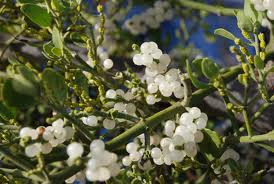
   Today mistletoe is rarely found on oak trees, but is most commonly found on old apple trees, although curiously not on pear trees. It also grows on ash trees, hawthorns and willows, among others. It is usually deposited by birds, notably the Missel Thrush which avidly devours the berries, and probably got its name from this predilection. It can also be “planted” on trees by rubbing the berries on the bark or the underside of branches, although birds are the best way of propagating mistletoe, farmers believe.
   European mistletoe is a true parasite and only grows on a living tree, not on decayed fallen bark as fungi can. Other mistletoes are not all true parasites. Viscum album grows a thick, woody root and has yellow calyxes in May, but the berries don’t fully ripen until December. The twigs and leaves (but not the berries) have been used as sheep fodder in winter.
   In Brittany mistletoe is known as the Herb of the Cross (Herbe de la Croix) as it is said that the wood of the mistletoe was used to make Christ’s cross, and was so demoted in the plant world and doomed to become a parasite. Mistletoe wood has been used as a protection from evil and epileptic fits since Druidic times, however.        
   Traditionally mistletoe leaves and twigs have been used to cure numerous ailments, among them hysteria, convulsions of delirium, for stopping internal haemorrhages, neuralgia, urinary disorders, heart disease, other problems related to the nervous system and as an aphrodisiac. Sir John Colbatch wrote a medical pamphlet in 1720 extolling the virtues of mistletoe as a cure for epilepsy, “The Treatment of Epilepsy by Mistletoe.” It was also used as a remedy for St. Vitus’ dance, and was often mixed with valerian root and vervain to treat nervous complaints. Cayenne peppers were added to this mixture for treating digestive disorders. Large quantities of mistletoe could aggravate the disorders it was supposed to treat however.
   The birdlime from the berries has been used to treat sores and ulcers and a berry was believed to relieve stitches in sides.
    You can make a cold water infusion with the chopped leaves and twigs by putting 2-4 tsp (10-20 gr) dried or fresh leaves into 500 ml of cold water and leaving them to steep overnight. Sweeten with honey and drink when you wake up. During the day steep more leaves in cold water and drink at bedtime. A tisane may be made with 1 tsp (5 gr) chopped leaves to 250 ml boiling water, and leaving this mixture to steep for 10-15 mins before straining and drinking. You can have 2 cups a day.
  Modern medical trials have shown that an extract of mistletoe when injected into the blood stream regularly can help in the treatment of bowel cancer as it can lower the effects of chemo and radiotherapy. It is believed that it acts upon the immune system, helping to prevent tumours spreading and to expel the toxic substances that build up in the body after the therapies. Those who underwent treatment with mistletoe extract survived for longer than patients who were not given the treatment, and they experienced fewer side effects from the therapies.
   Mistletoe contains lignans which are used as chemopreventives as well as to lower cholesterol levels and treat atherosclerosis. These are also found in flax seeds, pumpkin seeds and cranberries. It also contains acetylcholine which is involved in the transmission of nerve impulses in the body. There are also lectins or viscotoxins present, which behave in a similar way to snake venom. Bioflavonoids such as quercetin are also present in mistletoe and so it can help lower blood pressure and heart rate as well as ease anxiety and promote sleep.
   It is also thought that mistletoe may help improve blood sugar levels in people with diabetes, so perhaps the Druids weren’t wrong when they thought of this parasite as a universal healer.

SPINACH SOUP FOR POPEYE FANS: EASY AND TASTY RECIPE


SPINACH SOUP
This is a heart-warming winter recipe full of vitamins and minerals to help ward off colds and flu. It’s good cold in summer to with the addition of a little yoghurt.
 

Ingredients
½ kilo spinach washed well and leaves stripped from stalks
2 slices dried bread cut into cubes and fried in oil until golden brown
½ tsp freshly ground black pepper
salt to taste
fresh cream or butter to taste

Method
Put leaves in a pot with a little water and boil for 10 mins.
Allow to cool then blend.
Pour the chicken stock into the pan with the blended spinach and stir to mix well.
Cook for 5 mins. When the liquid starts to boil add salt.
Remove from the heat and transfer to a serving bowl topped with the croutons (fried bread cubes), black pepper and cream.
This has Taste and is a Treat.

VERVAIN ( VERBENA OFFICINALIS): HEALING HERB OF THE CELTS: VERVAIN TISANE REPUTED APHRODISIAC


VERVAIN, VERBENA OFFICINALIS
There are different types of vervain that grow around the world. Verbena officinalis is indigenous to the British Isles and Europe, while Blue vervain also known as Traveller’s Joy and Wild Hyssop, or Verbena hastate is native to the US. Vervain also grows in the Caribbean, two species being Burry vervain and Verbena jamaicensis. Verbena officinalis is the herb under discussion here.
   Vervain or Verbena officinalis is also known by the following names, Herb of Grace, Herba Sacra, Herba Veneris, and devil’s bane, formerly as it was believed that it would banish evil spirits. It was held sacred to the goddesses Diana and Venus by the Romans and could be burned like incense in temples and was used in them and in homes to make the air sweeter and more hygienic. The Egyptians dedicated vervain to their goddess Isis. It was given the name the venal herb because it has aphrodisiac qualities and stimulates the libido.  It is known as Herba Sacra because of the use made of it by the Romans in sacred rituals. It was believed in Mediaeval times that it had flourished on Mount Calvary where Christ was crucified and had helped to staunch the blood from his wounds as he hung on the cross.
   In Britain it was used by the Druids to connect them to the spirit world, and was used as a healing herb and almost had has much influence for them as mistletoe. The word vervain comes from the Celtic words, fer meaning to drive away and faen a stone. An amulet of the bruised herb was worn around the neck to protect from venomous bites and evil as well as just for good luck. It was passed over the Beltane fires and used to protect animals in the winter. At Midsummer it was strewn in fields to ensure the soil was fertile so that the crops would grow. It is said that it is best to gather the herb at Midsummer and dry it immediately for later use.
   The Druids on the other hand, believed that it was at its most effective when gathered during the waning period of the moon when Sirius the Dog Star was rising. They used it in and infusion and sprinkled their homes with the water to banish any evil lurking in them. In the old language of flowers, vervain symbolized enchantment and was used in love potions and to protect from the witches who made the potions.
   The Romans and Greeks used it for diarrhoea, and as it contains tannin it was probably effective, and would chew the root to strengthen the teeth and gums. The infusion of the herb actually makes a good mouth wash for ulcers and gingivitis.
    It has also been used for nervous disorders and is still used by herbalists for soothing nervous disorders, such as anxiety and stress and to promote relaxation and sleep. It has sedative properties, as well as astringent ones, and can be used as a diuretic, or to promote sweating in cases of fever. It has been used as an antispasmodic for stomach cramps and is used for symptoms of PMT (PMS) and the menopause. It is also used for promoting good eyesight and poultice made with a tincture of vervain have been used for headaches, rheumatism and neuralgia among other ailments. It leaves the skin a slightly red colour when used in this way and people thought that it brought the blood to the surface of the skin.
   For a decoction you need 2 ounces of the dried herb or 4 of fresh to 2 pints of water and boil until the liquid has reduced by half.  This can be used for piles and as a purgative. It can also be used for skin irritations. The tisane is good to stave off colds and flu, and it is a healthy drink as it contains bioflavonoids such as quercetin and kaempferol etc.
   Modern medical research has shown that it can inhibit the Hepatitis B virus, which agrees with one of the ancient usages of this herb as a liver tonic. It is also effective as a calming nerve tonic and helps as much as St John’sjohn's Wort does in soothing stress and anxiety. It is an antidepressant which is as useful as rosemary, lavender, mugwort and St. John’s Wort.
   It enhances lactation in breast feeding mothers and helps in childbirth as it induces contraction of the uterine muscles, making childbirth easier. It should not be used during pregnancy for this reason. 
    Vervain can also be used as a diuretic, and sachets of the dried herb can be kept in clothes to make them smell good and to repel insects. You can put it in your bath to help you relax and to help get rid of any skin problems.
   The tisane will help pep up a jaded appetite and promotes digestion. It can also be used to dress wounds and sores. Mostly it is used to calm the nerves and has a reputation for being an aphrodisiac, presumably because of the actions of the bioflavonoids and its sedative properties which will lower inhibitions.
 
VERVAIN TISANE
Ingredients
1 tbsp dried herb or 2 tbsp chopped fresh herb, flowers and leaves.
1 cup boiling water

Method
Pour the boiling water over the herb and leave to steep for 15 mins. Strain and drink.
Three cups a day can be taken but remember that it is a diuretic.
This has Taste and is a Treat(ment).